In the dispute over doctors’ contracts, the question keeps coming back of what role the medical self-government played in them. This text sets out where contracts came from, what the Supreme Medical Council and its Presidium wrote in their numbered positions, and what the council’s president said. We separate statements from resolutions, and both from assessments.
We do not repeat a description of the contract itself here. How it works and why it hides the total amount is explained in our text Contract or employment. Combining many facilities and record work schedules are described in our text on multiple jobs and parallel contracts, and the structure of the self-government in our analysis Poland’s harshest penalty for doctors is almost never imposed.
Three organisations, three roles
Three doctors’ organisations that are easy to confuse speak out on contracts. Each has a different legal basis and a different interest.
| What it is | Link with contracts | |
|---|---|---|
| Supreme Medical Chamber (NIL) | The professional self-government. All doctors with a licence to practise, which the chamber grants, belong to it. It represents the profession and oversees its practice. | The regional chambers kept the registers of medical practices. Today the Supreme Medical Council and its Presidium give opinions on draft rules on employment and working time. |
| National Trade Union of Doctors (OZZL) | A trade union. Its members are doctors who have joined it. | In 1997 it advised doctors to resign from employment and sign contracts with hospital directors. |
| Zielona Góra Agreement (Porozumienie Zielonogórskie, PZ) | An organisation of family doctors. | In 2003 and 2015 it was in dispute with the NFZ and the minister of health over the terms of contracts for primary care. |
The table is based on the Act on medical chambers,1 the OZZL account of the protests of the 1990s2 and a description of the 2015 dispute.3 In January 2015, when some family doctors’ clinics did not open after a dispute with the NFZ over contracts, the demands of the Zielona Góra Agreement were supported by both OZZL and the Supreme Medical Chamber. The dispute concerned the terms of contracts with the payer, including the possibility of changing them unilaterally, not the choice between employment and a contract.3
Where contracts came from
Two things combined to produce contracts: rules that allowed the profession to be practised outside employment, and the action of a trade union that called on doctors to leave employment. The order of dates shows that the OZZL action began before the Act on the medical profession came into force:
- 3 January 1997. The OZZL National Board drew up a timetable for “self-privatisation” (our translation). The union advised doctors to resign from their jobs en masse, set up doctors’ companies and sign contracts with directors on new terms.2
- 1 April 1997. On the initiative of OZZL, doctors resigned from their jobs as a group for the first time in the country. They were ambulance service doctors in Łomża province. According to the union, by the end of the year about 2,000 ambulance doctors had handed in their notice; they later returned to work on better terms.2
- 27 September 1997. The Act of 5 December 1996 on the medical profession, published on 26 March 1997, came into force. Its Article 50 allowed a doctor to run an individual medical practice after obtaining a permit and being entered in a register kept by the regional medical chamber.4 The chamber’s role here was that of a registrar: it issued permits for a form of practice that the act had provided for.
- 1998–1999. When the regional health insurance funds (kasy chorych) were launched, anaesthetists organised in a separate trade union resigned from their jobs en masse. They demanded that from January 1999 the funds sign a contract directly with their national non-public healthcare facility. OZZL supported them.2
- 2011. The forms of medical activity were regulated anew by the Act on medical activity.5 Under its Articles 26 and 27, hospitals today conclude contracts with contract doctors — as the Presidium of the Supreme Medical Council itself points out.6
The account of 1997–1999 comes from OZZL, that is from a party that took part in these events. In the sources we reviewed we found no resolution of the self-government from those years calling for a move to contracts. However, we did not review the chamber’s older positions in full.
When the self-government dealt with the form of practice, the issue was employment within the practices themselves. By resolution no. 16/19/VIII of 22 March 2019 the Supreme Medical Council adopted a draft amendment that would allow a doctor running a practice to employ another doctor, among other things for the period of specialist training, as a substitute or as part of permanent cooperation.7 The draft concerned practices, not doctors’ contracts with hospitals.
In 2026 the president of the Supreme Medical Council (NRL) presented his own version of this history. At a meeting with journalists on 13 August 2026 he said: “It was not doctors who created the system of contracts” (our translation). In his view it was brought about by the authorities, and hospital directors turned to contract doctors to keep the system going.8
What the self-government wrote in its positions
In 2025–2026 the Supreme Medical Council (NRL) and its Presidium adopted at least five numbered positions concerning contracts, working time or doctors’ pay. We set them out on the basis of the texts published by NIL.910611
| Date and subject | What the position says | |
|---|---|---|
| NRL, no. 8/25/IX | 21.11.2025 — draft amendment to the Act on the National Labour Inspectorate | Negative about giving a labour inspector the power to declare by administrative decision that a civil-law contract is an employment relationship, even for 3 years back. This should continue to be decided by the courts. |
| NRL Presidium, no. 1/26/P-X | 17.06.2026 — staff shortages, working time and doctors’ pay | The higher amounts paid to some doctors in specialist training result from civil-law contracts and from work “in a volume far exceeding the limits of one full-time job” (our translation). The self-government calls for a review of the pricing of procedures and considers the government’s idea of “tracking” pay a step in the wrong direction. It declares readiness to work on working time standards. |
| NRL Presidium, no. 13/26/P-X | 24.07.2026 — draft regulation on care quality indicators | Opposition to an indicator of the share of employment contract costs in staff costs. According to the Presidium, there is no evidence that a contract doctor treats patients worse than a salaried doctor. |
| NRL Presidium, no. 14/26/P-X | 24.07.2026 — draft changes to the general terms of NFZ contracts | Opposition to the obligation to send the NFZ monthly hourly attendance records of staff and to a contractual penalty of up to 2% of the contract value. The Presidium considers the existing ban on providing services in two facilities at the same time sufficient. |
| NRL Presidium, no. 17/26/P-X | 11.08.2026 — government draft act UD439 (limit of two full-time jobs, maximum rates) | Negative assessment. The self-government supports transparency of contracts financed from public money and limiting glaring pay disparities. It opposes, however, among other things, the requirement of at least a half-time job in one facility, a limit covering work outside the public system, a maximum rate equal to 1/20 of the minimum wage, the ban on percentage-based rates and criminal liability for declarations of earnings. |
None of these positions demands that contracts be abolished. Two defend the contract directly: against turning contracts into employment by an authority’s decision and against an indicator that ranks employment higher. The Presidium does not, however, defend every high payment. In position 17/26/P-X it states that there “should be no place” (our translation) for extreme pay peaks, and it sees their cause in the poor pricing of services.11
After the government adopted the draft
The Council of Ministers adopted the draft in September 2026.12 On 7 October the Sejm Health Committee held the first reading (print no. 3157),13 and on 22 October the Sejm passed the act; it is now before the Senate.14 According to Menedżer Zdrowia, representatives of NIL pointed out at the committee meeting, among other things, that the provisions were imprecise.15 We did not find a new numbered position on the version adopted by the government on the NIL website. The Presidium’s positions of 9 October concern other matters.16
What the council’s president said
Part of the self-government’s position is known from statements by the president of the Supreme Medical Council at conferences and in the media. They are not resolutions, although the media report them as the chamber’s proposals:
- January 2025. At the presentation of a NIL survey, the president rejected the Ministry of Health’s proposal to abolish contracts. In his view it would cause “an immediate heart attack of the system” (our translation). In the chamber’s own survey, answered by 5,599 doctors, 61% were against abolishing contracts altogether and 29% in favour. 44.4% of respondents worked as employees and 42.8% under contracts.17
- 24 June 2026. At a press conference the president demanded that the prime minister unify doctors’ maximum working time regardless of the form of employment: 78 hours a week, or — as he put it — “a little over 300 hours a month” (our translation). He made talks on pay conditional on a change in the pricing of procedures.18 Rzeczpospolita, citing RMF FM, reported a variant of 312 hours a month, with an alert system flagging when it was exceeded.19
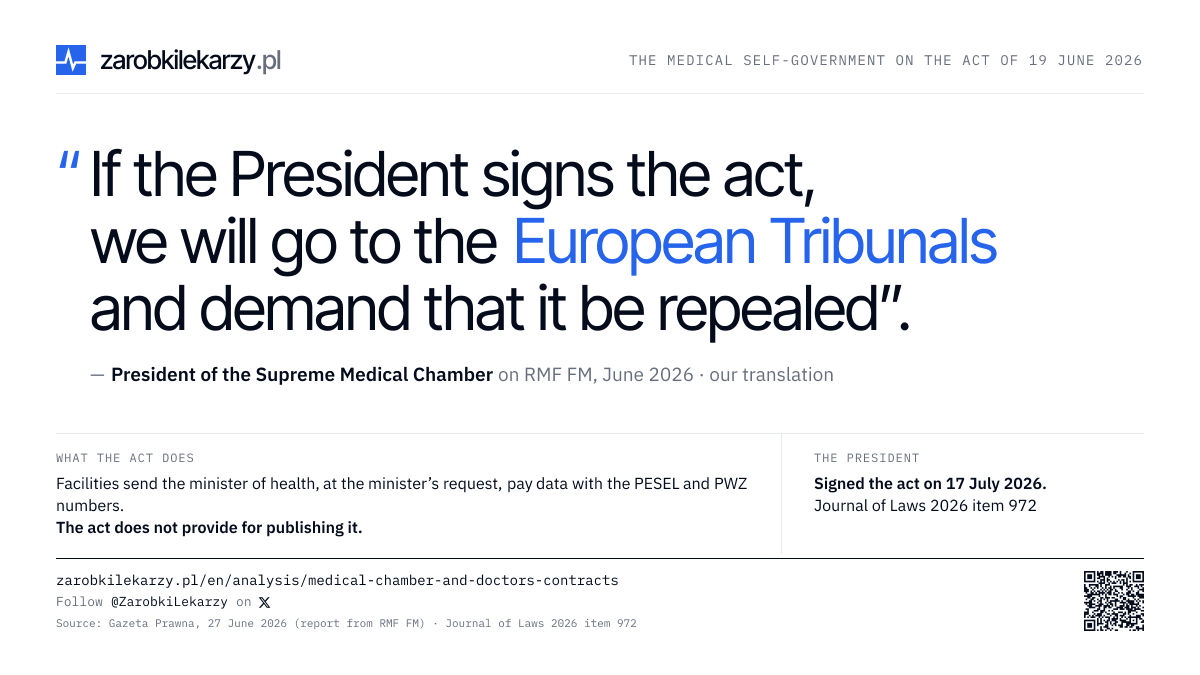
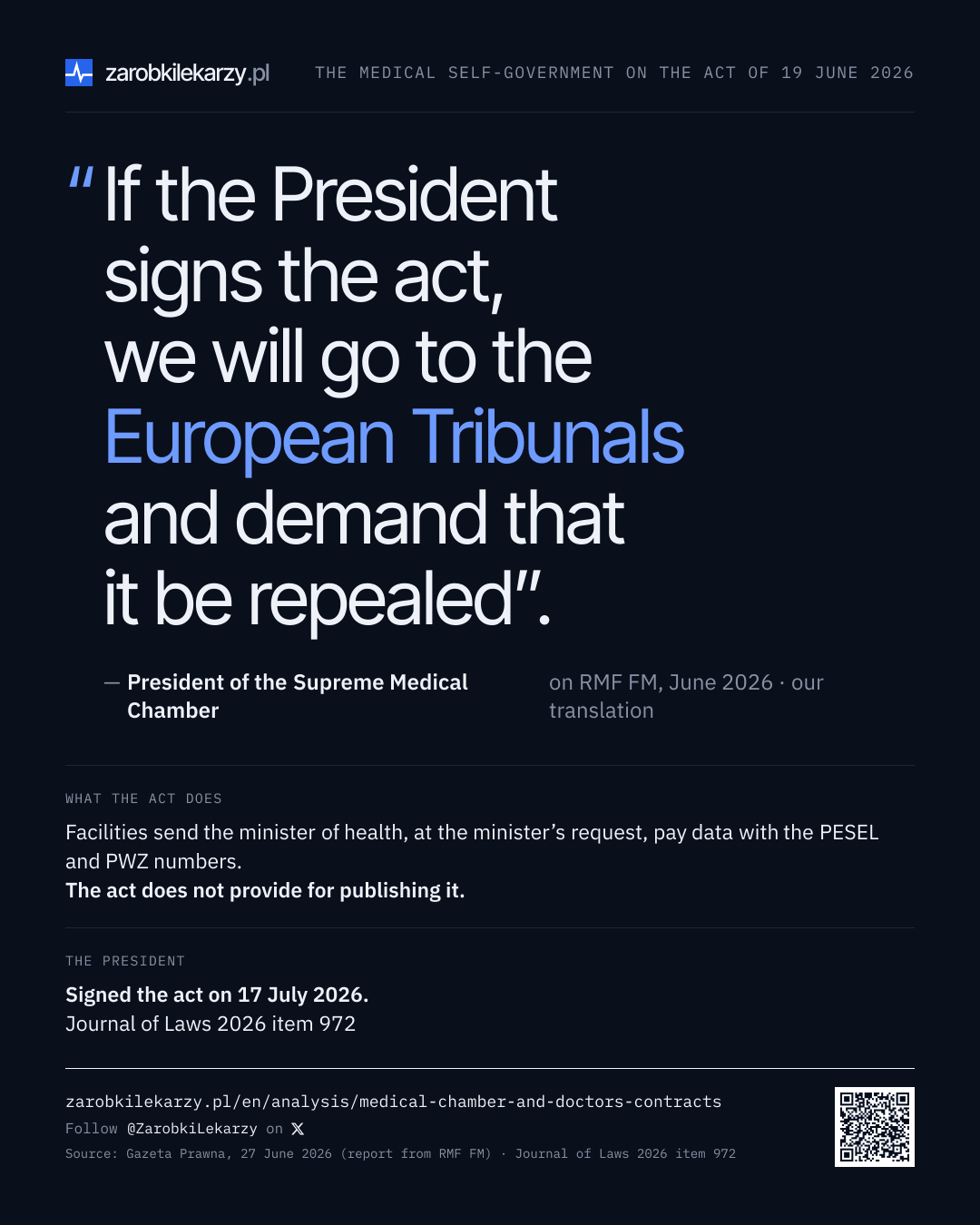
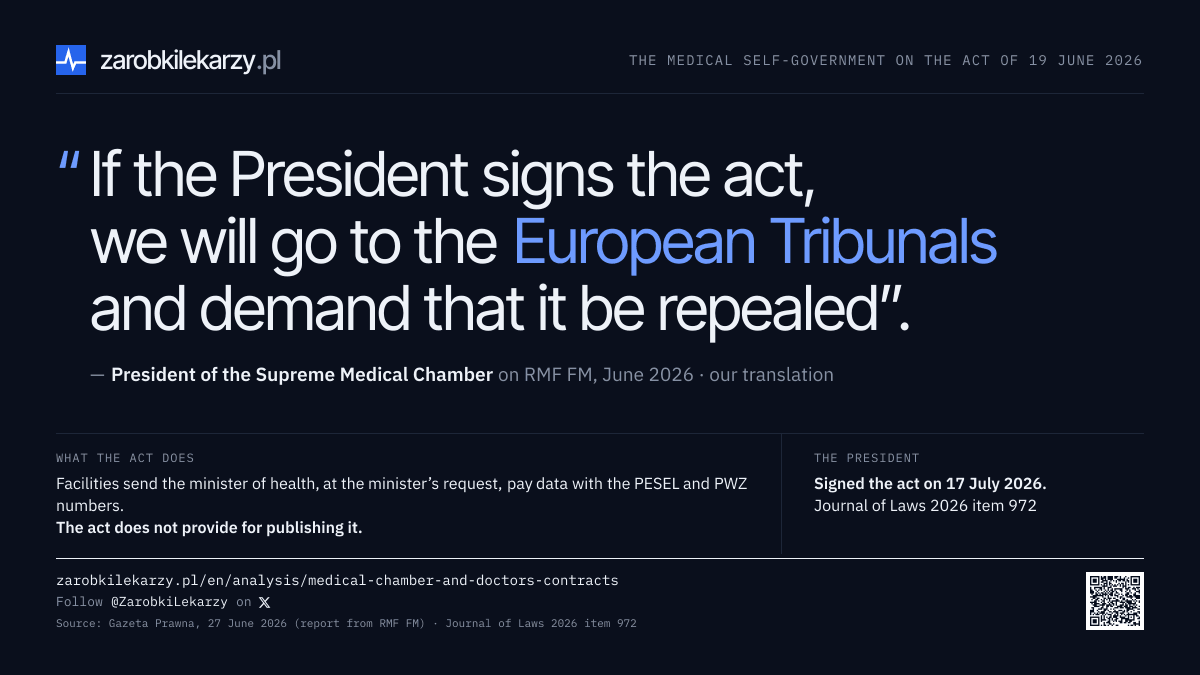
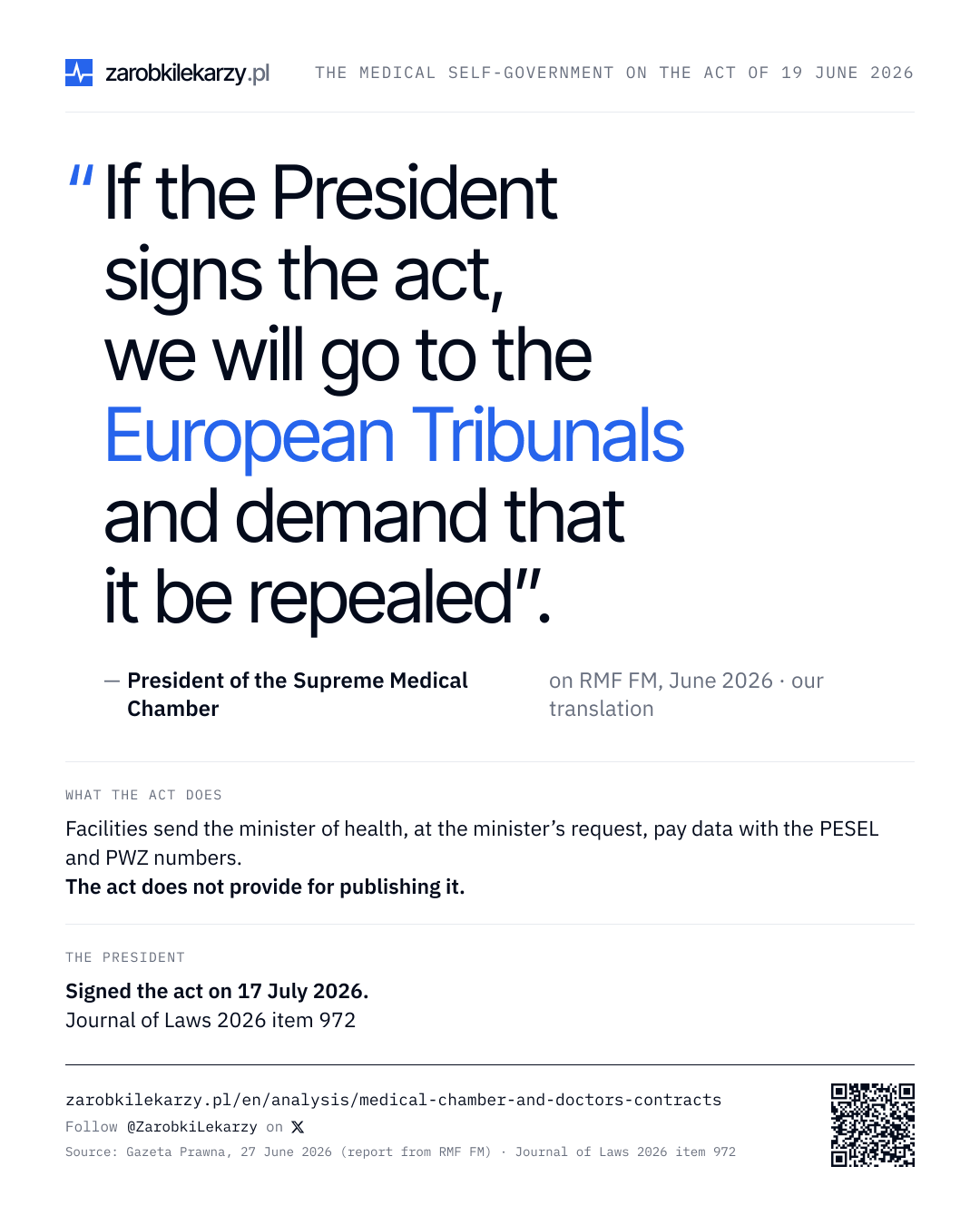
- June 2026. Speaking on RMF FM about the act on pay data passed on 19 June, the president said: “If the President signs the act, we will go to the European Tribunals and demand that it be repealed” (our translation). He explained that doctors do not want sensitive data to be sacrificed in the name of transparency. The statement was reported by Gazeta Prawna on 27 June 2026.20
- 13 August 2026. At a NIL press breakfast devoted to position 17/26/P-X, the president said that “bans alone will not heal the system” (our translation). The chamber also presented a survey of hospitals’ medical directors, answered by about 10% of facilities: 73% fear that doctors will leave, and 90% see a risk of wards or whole hospitals closing.8
Different figures circulate in statements about contracts. In January 2025 Rzeczpospolita wrote, without giving a source, of about 85% of specialists on contracts,17 while the president of the Supreme Medical Council spoke of 75% in June 2026.18 The AOTMiT data on which we rely in Contract or employment show 73%.21
The 78-hour limit in figures
Among the resolutions and positions of the Supreme Medical Council and its Presidium we found none adopting a limit of 78 hours a week. It is the president’s proposal from a press conference. Nor is there a single monthly version: the president spoke of “a little over 300 hours”,18 and 312 hours was reported only by Rzeczpospolita, citing RMF FM.19
Spread over five working days, 78 hours gives 15.6 hours of work a day, and over seven days — 11.1 hours. 312 hours a month is on average 10.3 hours every day, weekends included.
Rzeczpospolita compared the proposal with the case of a doctor who in 2025 reported 3,976 hours in one hospital alone, i.e. an average of 331 a month, and judged that 312 hours is “not much less” (our translation).1922 The result of the comparison depends, however, on which limit would apply:
| Ceiling | Compared with the 2026 case | |
|---|---|---|
| The 2026 case, one hospital | 3,976 h a year, an average of 331 h a month | — |
| Monthly limit as reported by RMF FM | 312 h a month | 5.7% less than 331 h |
| Weekly limit from the president’s statement | 78 h × 52 weeks = 4,056 h a year | 2% more than 3,976 h |
| Employment with an opt-out clause, today | up to 78 h a week | the same as the weekly limit |
| Government draft, print no. 3157 | 320 h a month, the equivalent of two full-time jobs | 3.3% less than 331 h |
With the weekly limit, the annual figure from this case would therefore fit within the ceiling; with the monthly one, it would exceed it by a dozen or so hours a month. In both variants these are hours from one facility, and the doctor also worked in others. We describe the details of the case in our text on multiple jobs and parallel contracts.
In fairness it must also be added that 78 hours is not a new, higher ceiling. That is how much a salaried doctor who has signed an opt-out clause may already work today — as the president himself pointed out when presenting the proposal.18 The proposal therefore extends to contracts the limit that applies to employment, rather than creating a looser one. The government draft provides for a similar ceiling: 320 hours a month.13 The reservations of the Presidium of the Supreme Medical Council in position 17/26/P-X concern, among other things, how the limit is calculated (whether on-call duty and standby by phone are included), extending it to work outside the public system, and declarations made under threat of criminal liability.11
Who will count the hours
A limit for one person across many facilities requires someone to add up that person’s hours. The Rzeczpospolita and Rynek Zdrowia reports of the June conference do not describe who would do this or on what basis — only an alert system is mentioned.1918 The Presidium of the Supreme Medical Council, for its part, opposes monthly hourly attendance records for the NFZ, considering the current schedules and the ban on working in two places at once sufficient.6 The open question is who would add up one person’s hours from different facilities if the limit covered all forms of employment.
How such billing comes to light today is shown by a case from the county hospital in Braniewo. Invoices of one doctor showed more than 1,000 hours in some months, and as many as 72 hours in some days. This came to light only when payments were verified after a change of management, and the hospital stresses that it does not prejudge whether all the hours were worked or whether the billing was correct.23 By July 2026 no one had been charged in the investigation,23 and on 15 September the prosecutor’s office suspended it pending an expert opinion.24
Transparency of contracts and pay data
The act the president spoke about in June was signed by the President of Poland on 17 July 2026 and came into force on 5 August.25 From that day the minister of health may request from facilities pay data linked to the PESEL number (the national identification number) and the licence to practise (PWZ) number. The act does not provide for their publication.26 We discuss the provisions in our analysis The pay data act. We have not established whether the self-government has filed the complaint it announced.
The self-government’s position has two sides here. The Presidium of the Supreme Medical Council called the announced “tracking” of pay a step in the wrong direction that could deepen the outflow of doctors from public healthcare.10 In position 17/26/P-X, however, it wrote that the self-government “supports increasing the transparency of contracts” (our translation) for services financed from public money.11 This concerns the transparency of contracts, not the disclosure of total payments to one person. The documents we reviewed do not address the latter question.
Our demand concerns precisely the total amount: public, pseudonymised data on payments from public money to each person, under a permanent identifier and without names. We describe the details in our demand.
What follows from the documents and what does not
What follows
from acts, resolutions and positions
- Practice outside employment was allowed by the legislature in 1996, and the mass departure from employment in 1997 was organised, by its own account, by a trade union.
- The Supreme Medical Council and its Presidium defend the contract as a form of work and oppose turning contracts into employment by an authority’s decision.
- The self-government declares support for transparency of contracts and readiness to work on working time standards, and sees the cause of extreme pay peaks in the pricing of services.
What does not follow
what we do not claim
- That the self-government never spoke about contracts before 2015 — we did not review older positions in full.
- That the 78-hour limit is a position adopted by resolution. It is a proposal by the president of the Supreme Medical Council.
- That the self-government supports disclosure of total payments to individual persons. The documents speak of transparency of contracts.
Notes 26laws, data and statements we relied on
-
Act of 2 December 2009 on medical chambers (in Polish), consolidated text Dz.U. 2021 item 1342: Article 2(2) (representing the profession and overseeing its practice), Article 5(3) (granting the licence to practise), Article 6(1) (entry on the chamber’s membership list). ↩
-
OZZL, “Saga lekarskiego protestu — historia prawdziwa” (“The saga of the doctors’ protest — a true story”, in Polish) — the union’s account: the “self-privatisation” timetable of 3.01.1997, resignations of ambulance doctors from 1.04.1997, the anaesthetists’ action of 1998–1999. ↩ ↩2 ↩3 ↩4
-
TVN24, “Lekarze grożą strajkiem. OZZL i Naczelna Izba Lekarska popierają Porozumienie Zielonogórskie” (“Doctors threaten to strike. OZZL and the Supreme Medical Chamber back the Zielona Góra Agreement”, in Polish), 5.01.2015. ↩ ↩2
-
Act of 5 December 1996 on the medical profession (in Polish; Dz.U. 1997 no. 28 item 152), published 26.03.1997, in force from 27.09.1997 — Article 50 (individual medical practice, permit and entry in the register of the regional medical chamber); text on the Infor website. ↩
-
Act of 15 April 2011 on medical activity (ISAP, in Polish). ↩
-
Supreme Medical Chamber, “Stanowiska podjęte przez Prezydium NRL 24 lipca 2026 r.” (“Positions adopted by the NRL Presidium on 24 July 2026”, in Polish) — no. 13/26/P-X (quality indicators; contract agreements under Articles 26 and 27 of the Act on medical activity) and no. 14/26/P-X (general terms of NFZ contracts). ↩ ↩2 ↩3
-
Supreme Medical Chamber, “Zatrudnianie w praktykach — uchwała NRL” (“Employment in practices — NRL resolution”, in Polish); resolution no. 16/19/VIII of 22 March 2019 (PDF, in Polish). ↩
-
Supreme Medical Chamber, “„Wypalić las, żeby pozbyć się korników”. NIL ostrzega przed reformą, która może dobić szpitale” (“‘Burning down the forest to get rid of the bark beetles’. NIL warns against a reform that could finish off hospitals”, in Polish), 13.08.2026 — press breakfast, statement by the NRL president, survey of medical directors. ↩ ↩2
-
Supreme Medical Chamber, “Stanowiska podjęte przez NRL w dniu 21 listopada 2025 r.” (“Positions adopted by the NRL on 21 November 2025”, PDF, in Polish) — position no. 8/25/IX on the draft act amending the Act on the National Labour Inspectorate. ↩
-
Supreme Medical Chamber, “Warunki pracy lekarzy nie są przyczyną kryzysu ochrony zdrowia — Prezydium NRL reaguje” (“Doctors’ working conditions are not the cause of the healthcare crisis — the NRL Presidium responds”, in Polish) — position no. 1/26/P-X of 17.06.2026. ↩ ↩2
-
Supreme Medical Chamber, “Błędna diagnoza. Zamiast leczyć system, rząd odetnie pacjentów od lekarzy” (“Wrong diagnosis. Instead of healing the system, the government will cut patients off from doctors”, in Polish), 12.08.2026 — NRL Presidium position no. 17/26/P-X of 11.08.2026. ↩ ↩2 ↩3 ↩4
-
Rynek Zdrowia, “Limity wynagrodzeń przyjęte przez rząd” (“Pay limits adopted by the government”, in Polish), 22.09.2026. ↩
-
Rynek Zdrowia, “Pakiet reform zdrowotnych po pierwszym czytaniu. Dalsze prace w Sejmie od 20 października” (“Health reform package after the first reading. Further work in the Sejm from 20 October”, in Polish), 8.10.2026 — print no. 3157, 320 hours a month, a rate of up to PLN 240 per hour. ↩ ↩2
-
Sejm of the Republic of Poland, 67th sitting, 22.10.2026 — vote no. 149 (in Polish) on the bill on pay limits for medical staff as a whole: 229 in favour, 144 against, 67 abstentions. ↩
-
Menedżer Zdrowia, “Posłowie zrobili pierwszy krok w stronę ograniczeń w wynagrodzeniach medyków” (“MPs take the first step towards limits on medical pay”, in Polish), 8.10.2026. ↩
-
Supreme Medical Chamber, “Stanowiska Prezydium NRL podjęte 9 października 2026 r.” (“NRL Presidium positions adopted on 9 October 2026”, in Polish). ↩
-
Rzeczpospolita, “Zarobki lekarzy. Naczelna Izba Lekarska pokazała badania” (“Doctors’ earnings. The Supreme Medical Chamber presents a survey”, in Polish), 21.01.2025 — NIL survey (5,599 responses), the president’s statement on abolishing contracts. ↩ ↩2
-
Rynek Zdrowia, “Samorząd lekarski: cięcie wynagrodzeń nie, limit czasu pracy tak. 78 godzin tygodniowo” (“Medical self-government: no to pay cuts, yes to a working time limit. 78 hours a week”, in Polish), 24.06.2026 — 78 hours a week, “a little over 300 hours a month”, employment: 48 hours, 78 after opt-out. ↩ ↩2 ↩3 ↩4 ↩5
-
Rzeczpospolita, “Naczelna Izba Lekarska proponuje limit godzin pracy lekarzy” (“The Supreme Medical Chamber proposes a limit on doctors’ working hours”, in Polish), 24.06.2026 — citing RMF FM: 78 hours a week and 312 a month, an alert system. ↩ ↩2 ↩3 ↩4
-
Gazeta Prawna, “Lekarze oburzeni nowymi przepisami. Prezes NIL zapowiada stanowcze działania” (“Doctors outraged by new rules. NIL president announces firm action”, in Polish), 27.06.2026. ↩
-
Rzeczpospolita, “Wypłaty lekarzy na kontraktach większe niż 100 tys. zł tylko w 1 proc. przypadków” (“Payments to contract doctors above PLN 100,000 in only 1% of cases”, in Polish) — AOTMiT data on the forms of employment of specialist doctors. ↩
-
Rynek Zdrowia, “Lekarz na celowniku izby lekarskiej — średnio 331 godzin w miesiącu” (“A doctor in the medical chamber’s sights — an average of 331 hours a month”, in Polish), 15.06.2026 — 3,976 hours in 2025 according to data from one hospital. ↩
-
Interia, “Braniewo — doby rozliczone na 72 godziny w szpitalu powiatowym” (“Braniewo — days billed as 72 hours in a county hospital”, in Polish), 9.07.2026 — invoices, verification of payments by the new management, the hospital’s reservation, no charges. ↩ ↩2
-
TVN24, “Śledztwo w sprawie rozliczeń lekarza ze szpitala w Braniewie zawieszone” (“Investigation into the billing of a doctor from the Braniewo hospital suspended”, in Polish), 15.09.2026 — suspension pending an expert opinion. ↩
-
Money.pl, “Państwo sprawdzi zarobki medyków. Zmiany od sierpnia” (“The state will check medics’ earnings. Changes from August”, in Polish), 21.07.2026 — passed on 19.06, signed by the President on 17.07, in force from 5.08.2026. ↩
-
Act of 19 June 2026 amending the Act on publicly funded healthcare services and the Act on medical activity (in Polish; Dz.U. 2026 item 972), in force from 5.08.2026 — new wording of Article 27a of the Act on medical activity. ↩
Infographic to download
1 graphic · portrait and landscape, light and dark
A graphic to share in two formats — portrait 1080×1350 (Instagram, Facebook, X) and landscape 1200×675 (X, LinkedIn, presentations) — light and dark. The sources, the page address and a QR code to the page are on the graphic.
The medical self-government on the act of 19 June 2026