
How Poland’s medical courts work
From complaint to final ruling: who prosecutes, who decides and how rarely the harshest penalties are imposed — with examples from rulings.
A guide to doctors’ work and pay in Poland
We explain how public money flows from the health contribution to the doctor’s office — and what follows for patients. For every figure we give a source and say whether it is exact or an estimate.
 11,113 payroll entries in the database
316,079PLN / month
the highest public contract of a doctor — provincial hospitals in Mazovia, 2025
ExactRynek Zdrowia
~73%
of specialists work on a B2B contract — nobody publishes the amounts of these contracts
EstimateForms of employment
4.2months
average wait for a specialist, although the NFZ budget has doubled in real terms since 2015
ExactWHC Barometer 2025
34PLN bn
of hospital debt — mostly related to wage costs
ExactDebt of SPZOZ hospitals
The English section is new. Each text is translated from Polish and checked against the original, which remains authoritative. Guides, tools and our demand are on the main site in Polish. Main site (in Polish)
Where to start
You do not have to read everything. Choose the starting point that suits you — each path leads from the basics to detailed data.
I am a patient
What you are entitled to at the doctor’s, how to check the visits billed in your Internet Patient Account (IKP) and where to report a breach — with the legal basis.
I want to understand pay
From a resident’s salary to the top 1%. Employment, contracts, on-call duty and hourly rates in 29 specialties.
I am going to study medicine
Limits on places, the LEK exam, residency and the choice of specialty. What awaits you after the diploma and how long it takes.
New and updated
From complaint to final ruling: who prosecutes, who decides and how rarely the harshest penalties are imposed — with examples from rulings.
About 73% of specialists work as a business or under a contract of mandate rather than as employees. Salaried pay is set by a public act, while nobody publishes contract amounts — and this difference decides whether it is possible to work out how much public money goes to one person.
A hospital must have a doctor on the ward around the clock, however many patients it has. Yet the NFZ pays it a lump sum based on reported services, not on staffing hours — and when the money runs short, the difference stays with the hospital, in the county budget or in debt.
The salary of a public hospital director is capped by the so-called chimney act and can be seen in the director’s asset declaration. Eight cases from 2024–2025 show that record totals come mainly from medical work, while a doctor’s contract is subject neither to a ceiling nor to a duty of disclosure.
What the medical self-government has adopted on contracts and what its president has said. The chamber defends the contract as a form of work, proposes a common limit on hours for employment and contracts, and opposes collecting data on the pay of individual doctors.
In a single month the same doctor may bill under contracts in several public facilities. Each sees only its own part — nobody adds up the total hours or the total pay.
News
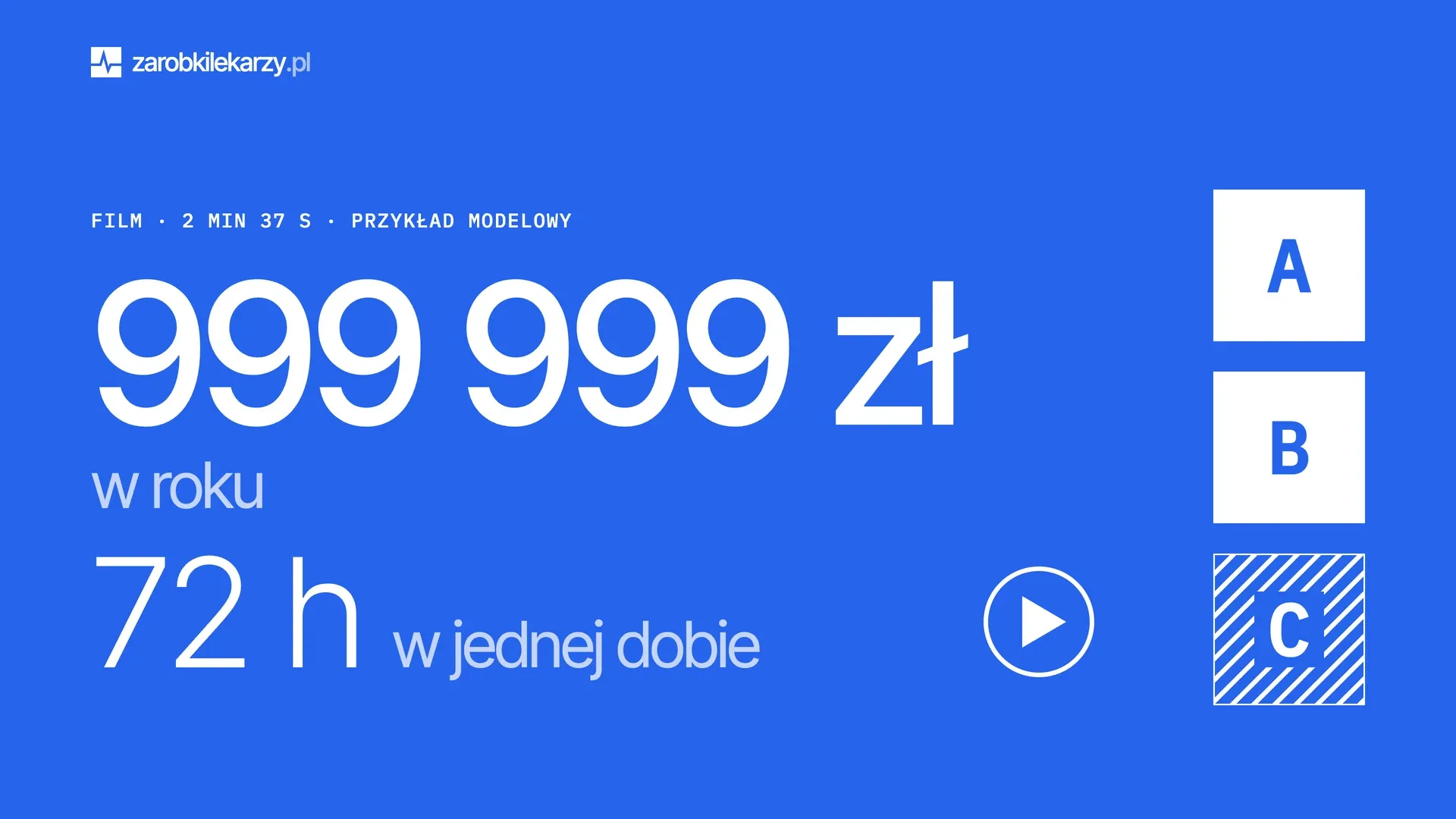
How a doctor with a PLN 20,000 job can receive PLN 999,999 in a year and bill 72 hours in a single day. The film “Doba” (“24 hours”) is under the free CC BY 4.0 licence.

The English version of the site is at /en/: our demand, patient rights with live emergency department queues, and 39 articles. The Polish version remains authoritative, and every English page says when it was translated.

The act was passed by 229 MPs, with 144 against and 67 abstaining. The Sejm added a ban on NFZ-funded work for doctors who knowingly certified something untrue, with a public register of bans. The act now goes to the Senate.
Patient, doctor, hospital director, payer. We show how a decision in one part of the system is felt in the others — we describe mechanisms, not individuals.
How the system works
~73% of specialists bill as a business. What does that change?

Several facilities, several contracts — and nobody sees the total.

The NFZ budget is growing, waiting times are not shrinking. Why?

Limits on places and empty residencies. Where do the shortages come from?
Data
Selected indicators from our data sections. Each chart leads to the full dataset with its method and links to sources.
Waiting times · NFZ
Public pay lists · 97 facilities
Record payments
316,079PLN / month
The highest documented contract (≈ €71,700 a month) — in a region whose hospitals owe PLN 1.4 billion (≈ €318 million). No names, from documents.
All recordsThe subject in 30 seconds
We all pay. From our contributions and subsidies from the state budget, the NFZ plans to spend about PLN 227.4 billion (≈ €51.6 billion) in 2026. A large part goes to hospitals and clinics, and from there — to pay.
Nobody sees the total. A doctor can work in several facilities at once — on an employment contract, a civil-law contract and on-call duty. Each pays separately, and nobody publishes the combined amount.
The solution is simple. Every quarter, public data on total pay from facilities with an NFZ contract — under a permanent identifier, without names.
 PLN 0the first copy of your medical recordsArticle 28 of the Act on Patient Rights
For patients
Short and to the point: what you are entitled to, on what basis and where to turn when something goes wrong.
Clear and complete — including the prognosis and alternative treatments.
You can ask the doctor to consult another doctor.
The facility must assess your pain and relieve it.
The first copy in the requested scope is free of charge.
How we work
We link only to publicly available documents, data and replies to freedom-of-information requests.
We label every figure as exact or estimated. We leave empty fields empty — we do not guess.
We describe how the system works. We do not point to individual doctors and do not publish personal data.
Spotted an error? Write to us. We correct the text and change the update date.
Editorial position
We call on the state to publish, every quarter, the total pay of each person working in facilities with a National Health Fund (NFZ) contract — summed across all their workplaces, under a permanent identifier instead of a name.