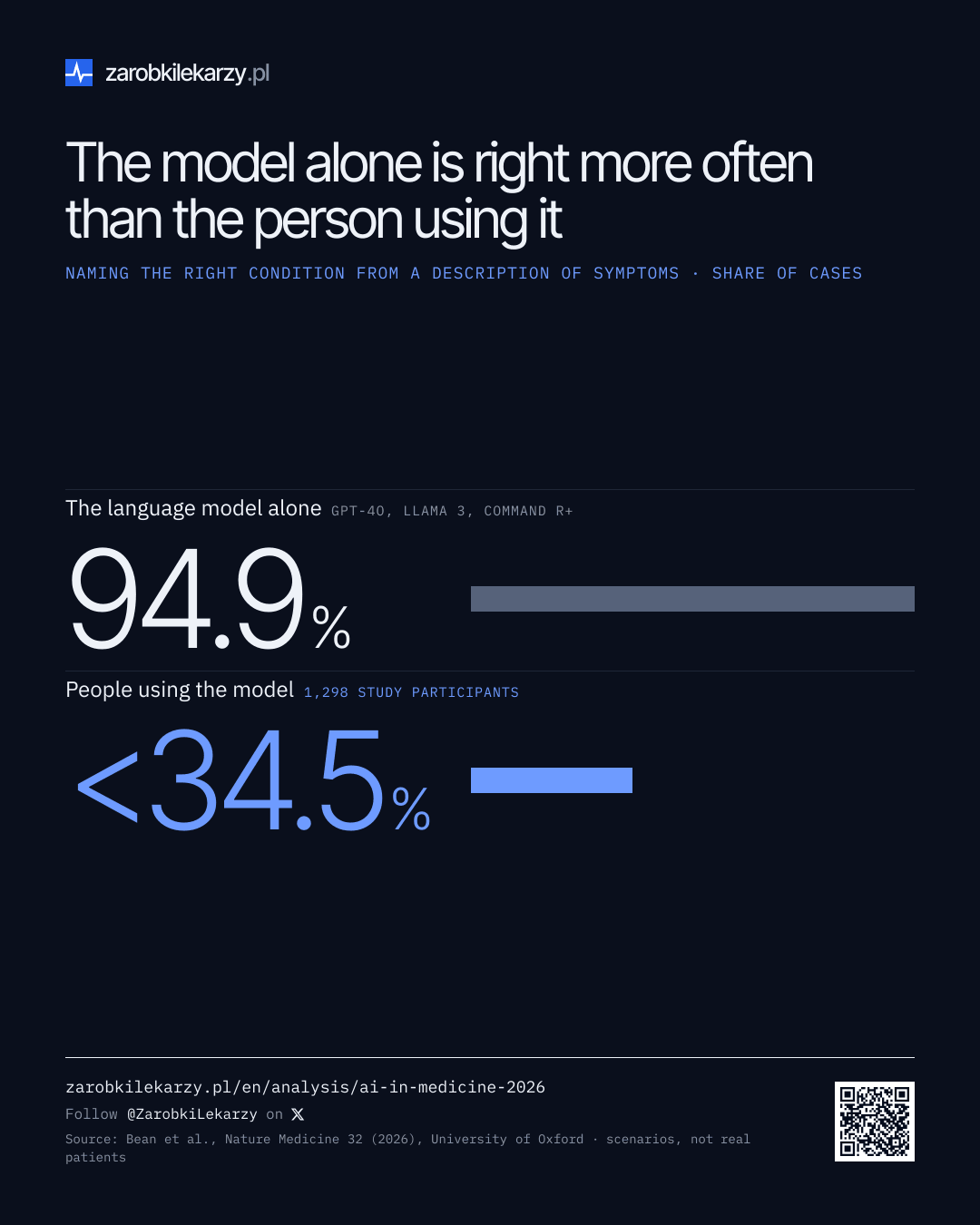
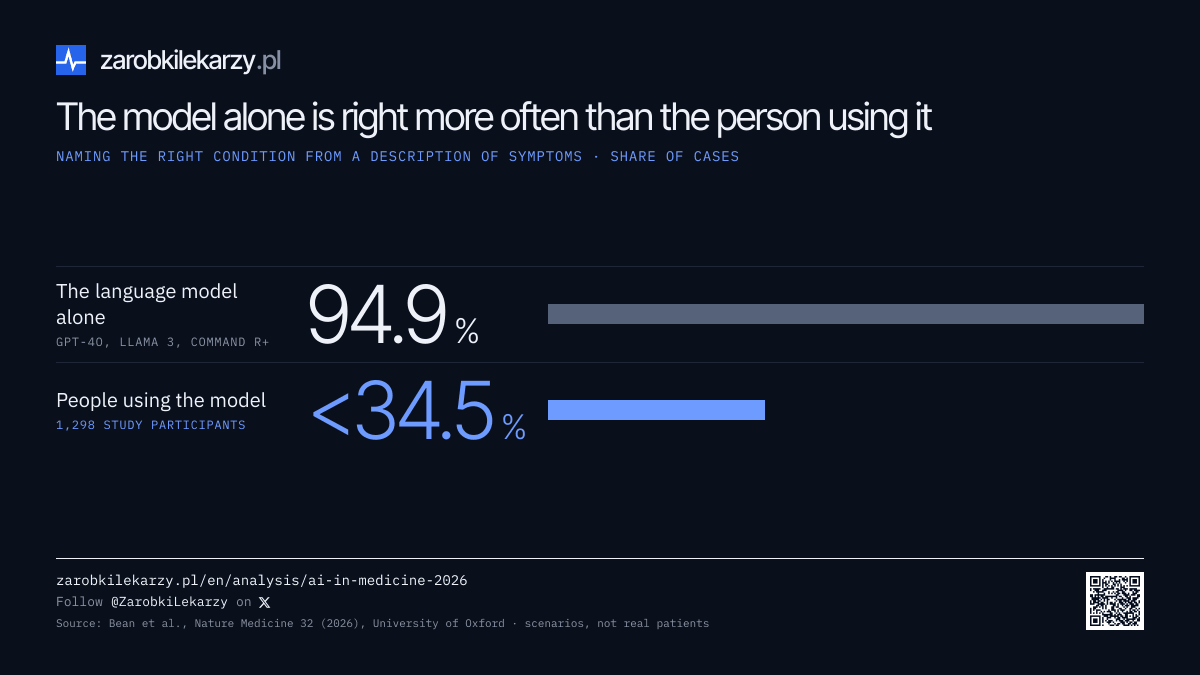
In 2026, artificial intelligence in medicine is not a single “digital doctor” but several different tools. Assistants and search engines answer questions from patients and doctors. Decision models choose one of several possible answers — they decide, for example, whether a patient meets the criteria for a clinical trial. Surgical robots transfer the surgeon’s movements to the instruments. A separate group consists of algorithms built into medical devices, which assess X-rays, CT scans or ECG recordings.
We describe which of these tools are available, how they perform in independent studies and what is happening in Poland. At the end we explain why the pace of change today is decided not by technology but by approval for use in treatment.
What is on the market
Assistants for patients
In January 2026 the two largest companies developing language models launched versions of their assistants intended for health matters. ChatGPT Health (OpenAI, 7 January) is a separate part of the chat to which medical records and data from apps can be connected. OpenAI stresses that the tool is not intended for diagnosis or treatment — it is meant to help with everyday questions and with preparing for a conversation with a doctor.2 Claude for Healthcare (Anthropic, 11 January) connects the model with databases used in healthcare, including the ICD-10 classification and the PubMed database of publications. Users in the US can connect their test results to it, and the model is meant to communicate the uncertainty of its answers and refer people to specialists.3
How such a tool performs in practice was studied by a team at Mount Sinai hospital in New York. The researchers held 960 conversations with ChatGPT Health based on 60 clinical scenarios from 21 specialties, and three doctors independently assessed the urgency of each case. The model recognised obvious emergencies, such as a stroke or a severe allergic reaction, well, but did worse with less obvious ones. Overall, in more than half of the cases that required urgent care, it recommended a less urgent course of action. The authors point out that the models are updated often, so the assessment refers to a single moment and needs to be repeated.4
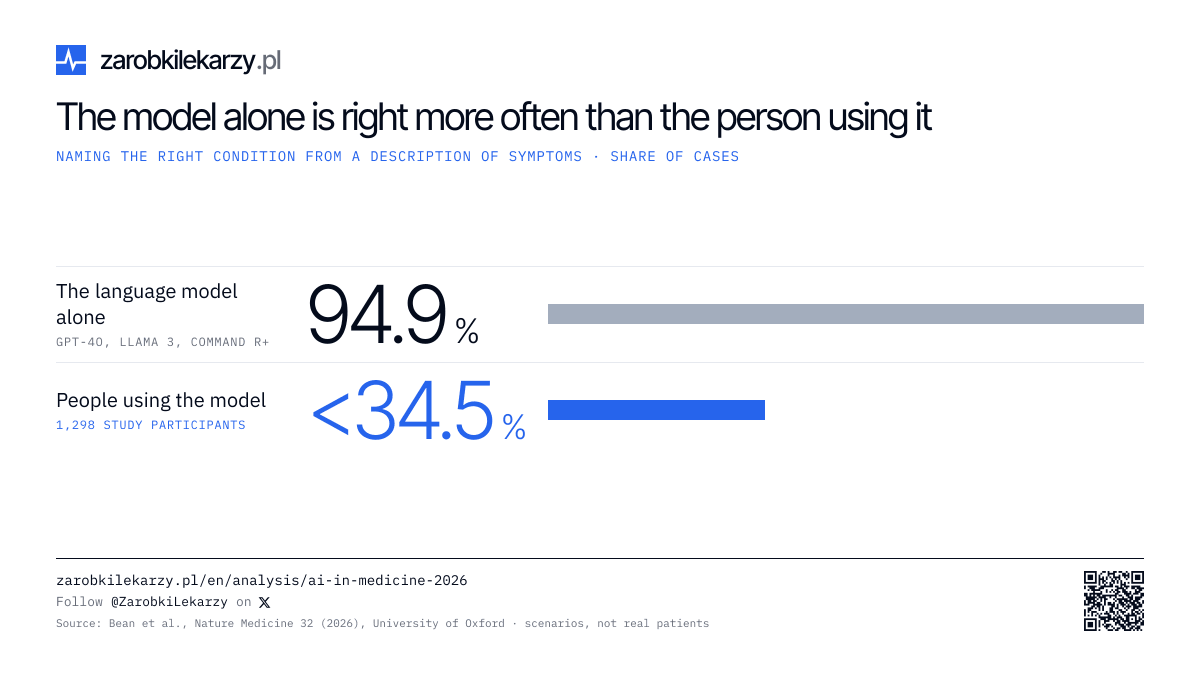
The Oxford study cited at the beginning shows where the problem lies. Participants gave the models incomplete information, and the models’ correct suggestions often did not get through to them. The authors note that standard tests on exam questions do not capture this, and recommend studies with real users before such tools are deployed.1
Tools for doctors
The most widely used search engine for medical knowledge is the American OpenEvidence. It answers clinical questions on the basis of scientific publications, is free for verified doctors and earns its money mainly from advertising, largely pharmaceutical.5 In January 2026 the company raised US$250 million (≈ €224 million) at a valuation of US$12 billion (≈ €10.8 billion) and stated that in December 2025 its tool handled about 18 million clinical consultations — these are the company’s own figures.6 Relying on advertising raises a question that is old in medicine: who pays for the information a doctor uses with a patient.
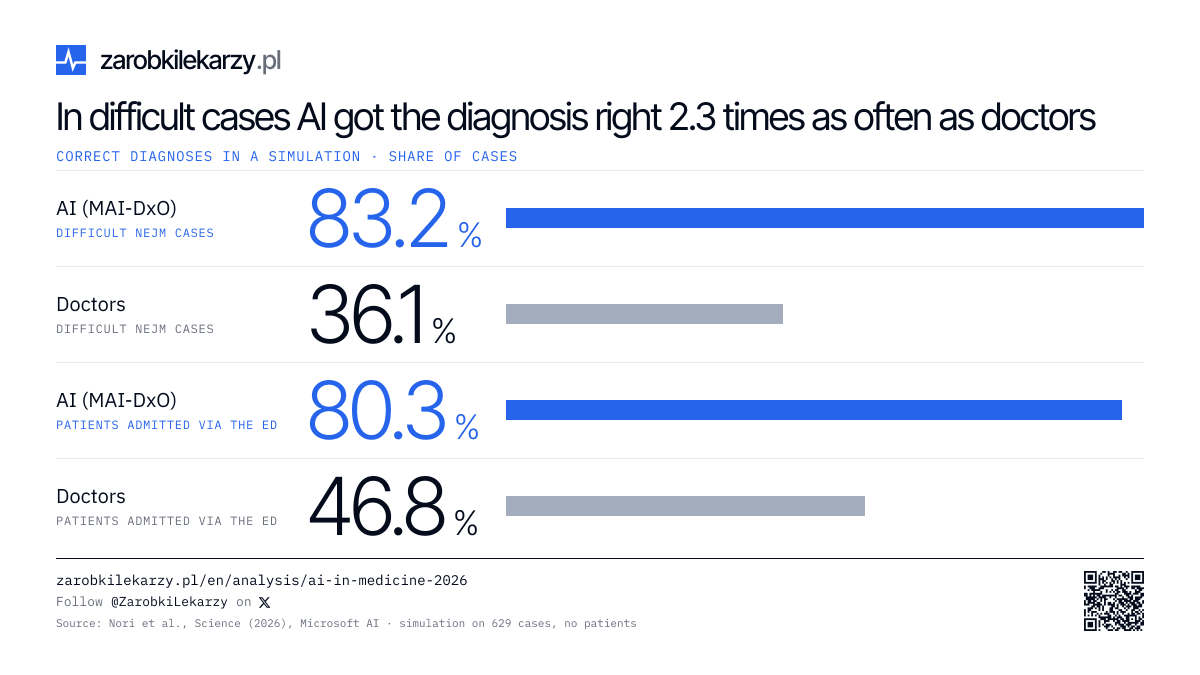
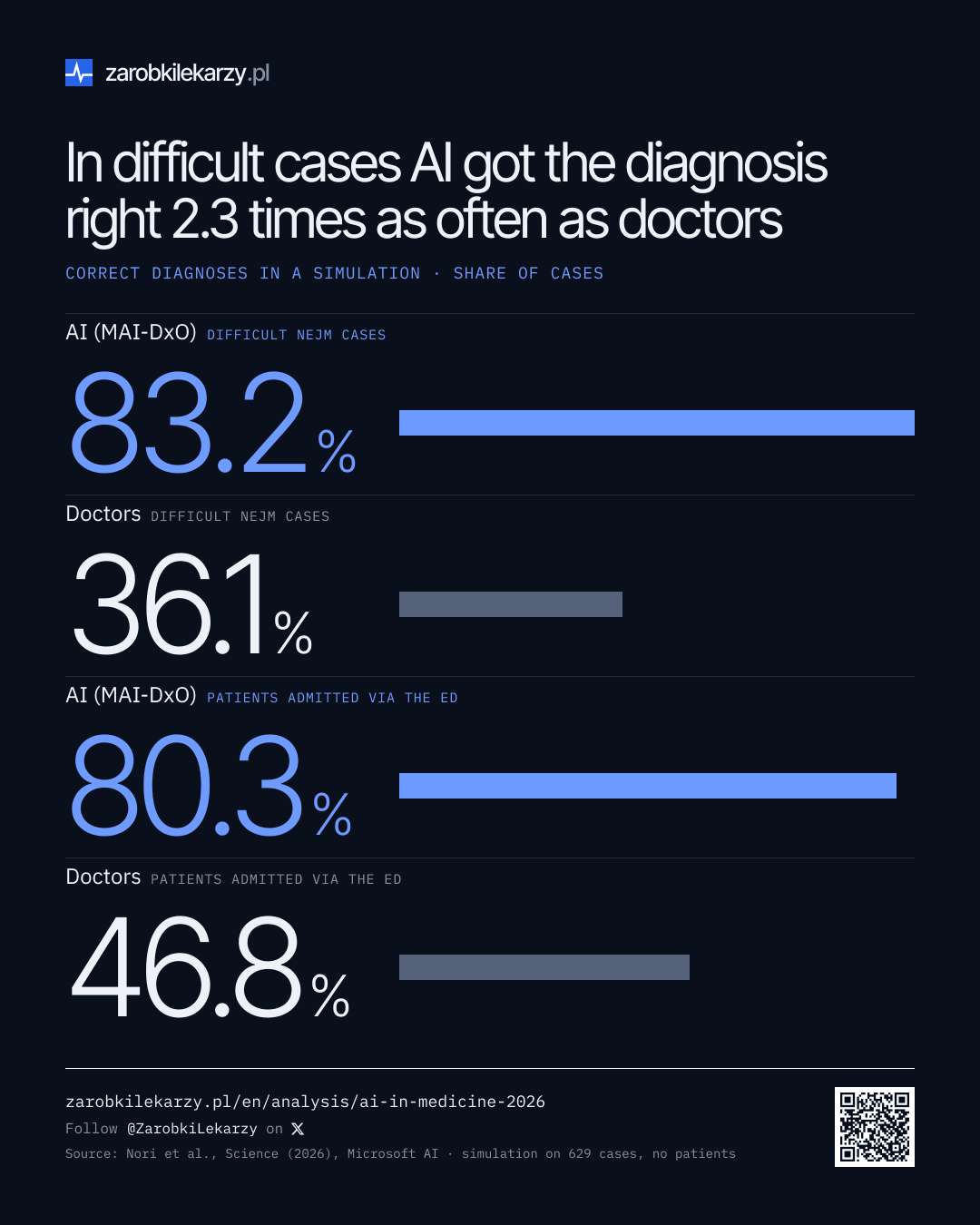
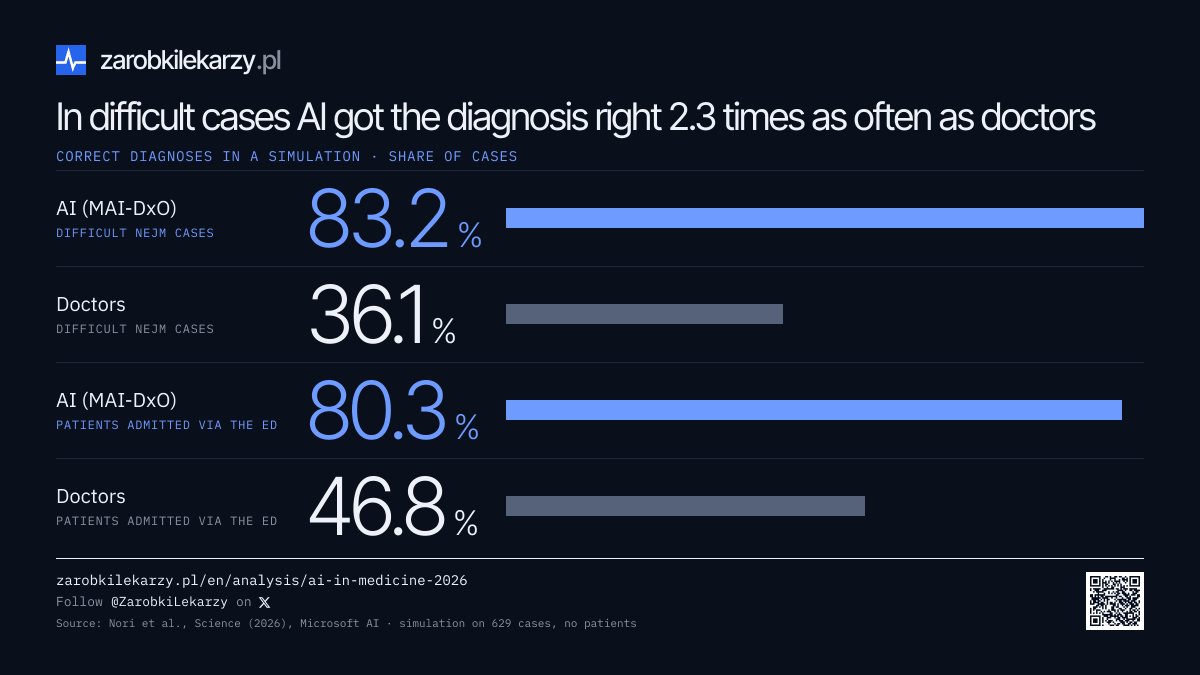
Manufacturers like to compare models with doctors. The most thoroughly described comparison was prepared by a Microsoft team, and in October 2026 it was published by the peer-reviewed weekly Science. The researchers turned 304 difficult cases described in the New England Journal of Medicine (NEJM) and 325 hospital admissions from an emergency department in Boston into step-by-step tasks: a doctor or the AI receives a short description of the patient and decides for themselves what to ask about and which tests to order. Each test has a price, so besides accuracy, the cost of diagnostics counts. The MAI-DxO system, running on the GPT-5 model, simulates a team of doctors who discuss possible diagnoses and choose cheaper tests. It reached the right diagnosis in 83.2% of the difficult cases and in 80.3% of the emergency department cases. Doctors from the US and the United Kingdom — family doctors and hospital doctors without a narrow specialisation, with a median of 12 years of experience — did so in 36.1% and 46.8%.8
In the simulation, AI reached the right diagnosis more often than doctors
The result comes from a simulation, not from work with patients — the authors themselves make this reservation. The doctors could use textbooks and guidelines, such as UpToDate, but not AI tools or help from colleagues, and NEJM cases are chosen precisely because they are unusual. The doctors solved only some of the tasks: the 56 most recent NEJM cases and 71 emergency department cases. Only the variant with a cost limit comes out cheaper than the doctors — US$2,241 (≈ €2,010) at an accuracy of 80.9%; the most accurate variant ordered tests costing US$5,430 (≈ €4,870) per case, more than the doctors’ US$4,725 (≈ €4,240). The costs are a valuation of the tests ordered according to the price list of an American hospital system, not actual spending.9 The study was carried out by Microsoft employees, and the company stresses that the system has not been approved for clinical use.10 Such comparisons say more about what a model can do than about how it would perform in a doctor’s office.
Alongside closed services, open models are developing. Google makes the MedGemma model available, but points out that it is not yet ready for clinical applications and must be validated before use.11 In June 2026 the Swiss Federal Institute of Technology in Lausanne (EPFL) released the MeditronFO models and published, together with them, the data, code, training procedure and evaluation method.12 Such a model can be checked by anyone — including a hospital that would like to deploy it.
Poland: decision models
In Poland, models of a different type from chatbots are being built. A decision model does not write an answer: it receives a description of the situation and a list of permitted options, and returns the probability of each of them in a single pass. It cannot therefore “add” something from outside the list, and its confidence can be measured and compared with reality.
Basal is a family of such models. They are not medical models — they are used for “choose one of the options” decisions, such as routing requests or assessing urgency. Medicine is only one of the areas in which they have been tested. The main model of version 2.0, built on the Polish Bielik model, answers 62.0% of questions from the Medical Final Examination (LEK) correctly in Polish and 63.0% in English.13 The largest, basal-omni-1.0-ultra (31 billion parameters, based on Google’s Gemma 4 model, released on 16 October 2026), answers 86.9% of questions correctly in Polish and 87.0% in English. On the same questions the author also measured the medical MedDecider-31B: 87.6% and 86.9% — the difference is within the margin of measurement error.14 For comparison: to pass the LEK, a candidate needs 56% of the points (test yourself in the simulator, in Polish). LEK questions are public, so they may have ended up in the data on which the base models were trained — exam results should be read with this reservation. The models are released under the open Apache 2.0 licence, and the author stresses that decisions with serious consequences for people should be verified by a human.
Author of the Basal models

Remek Kinas
@KinasRemek
Develops Basal — open decision models based on the Polish Bielik model, tested among other things on LEK questions.
MedDecider is a family of medical models of the same type, released in October 2026 by thelion.ai — a collective of programmers and researchers that started at Gdańsk University of Technology. The models are meant to check medicines and diagnoses in clinical notes, assess patients’ eligibility for clinical trials and evaluate scientific evidence. They were trained in English. On sets of exam questions that the models did not see in training — including the difficult MedXpertQA set and the Polish specialisation examination — the share of correct answers averages 55–70%, depending on the size of the model.15 On LEK questions (4,722 questions from 26 sessions in 2008–2026) the largest single model, MedDecider-31B, answers 87.7% correctly, and the combination of the two largest models (MedDecider Duo) 89.2%. On 286 questions from the 2025–2026 sessions MedDecider-31B scored 89.9%; according to the authors, the average result of candidates in those sessions was 71.3%.16 The authors state plainly that these are research models, not medical devices, and that the clinical notes used in training were synthetic.
Author of the MedDecider models

Aleksander Obuchowski
@AlexObuchowski
Creates MedDecider at thelion.ai — open medical decision models, tested among other things on questions from Polish specialisation examinations.
The state is announcing its own applications. The Ministry of Health wants to introduce AI tools into the Internet Patient Account (Internetowe Konto Pacjenta, IKP) that explain test results and assess urgency,17 and a voice assistant in the central e-registration system was to remind people who had given only a landline number about their appointments from 1 October 2026.18 The ministry has also named the first algorithms for analysing imaging tests for hospitals — we describe them below, in the part on radiology. For now these are announcements — we will assess them once they are in operation.
Medical history taken by AI
A diagnosis begins with taking the medical history: the doctor asks about the symptoms, their course and chronic conditions. In the Oxford study the users themselves led the conversation, and it was they who gave the models incomplete information.1 Google is testing the reverse arrangement — the AMIE system takes the history itself and asks the patient follow-up questions. It is a research tool, not publicly available.19
In a randomised study with double-blind assessment, AMIE and 20 primary care doctors held chat consultations with actors playing patients, in 159 scenarios from Canada, the United Kingdom and India. AMIE diagnosed conditions more accurately and, according to specialist doctors, performed better on 30 of the 32 criteria assessed, and according to the actors on 25 of 26, including empathy. The authors note that the doctors worked in a text chat, which they do not use day to day, and that the patients were played by actors.20
The first study with real patients was carried out in the clinic of Beth Israel Deaconess hospital in Boston. Of 114 enrolled patients, 98 talked to AMIE up to five days before an urgent-care visit, and supervising doctors followed every conversation in real time. They did not have to stop any of them; they recorded one hallucination, and in five conversations they added clinical information. Doctors who read the transcript of the conversation before the visit found it helpful in 33 of 44 cases. The study was funded by Alphabet, Google’s owner.21 In an earlier version of the paper, before peer review, the authors also reported that the final diagnosis was on AMIE’s list of possible diagnoses in 90% of cases, and that the quality of diagnoses and treatment plans was similar to that of the doctors — the doctors proposed more practical and cheaper treatment.22 The advantage from the simulation therefore did not carry over directly to the clinic, but the system took the history safely and prepared the doctor for the visit.
Radiology: here AI is already at work
Most of the algorithms approved for use serve radiology — on the list of the US FDA they account for 76% of medical devices with AI.23 Such programs mark suspicious lesions on images, order the reading queue so that urgent examinations reach the doctor first, or act as a second reader. In the studies described below the final assessment was always made by a radiologist.
The strongest evidence comes from screening mammography. In a Swedish randomised trial covering more than 105,000 women, the AI-supported programme detected 6.4 cancers per 1,000 women screened against 5.0 in the standard programme, with a similar rate of false alarms. At the same time radiologists had 44.2% fewer readings, because images assessed by AI as low risk were looked at by one doctor instead of two.24 Cancers diagnosed between successive screening rounds — missed, or ones that developed in the meantime — numbered 1.55 per 1,000 in the AI group and 1.76 in the standard group; the difference is not statistically significant, but AI did not worsen the results.25 In Germany, in an observational study of 463,000 women and 119 radiologists, the detection rate with AI was 17.6% higher with no increase in the number of recalls for further examinations; some of the authors declare links with the software manufacturer.26 None of these studies has yet shown whether AI means fewer women die of breast cancer.
AI can also do harm when a doctor trusts it too much. In an experiment with 27 radiologists, to whom a purported AI system suggested an assessment of a mammogram, the share of correct assessments with an incorrect suggestion fell among the least experienced from 79.7% to 19.8%, and among the most experienced from 82.3% to 45.5%.27
In China, AI in imaging is already widely approved and used. According to a review published in JMIR Medical Informatics, the Chinese regulator of medicines and medical devices (NMPA) had approved 154 medical devices with AI by mid-2025, of which 123 were in the highest risk class. 106 of them (68.8%) serve radiology, most often to detect lung nodules on CT.28 In a nationwide survey from 2023, in which 6,726 radiologists from 1,143 hospitals took part, 3,017 said they used AI regularly. The survey was conducted in hospitals covered by the national radiology quality-control system, so it does not tell us what share of all Chinese hospitals use AI.29 Full adoption is still a plan: according to government guidelines from October 2025, by 2030 AI is to support imaging diagnostics widely in grade II and III hospitals.30 Language models also arrived there quickly. Within a month of the first deployment, on 10 February 2025, the DeepSeek model had been launched by 37 of the 100 leading Chinese hospitals, and by the end of June by 48, mainly to support diagnosis and the choice of treatment. Only 21 of the 58 deployments described indicated that the model had been evaluated before launch.31
In Poland there are 4,434 specialists in radiology and diagnostic imaging and 554 doctors with a first-degree specialisation (as of 30 June 2026).32 The Ministry of Health has named the first five AI tools for hospitals under the Intelligent Services Platform (Platforma Usług Inteligentnych) of the e-Health Centre (Centrum e-Zdrowia): for chest CT, brain imaging in stroke and haemorrhage, bone X-rays after injuries, mammography and chest X-rays. Up to 400 hospitals with a contract with the National Health Fund (NFZ) are to be able to use them.3334 We did not find a separate NFZ tariff for the use of AI in imaging diagnostics, nor any deployment of AI in the public mammography screening programme.
Surgical robots: the surgeon’s hands, not AI
A surgical robot in a hospital does not operate on its own. The most popular system, da Vinci, transfers to the instruments the movements of a surgeon sitting at a console — every cut and stitch is made by a human. A review of 49 surgical robots cleared in the US in 2015–2023 found that 42 (86%) operate at the lowest level of autonomy — as a tool in the surgeon’s hands — and that none reaches the level at which the robot conducts the operation itself.35
In Poland, robots work within the public system. The NFZ has funded robotic surgery for prostate cancer since April 2022, and since August 2023 also for endometrial cancer and colorectal cancer.3637 According to a report by the Modern Healthcare Institute, 24,585 robot-assisted procedures were performed in 2025, 44% more than a year earlier. They were performed by 93 hospitals, and 98% of the procedures were funded by the NFZ.38
Autonomous operations by AI-controlled robots so far take place only in laboratories. In 2025 a team at Johns Hopkins University in the US described a system that, without human control, performed a stage of gallbladder removal — clipping and cutting the cystic duct and artery. It did so without error on 8 specimens, but on pig organs outside the body, more slowly than a surgeon, and the instruments were changed by a human.39 In July 2026 a team at the University of California San Diego described the first operations performed by humanoid robots — on animals, with the robots entirely controlled by surgeons.40
The first study with patients in which AI controls part of a robot is being run by the Chinese University of Hong Kong. The study began in June 2026 and is to include 10 patients. During gallbladder removal a voice-controlled robotic arm performs auxiliary tasks, while the surgeon guides the main instruments.41 A review of research on surgical robots that learn by trial and error (so-called reinforcement learning), published in August 2026, did not record any procedure in which such a robot acted autonomously on a human.42
Certification: the biggest brake
Models can do more than they are allowed to do with a patient. The reason is simple: a program that helps make a diagnosis or choose treatment is, in law, a medical device — just like a CT scanner or an insulin pump.
In the European Union this is governed by the Medical Device Regulation (MDR). Software that provides information used in diagnostic or therapeutic decisions is at least in class IIa. Where a wrong decision may result in death or an irreversible deterioration of health — in class III.43 Such devices are assessed by a notified body, that is, an independent institution designated by the state. There are 53 such bodies in the EU. In a European Commission survey from 2026, more than half of them said that full certification usually takes 13–18 months, and almost a third 19–24 months.44 On top of this come the requirements of the EU Artificial Intelligence Act (AI Act), which treats AI in medical devices as a high-risk system. These obligations were to apply from August 2027, but in July 2026 the Union postponed them to 2 August 2028.45
The greatest difficulty, however, comes not from the length of the procedure but from the nature of the models. A certificate covers a specific, frozen version of a device, and a significant change requires a new assessment. General-purpose language models are updated often and have no single, narrowly defined purpose — so it is hard to take them through a procedure designed for devices that behave in a fixed way. The US Food and Drug Administration (FDA) allows a manufacturer to agree a plan for future changes in advance (the so-called PCCP), which partly solves this problem.46
The effect can be seen in the registers. The FDA list includes 1,614 medical devices with AI, of which 76% concern radiology.23 These are narrow algorithms: they detect lesions on images, measure parameters, flag urgent examinations. Polish companies also hold CE certificates for such algorithms, including for analysing long-term ECG recordings, head CT and cardiac CT.474849 Supervision of the medical device market in Poland is exercised by the President of the Office for Registration of Medicinal Products, Medical Devices and Biocidal Products.50 No general-purpose language model — Polish or foreign — holds a medical device certificate. That is why the creators of assistants and models — from OpenAI to the authors of MedDecider — stress that their tools are not for diagnosis or are not medical devices.
Certification, however, is not bureaucracy for its own sake. It is the only mechanism that requires the manufacturer to prove effectiveness and safety and that identifies who is responsible for an error. Exam results and comparisons prepared by manufacturers do not provide such proof, as the studies from Oxford and Mount Sinai showed. The question is therefore not whether to certify models, but how to check tools that keep changing.
Where things stand in 2026
- Language models answer medical questions well, but people who use them do not make better decisions about their health as a result.
- What works with patients is mainly narrow, certified algorithms — especially in radiology and cardiology — not chatbots.
- A robot in a Polish hospital is a reimbursed tool of the surgeon. Autonomous operations by robots with AI so far take place in laboratories.
- Polish teams are building open models that can be checked. When they reach treatment will be decided by certification — just as in the rest of the world.
The common denominator is the same as with public money: trust requires verifiability. A model whose data, results and limitations are public is easier to assess — and easier to trust.
Notes 50laws, data and statements we relied on
-
A. M. Bean et al., Reliability of LLMs as medical assistants for the general public: a randomized preregistered study, Nature Medicine 32 (2026), pp. 609–615. The study included 1,298 people from the United Kingdom and three models (GPT-4o, Llama 3, Command R+); the control group used any sources, most often a search engine. ↩ ↩2 ↩3
-
OpenAI, Introducing ChatGPT Health, 7.01.2026. ↩
-
Anthropic, Advancing Claude in healthcare and the life sciences, 11.01.2026. ↩
-
Mount Sinai, press release on the study “ChatGPT Health performance in a structured test of triage recommendations”, Nature Medicine, 23.02.2026. ↩
-
MedCity News, on OpenEvidence’s business model and valuation, February 2026. ↩
-
OpenEvidence press release (Business Wire) of 21.01.2026, reprint. The number of consultations is the company’s own figure, not independently verified. ↩
-
L. De Angelis et al., The Need for Regulatory Certainty on Medical AI: Lessons From the OpenEvidence Geoblocking in the EU and UK Over the EU AI Act, The Lancet Regional Health – Europe 65 (2026), 101718. ↩
-
H. Nori et al., Sequential diagnosis with language models, Science, 22.10.2026. The authors are a Microsoft AI team. Accuracy, number of cases and the doctors’ results — according to the paper’s abstract. ↩
-
H. Nori et al., Sequential Diagnosis with Language Models, full version of the paper made available by a co-author, 8.11.2025, pp. 2 and 13–17. This is the source of the costs and the description of the group of doctors; the abstract in Science gives the same accuracy results. ↩
-
Microsoft AI, The Path to Medical Superintelligence, 30.06.2025. ↩
-
Google, MedGemma — model description. ↩
-
EPFL, EPFL launches the world’s first fully open medical LLMs, June 2026. ↩
-
Model card of basal-2.0-4.5B (Hugging Face) and the project website. Results reported by the author; LEK test with five answer options. ↩
-
R. Kinas, “basal-omni-1.0-ultra i silnik basal 2.1” (“basal-omni-1.0-ultra and the basal 2.1 engine”, in Polish), Basal project blog, 16.10.2026. Measurement by the author of Basal; MedDecider was run with its authors’ script. 95% interval for MedDecider-31B: 86.6–88.5% in Polish, 85.7–88.0% in English. ↩
-
thelion.ai, model card of MedDecider-4B (Hugging Face), October 2026. Results reported by the authors. ↩
-
thelion.ai, model card of MedDecider-31B (Hugging Face), October 2026. Results reported by the authors; 4,722 questions from 26 LEK sessions, all sessions passed. ↩
-
Pion.pl, “AI na IKP — nowe plany Ministerstwa Zdrowia” (“AI in the IKP: the Ministry of Health’s new plans”, in Polish), 21.05.2026. ↩
-
Alert Medyczny, “Asystent AI w e-rejestracji nie od 1 lipca — ministerstwo przesuwa termin” (“AI assistant in e-registration not from 1 July: the ministry moves the date”, in Polish). ↩
-
Google Research, AMIE: A research AI system for diagnostic medical reasoning and conversations. ↩
-
T. Tu et al., Towards conversational diagnostic artificial intelligence, Nature 642 (2025), pp. 442–450. The study was carried out by a Google team. ↩
-
Brodeur et al., Conversational diagnostic artificial intelligence in ambulatory primary care: a prospective feasibility study, The Lancet, October 2026 (NCT06911398). ↩
-
A prospective clinical feasibility study of a conversational diagnostic AI in an ambulatory primary care clinic, arXiv:2603.08448, March 2026 — version before peer review, 100 patients. The difference in the quality of diagnoses is not statistically significant (p = 0.6); in AMIE’s top three diagnoses — 75%. ↩
-
FDA, Artificial Intelligence-Enabled Medical Devices — count from the table, decisions up to 29.06.2026. ↩ ↩2
-
V. Hernström et al., Screening performance and characteristics of breast cancer detected in the Mammography Screening with Artificial Intelligence trial (MASAI), The Lancet Digital Health 7 (2025), e175–e183. Readings: 61,248 in the AI group against 109,692 in the control group. ↩
-
J. Gommers et al., Interval cancer, sensitivity, and specificity comparing AI-supported mammography screening with standard double reading without AI in the MASAI study, The Lancet 407 (2026), pp. 505–514. The study included 105,934 women; ratio 0.88 (95% CI 0.65–1.18), sensitivity 80.5% against 73.8%. ↩
-
N. Eisemann et al., Nationwide real-world implementation of AI for cancer detection in population-based mammography screening, Nature Medicine 31 (2025), pp. 917–924. Detection rate 6.7 against 5.7 per 1,000; radiologists decided themselves whether to use AI. ↩
-
T. Dratsch et al., Automation Bias in Mammography: The Impact of Artificial Intelligence BI-RADS Suggestions on Reader Performance, Radiology 307 (2023), e222176. ↩
-
L. Zhang et al., Approval of AI-Based Medical Devices in China From 2020 to 2025: Retrospective Analysis, JMIR Medical Informatics, 18.03.2026. As of 30.06.2025; the authors counted the devices in a commercial registration database, as there is no official NMPA compilation. ↩
-
H. Liu et al., Artificial Intelligence and Radiologist Burnout, JAMA Network Open, 2024. Survey from May–October 2023; the group of users includes people who declared regular or constant use of AI. ↩
-
National Health Commission and four other authorities, 关于促进和规范“人工智能+医疗卫生”应用发展的实施意见 (guidelines on the development of AI applications in healthcare, in Chinese), 国卫办规划发〔2025〕30号, 20.10.2025. ↩
-
W. Jiang et al., Promoting Responsible DeepSeek Deployment in Health Care: Scoping Review Comparing Grey and White Literature, Journal of Medical Internet Research, 5.12.2025. Data from hospitals’ websites and WeChat accounts, as of 28.06.2025. ↩
-
Supreme Medical Chamber (NIL), numerical summary of doctors by field and degree of specialisation (in Polish), as of 30.06.2026. Practising the profession: 4,276 specialists and 464 doctors with a first-degree specialisation. ↩
-
Rynek Zdrowia, “AI wkroczy do diagnostyki w szpitalach. Ministerstwo Zdrowia wskazało narzędzia dla lekarzy” (“AI will enter diagnostics in hospitals. The Ministry of Health has named tools for doctors”, in Polish), 2.09.2026. ↩
-
Debaty Zdrowie, “Szpitale mają otrzymać dostęp do krajowej platformy AI w 2026 roku” (“Hospitals are to get access to a national AI platform in 2026”, in Polish), 24.09.2026. ↩
-
A. Lee et al., Levels of autonomy in FDA-cleared surgical robots: a systematic review, npj Digital Medicine, 2024. Level 1: 42 systems, level 2: 4, level 3: 3, levels 4–5: none. ↩
-
Regulation of the Minister of Health of 25.01.2022 amending the regulation on guaranteed hospital treatment services, Dz.U. 2022 item 245 (Journal of Laws, in Polish; in force from 1.04.2022). ↩
-
Regulation of the Minister of Health of 28.07.2023, Dz.U. 2023 item 1477 (in Polish; in force from 1.08.2023). ↩
-
Modern Healthcare Institute, “Raport: chirurgia robotowa w Polsce 2026” (“Report: robotic surgery in Poland 2026”, in Polish), data for 2025. The number of hospitals refers to robots for soft-tissue surgery. ↩
-
J. W. Kim et al., SRT-H: A hierarchical framework for autonomous surgery via language-conditioned imitation learning, Science Robotics, 9.07.2025. ↩
-
UC San Diego, Surgeons use teleoperated humanoid robots to perform live surgery, July 2026 (published in Nature). ↩
-
ClinicalTrials.gov, NCT07705828: AI-Assisted Cholecystectomy With Laparoscopic Surgical Robot: A First-in-Human Study, Chinese University of Hong Kong. ↩
-
Applications of Reinforcement Learning for Autonomous Surgical Robotics: A Systematic Review, Biomimetics 11 (2026), 577 — covers publications up to March 2026. ↩
-
Regulation (EU) 2017/745 on medical devices, Annex VIII, rule 11 (Polish version on EUR-Lex). ↩
-
European Commission, survey of notified bodies, data up to 28.02.2026. For certification of the quality system and the product, 51% of bodies give 13–18 months and 31% 19–24 months; the survey does not single out software with AI. ↩
-
Regulation (EU) 2026/1744 of 8.07.2026 (the digital omnibus on AI; Polish version on EUR-Lex), point 40 amending Article 113 of Regulation (EU) 2024/1689 — applies to high-risk systems under Article 6(1). ↩
-
FDA, Predetermined Change Control Plan — final guidance, December 2024. ↩
-
Cardiomatics, announcement of the MDR certificate, 17.10.2023 — manufacturer’s information. ↩
-
Rynek Zdrowia, interview with the CEO of Brainscan (in Polish), 10.04.2024. ↩
-
Hemolens Diagnostics, announcement of the CE certificate, 26.06.2026 — manufacturer’s information. ↩
-
Act of 7.04.2022 on medical devices, Dz.U. 2022 item 974 (in Polish). ↩
Infographics to download
2 graphics · portrait and landscape, light and dark
Graphics to share in two formats — portrait 1080×1350 (Instagram, Facebook, X) and landscape 1200×675 (X, LinkedIn, presentations) — light and dark. The sources, the page address and a QR code to the page are on the graphic.
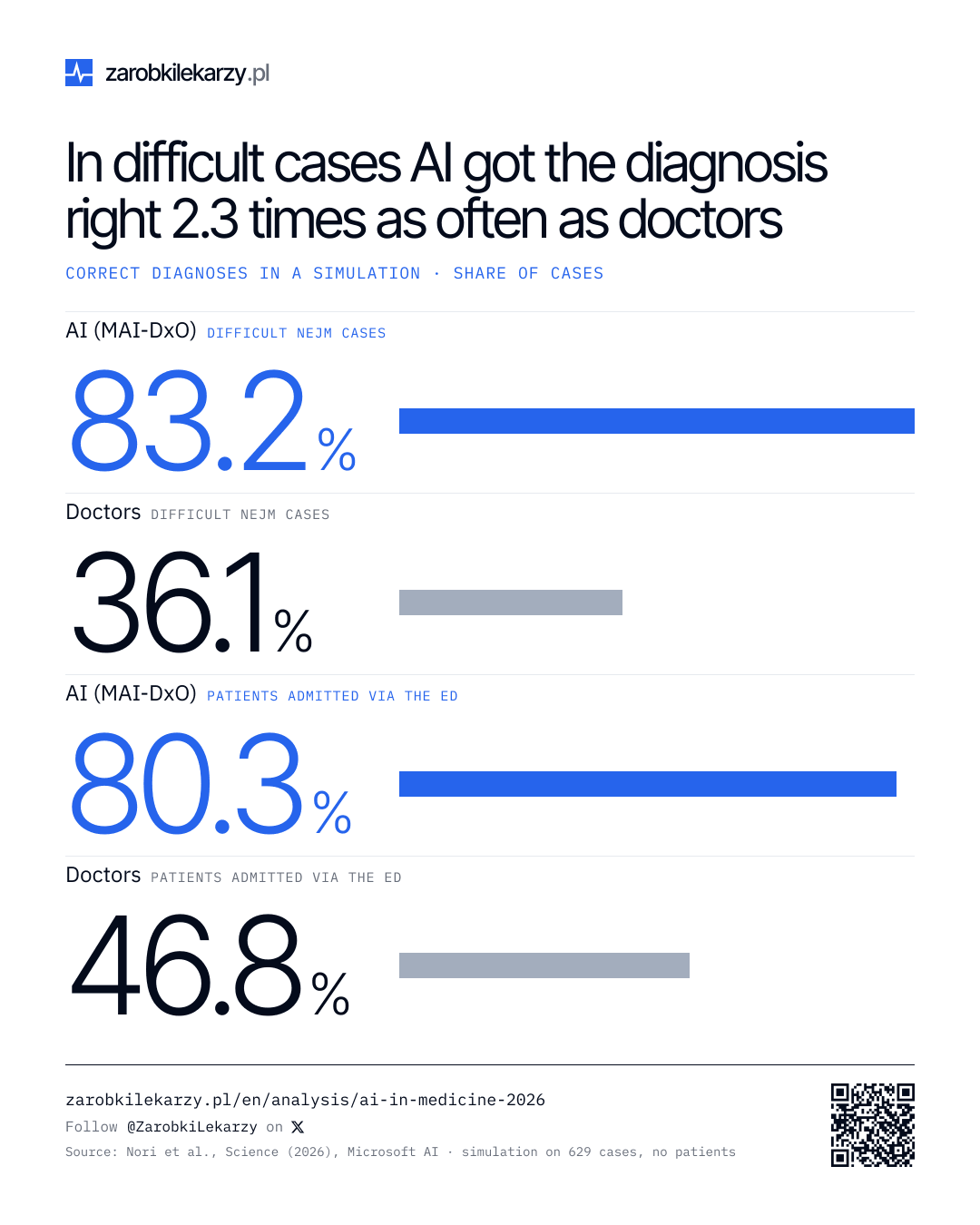
In difficult cases AI got the diagnosis right 2.3 times as often as doctors
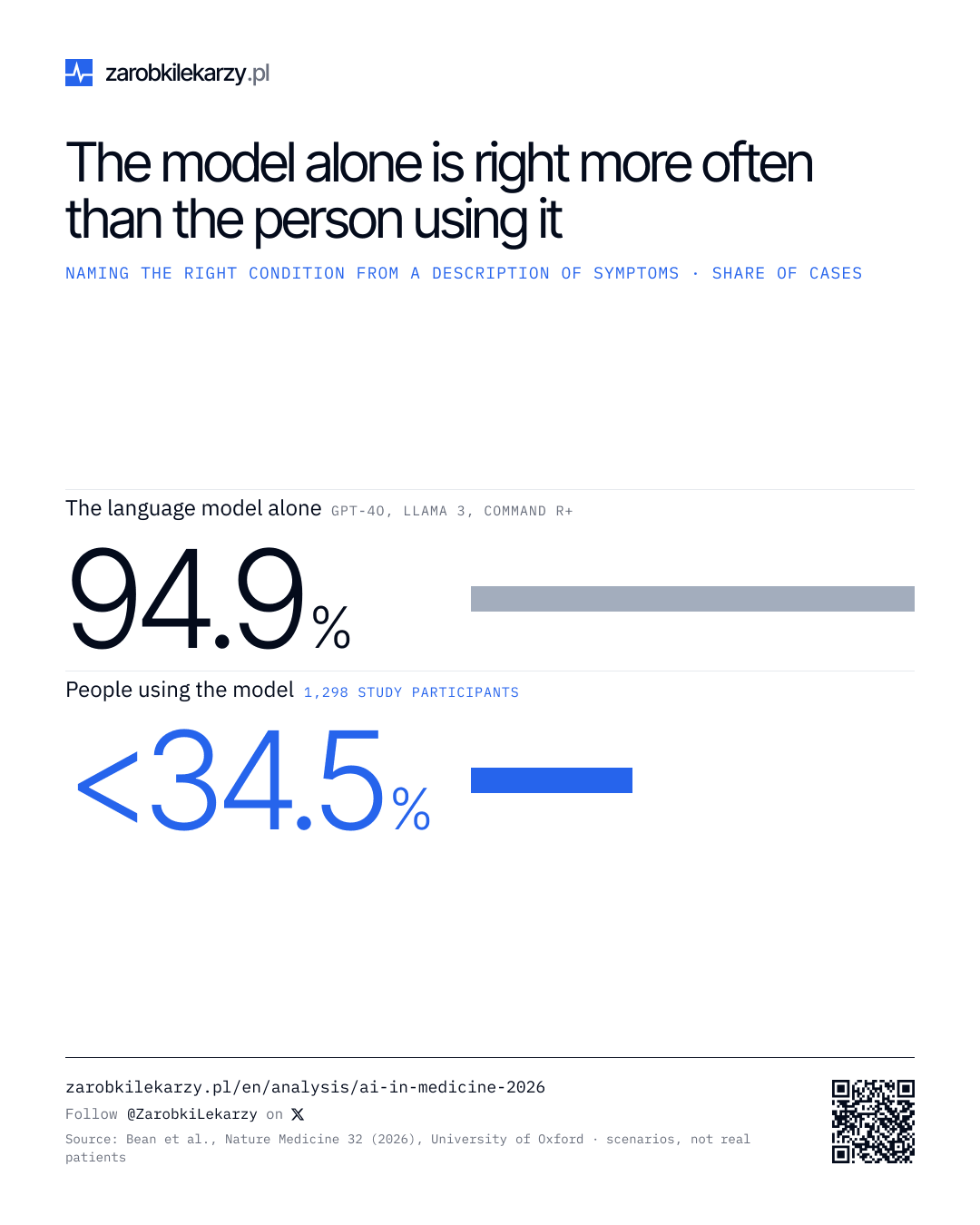
The model alone is right more often than the person using it