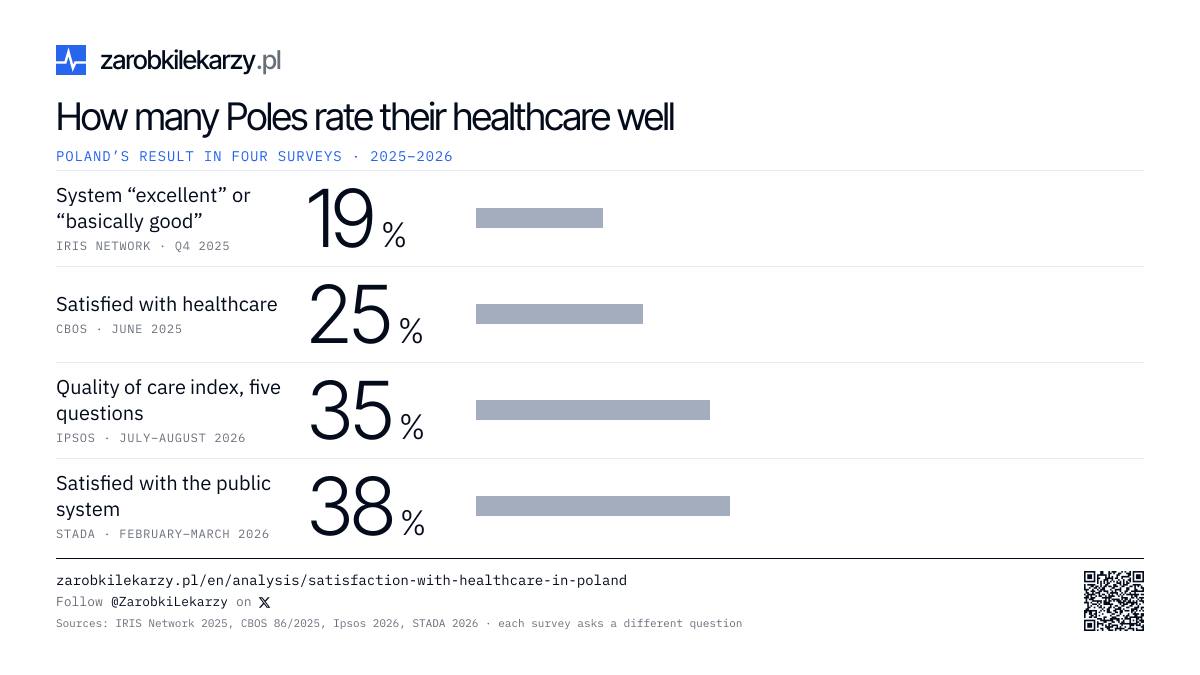
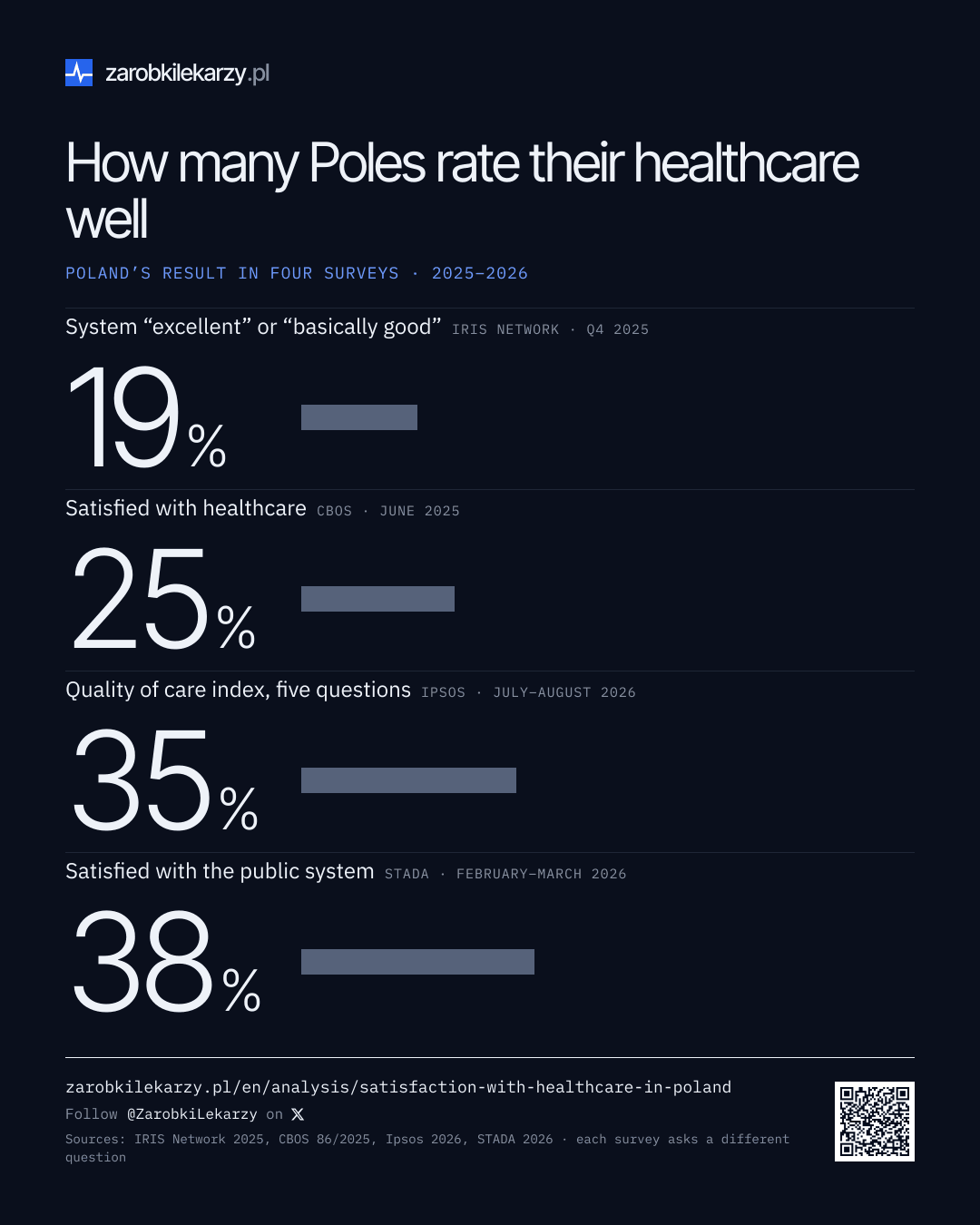
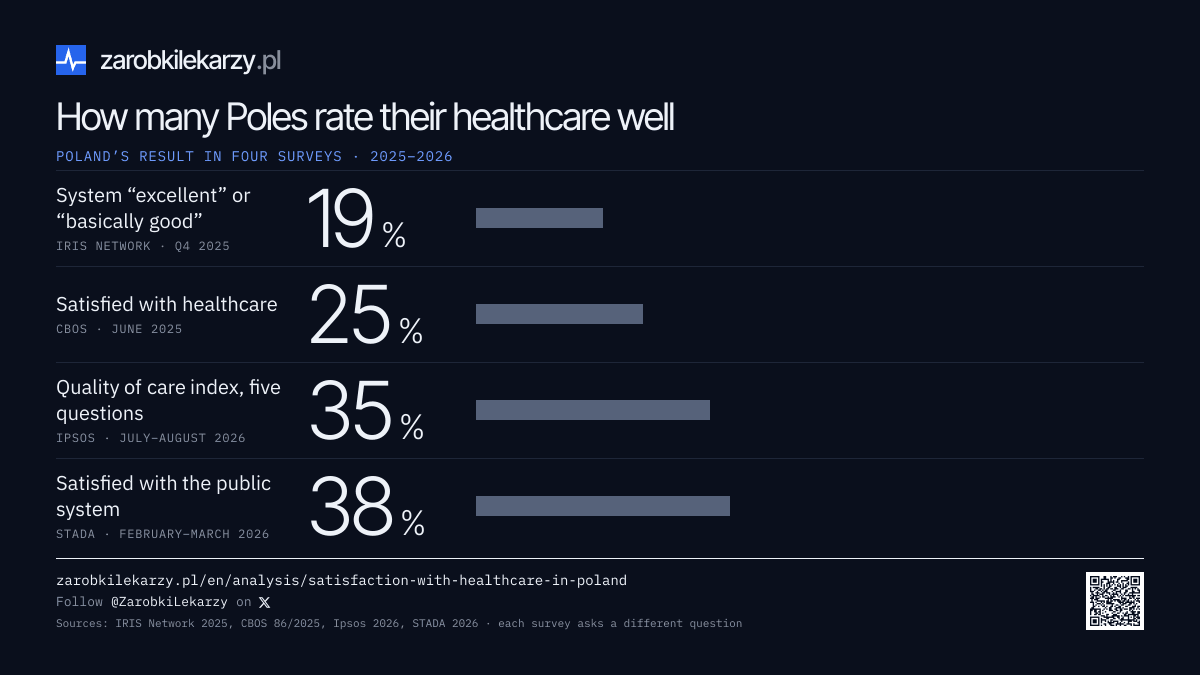
There is no single answer to the question of how many Poles are satisfied with their healthcare. Four surveys from 2025–2026 give 19%, 25%, 35% and 38%.1234 The differences arise because each survey asks a different question of a different group of people. The conclusion is nevertheless shared: clearly fewer than half of respondents give a good rating, and in international comparisons Poland is near the bottom of the list.
19%
rate the system as “excellent” or “basically good”; the average of 20 countries is 45%
38%
are satisfied with the public healthcare system; the average of 20 countries is 56%
Four questions, four numbers
The lowest result comes from the most sharply worded question. IRIS Network, a network of research agencies, asks respondents to choose one of four descriptions of the system: “excellent”, “basically good”, “deteriorating” or “in a state of crisis”. In Poland 19% choose one of the first two.1 CBOS simply asks about satisfaction with the way healthcare currently works in the country and gets 25%.2
The highest results come from online surveys. The Ipsos index is an average of five questions, one of which concerns easy access to a pharmacy, which is usually rated better than access to a doctor.3 STADA asks about satisfaction with the public healthcare system; the report does not quote the exact wording of the question.4
Alongside these four surveys we show the indicator used by the OECD: the share of people satisfied with the availability of quality healthcare where they live, from the Gallup World Poll. In 2024 it was 51% in Poland.5 The question concerns the availability of care locally, not a rating of the whole system, and the measurement is a year older, so we do not include it in the 19–38% range.
In every survey Poland is in the lower part of the field
- IRIS Network system “excellent” or “basically good”, Q4 2025 · this country is not in the survey45%19%
86%South Korea 81%Malaysia, Japan 65%Spain 64%Indonesia 58%Australia 57%Switzerland 47%Germany 45%USA 42%Austria 40%Canada 35%Ireland, Finland 34%Italy 33%Dominican Republic 26%Romania 22%Bulgaria, Greece 15%Turkey 19%Poland - CBOS satisfied with healthcare, June 2025 · this country is not in the survey25%
25%Poland - Ipsos index of five questions, July–August 2026 · this country is not in the survey35%
72%Malaysia 68%Singapore, India 67%Vietnam 64%Australia 63%Netherlands 61%Thailand 60%South Korea, Spain 59%South Africa 58%Belgium 57%Indonesia 55%Sweden 53%Argentina 52%New Zealand, France, Ireland 51%Great Britain, Canada 50%USA 49%Turkey 46%Japan 45%Mexico 43%Germany 42%Brazil, Italy 41%Chile, Romania 40%Colombia 33%Peru 28%Hungary 35%Poland - STADA satisfied with the public system, February–March 2026 · this country is not in the survey56%38%
86%Belgium 82%Uzbekistan 77%Switzerland 74%Czechia 71%France 67%Austria 65%Great Britain 63%Germany 62%Spain 60%Lithuania 54%Portugal 48%Romania 43%Kazakhstan 38%Slovakia 36%Serbia 27%Hungary 38%Poland - OECD (Gallup) satisfied with the availability of care where they live, 2024 · this country is not in the survey64%51%
89%Switzerland 86%Belgium, Denmark, Luxembourg 83%Netherlands 81%Germany 80%Japan, Norway 78%Austria 75%Czechia, Sweden, USA 73%Israel 71%Australia, Slovenia 70%Costa Rica 69%South Korea 65%Ireland 63%New Zealand 62%Estonia, Iceland, Spain 61%Finland, Great Britain 60%France 58%Portugal 56%Mexico, Slovakia 54%Latvia 53%Lithuania 50%Canada 46%Colombia 44%Chile, Italy 41%Hungary, Turkey 27%Greece 51%Poland
How to read this chart: the cobalt dot is Poland, the grey dots are the other countries, and the vertical line is the average given in the report. Hover over a dot or tap it to see the country and its result. Use the list above the chart to pick a country; it will be labelled next to Poland in every survey it takes part in. Below is a summary of what was asked and of whom.
| What the number measures | Sample in Poland | Survey mode | |
|---|---|---|---|
| IRIS Network | share choosing “excellent” or “basically good” from four descriptions of the system | 500–1,000 adults | mixed mode: online, face-to-face and telephone interviews |
| CBOS | share satisfied with the way healthcare currently works in the country | 971 adults drawn from the national population register (PESEL) | face-to-face (63%), telephone (24%) and online (13%) interviews |
| Ipsos | average of five questions: quality of care, trust in the system, ease of getting an appointment, access to a pharmacy, the same standard of care for everyone | 500 people aged 16–74 | online panel |
| STADA | share satisfied with the public healthcare system | 500–2,000 people aged 18–99 | online questionnaire |
| OECD (Gallup World Poll) | share satisfied with the availability of quality healthcare in the city or area where they live | at least 1,000 people aged 15 and over | Gallup poll, the same questionnaire in every country |
The online samples number a few hundred people, so a single result has a wide margin. For a sample of 500 Ipsos gives a credibility interval of ±5 percentage points.3 The difference between 35% and 38% falls within that margin; the difference between Poland and a survey’s average does not.
CBOS: the satisfied have been a minority since 2001
CBOS has been asking the same question for a quarter of a century, so only this survey shows change over time. In June 2025, 25% of respondents were satisfied and 70% dissatisfied. Two years earlier it was 27% and 70%.2
- 25 satisfied
- 5 hard to say
- 70 dissatisfied
1 cell = 1 respondent in 100
In fourteen measurements since 2001 the satisfied have never been a majority: there were most of them in March 2007 (37%) and fewest in February 2012 (19%). The two lines have run almost parallel for a quarter of a century, and the gap between them has never fallen below 21 percentage points.
Since 2001 the lines of the satisfied and the dissatisfied have never crossed
Satisfied and dissatisfied with the way healthcare works, according to CBOS: Jan 2001 31% and 64%; Mar 2007 37% and 58%; Aug 2008 25% and 68%; Mar 2009 34% and 63%; Feb 2010 22% and 75%; Feb 2012 19% and 78%; Jun 2014 28% and 68%; Jun 2016 23% and 74%; Jun 2018 30% and 66%; Jun 2020 36% and 58%; Jul 2021 29% and 67%; Sep 2021 29% and 66%; Jun 2023 27% and 70%; Jun 2025 25% and 70%.
The overall rating is made up of very different partial ratings. Access to specialist doctors comes out worst: 82% of respondents rate it badly. The possibility of booking an appointment at a convenient time is rated badly by 63%. Doctors’ competence is rated best, appreciated by 73% of respondents.2 The dissatisfaction therefore concerns mainly access to treatment, not the way doctors treat.
Respondents rate doctors well and access to them badly
Where the waiting lists come from is described in our analyses Why Poland is short of doctors and Private visits: the longer the queue, the higher the price.
The rating also depends on age. Among people aged 65 and over, 36% are satisfied, 11 percentage points more than in the whole sample.2
Poland among other countries
In the IRIS Network survey Poland ranks 19th of 20 countries. Only Turkey has a lower result (15%), and the average of all countries is 45%.1 The report also gives what respondents consider the main cause of the problems: in Poland 70% point to inefficient management and 30% to insufficient funding.
IRIS Network: Poland 19th of 20 countries
In the Ipsos index Poland has 35% and is 30th of 32 countries, ahead of Peru (33%) and Hungary (28%). Malaysia leads with 72%.3 The report gives neither an average for the index nor Poland’s result for the quality of care question alone, so we show only the order of countries.
Ipsos: Poland 30th of 32 countries
In the STADA survey 38% of people in Poland are satisfied with the public system, against an average of 56%. A year earlier the average was 58%.4 The international report does not contain a full table: it gives the results of 15 of 20 countries, and Slovakia has the same result as Poland. The results for Czechia (74%) and Austria (67%) come from the company’s Czech brochure for the same survey;6 we did not find results for Bulgaria, Ireland and Italy in STADA’s materials. Poland’s seventeenth place is given only in the company’s Polish press release.7
The same survey asked what respondents would change first if they were health minister. In Poland 66% pointed to shorter waiting times and more staff, and 57% to easier access to primary care.4 It is the same picture as in the partial ratings from CBOS.
OECD: availability of care where people live
In Health at a Glance 2025 the OECD uses the Gallup World Poll, which asks the same question in every country: in the city or area where you live, are you satisfied or dissatisfied with the availability of quality healthcare? In 2024, 51% were satisfied in Poland, against an average of 64% across the 38 OECD countries.5 Poland is 31st of 38 countries. Canada, Colombia, Chile, Italy, Hungary, Turkey and Greece have lower results, and Switzerland the highest (89%).
OECD: Poland 31st of 38 countries
It is the only one of the five comparisons in which Poland’s result rose over the past decade against the average: from 43% in 2014 to 51% in 2024, while the OECD average fell from 69% to 64%.5 The result is higher than in the other four surveys because the question is narrower: it asks whether care is available locally, not how the whole system works.
Notes 8laws, data and statements we relied on
-
IRIS Network, Global Public Confidence Study 2025 – Health Care Confidence Report, March 2026; country results on p. 11, causes of the problems on p. 13, method on p. 2. ↩ ↩2 ↩3
-
CBOS (Public Opinion Research Center), research report no. 86/2025 on opinions about the functioning of the healthcare system (in Polish), September 2025; survey of 5–15 June 2025. ↩ ↩2 ↩3 ↩4 ↩5
-
Ipsos, Ipsos Health Service Report 2026, October 2026; index on pp. 5–6, method on p. 34. ↩ ↩2 ↩3 ↩4
-
STADA, STADA Health Report 2026, June 2026; satisfaction on pp. 6–7, expected changes on pp. 9–10, method on p. 5. ↩ ↩2 ↩3 ↩4
-
OECD, Health at a Glance 2025, chapter “Population coverage for healthcare”, November 2025; Figure 5.2, figure data. ↩ ↩2 ↩3
-
STADA, STADA Health Report 2026 — Czech brochure (in Czech), 2026; the brochure refers to 19 European countries and 18,514 respondents. ↩
-
STADA Poland, press release on the STADA Health Report 2026 (in Polish), 21 October 2026. ↩
-
Rzeczpospolita, article on the IRIS Network report (in Polish), 10 April 2026. ↩
Infographic to download
1 graphic · portrait and landscape, light and dark
A graphic to share in two formats — portrait 1080×1350 (Instagram, Facebook, X) and landscape 1200×675 (X, LinkedIn, presentations) — light and dark. The sources, the page address and a QR code to the page are on the graphic.
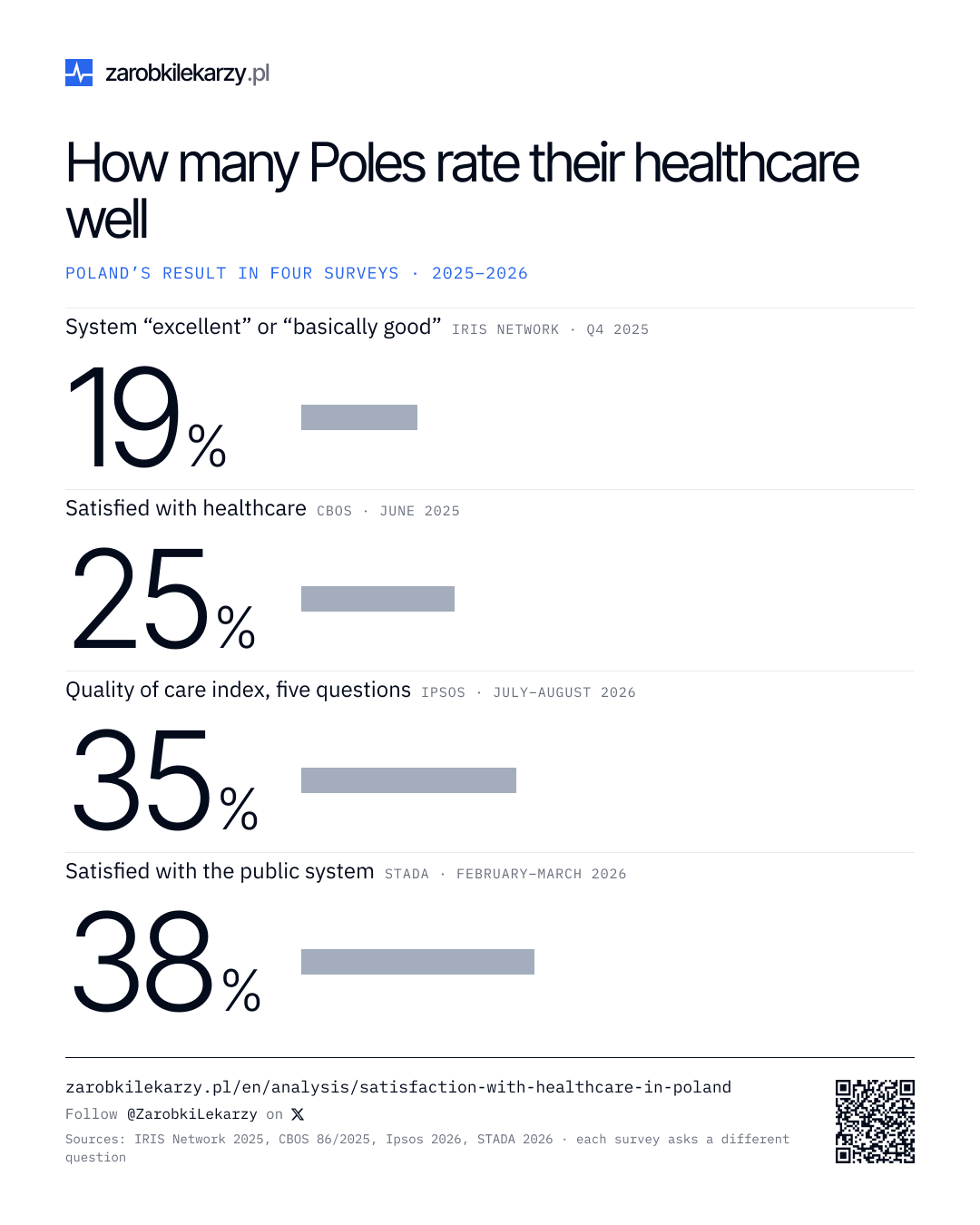
How many Poles rate their healthcare well
Change history 1
latest change 18 November 2026 · Added the OECD indicator from the Gallup poll (Poland 51%, 31st of 38 countries) as a separate section and a row in the comparison of surveys. Czechia (74%) and Austria (67%) were added to the STADA results from the company’s Czech brochure. A list above the spread chart lets you pick a country to compare with Poland.
Added the OECD indicator from the Gallup poll (Poland 51%, 31st of 38 countries) as a separate section and a row in the comparison of surveys. Czechia (74%) and Austria (67%) were added to the STADA results from the company’s Czech brochure. A list above the spread chart lets you pick a country to compare with Poland.