Do I have to agree to a procedure?
Correct. The other way round.No
The decision is yours — once you have received full information. For surgery and for higher-risk procedures, consent must be given in writing.
Path · five situations
Five situations in which it helps to know where you stand. Choose yours or go through them in order. Each one has something you can check straight away.
 PLN 0first copy of your medical recordsArticle 28 of the Act on patient rights
01 · My rights
Patient rights are easiest to check on specific questions, and each answer cites the article of the act. See how many you know before you read the whole page.
Yes or no?
Do I have to agree to a procedure?
Correct. The other way round.No
The decision is yours — once you have received full information. For surgery and for higher-risk procedures, consent must be given in writing.
Can I ask for a second opinion?
Correct. The other way round.Yes
You can demand a consultation with another doctor or a panel of doctors (konsylium). The doctor may refuse, but must record the refusal in your medical records.
The hospital wants to charge me for staying with my child. Is it allowed to?
Correct. The other way round.No
The hospital may not charge for a parent or carer staying with a child or with a person with a severe degree of disability.
Can someone close to me be with me?
Correct. The other way round.Yes
At your request — including during an examination. A refusal is allowed for only two reasons and must be recorded in your medical records.
There are students or other people at my examination. Do I have to agree?
Correct. The other way round.No
You have the right to respect for your privacy and dignity. People who are not providing your care — students, for example — may be present only with your consent.
I am in pain. Is pain relief my right?
Correct. The other way round.Yes
Yes, it is written into the act. The facility must assess how severe the pain is, treat it and check whether the treatment works.
0 of 6 correct
All the rights, with the article of the act for each answer and a sentence you can calmly say in the surgery, are on one page.
Prefer the answers straight away? All the rights are on one page.
Read more
Next: How does the emergency department queue work? 5urgency categories, each with its own time limitregulation on emergency departments
02 · Urgent
The order depends on your state of health, not on when you arrived. After an initial assessment, called triage, you get one of five urgency categories, and each has a longest permitted time to a doctor.
What colour will you get after triage?
immediately
Red · highest priority
02 hrs4 hrs
up to 10 min
Orange · high priority
02 hrs4 hrs
up to 60 min
Yellow · medium priority
02 hrs4 hrs
up to 120 min
Green · low priority
02 hrs4 hrs
up to 240 min
Blue · lowest priority
02 hrs4 hrs
The map of all departments shows how many people are waiting for a doctor and whether the time is within the limit.Queue map →
Longest permitted time to a doctor: regulation on hospital emergency departments, § 6(9–14). One field is 10 minutes.
Read more
Next: Is everything right on my account? >1,600justified patient reports about IKP entries in 2024NFZ via Rynek Zdrowia
03 · My account
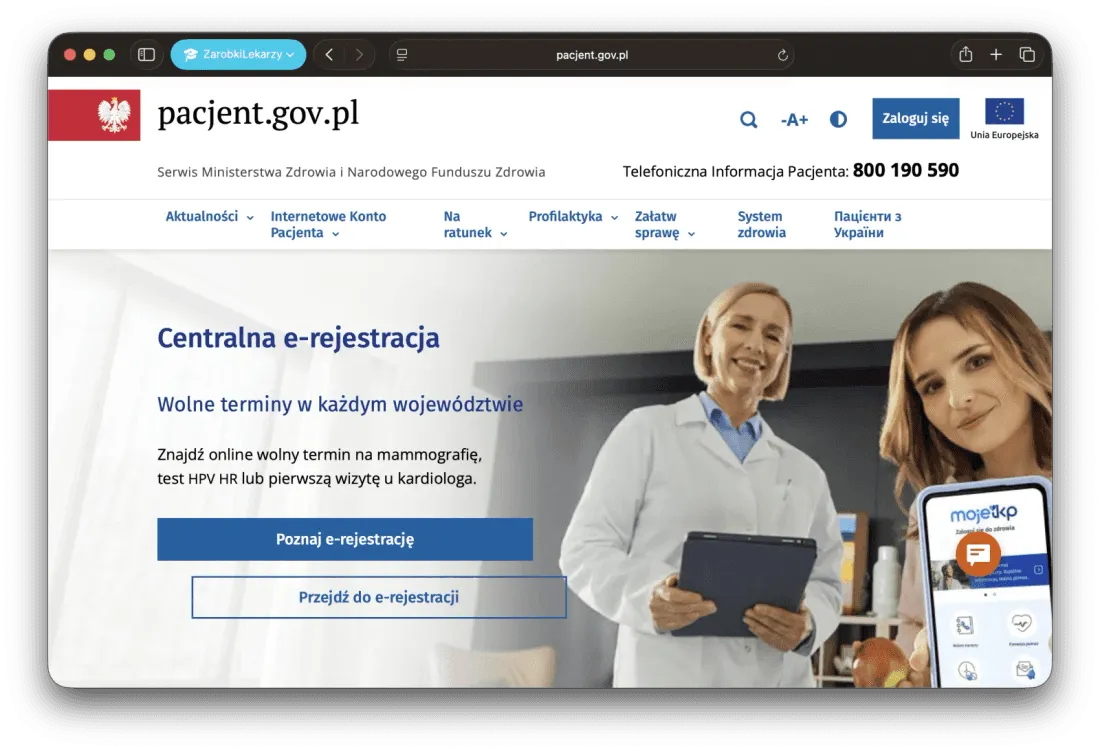
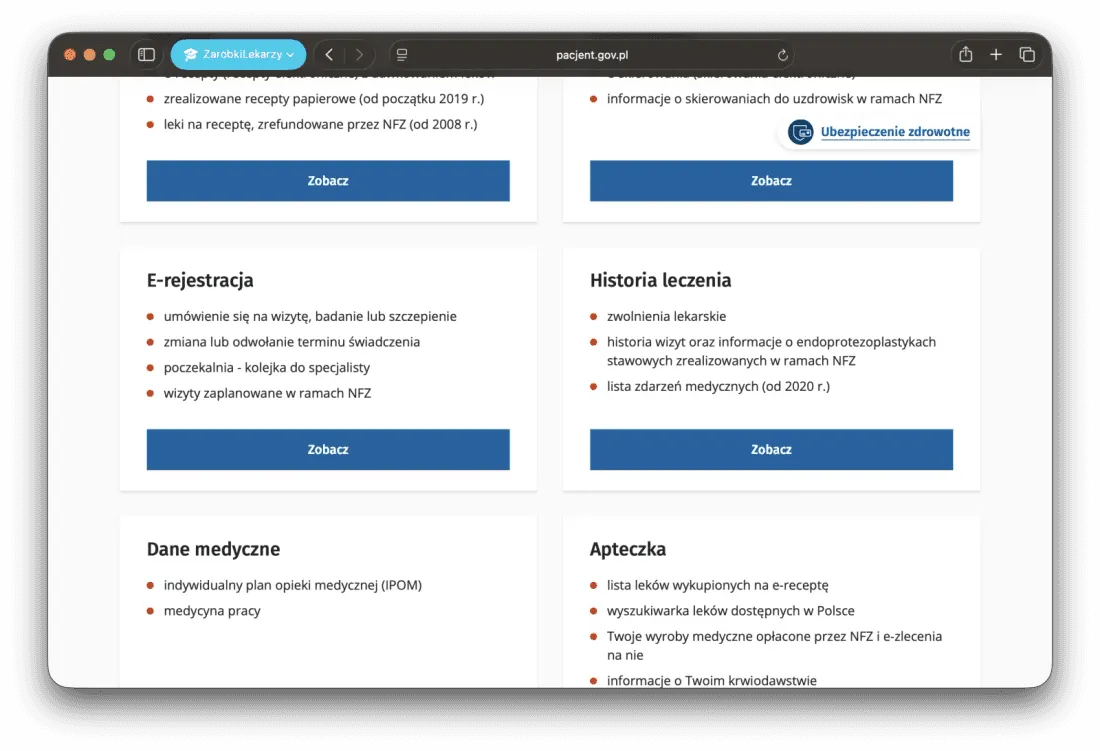
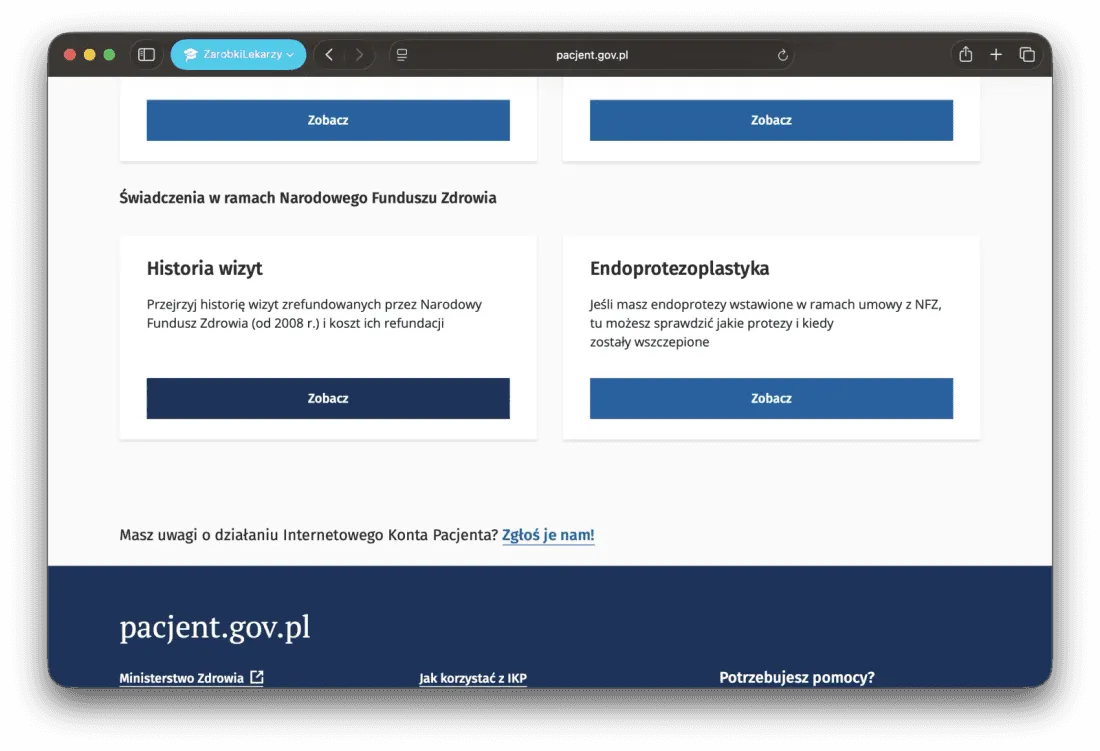
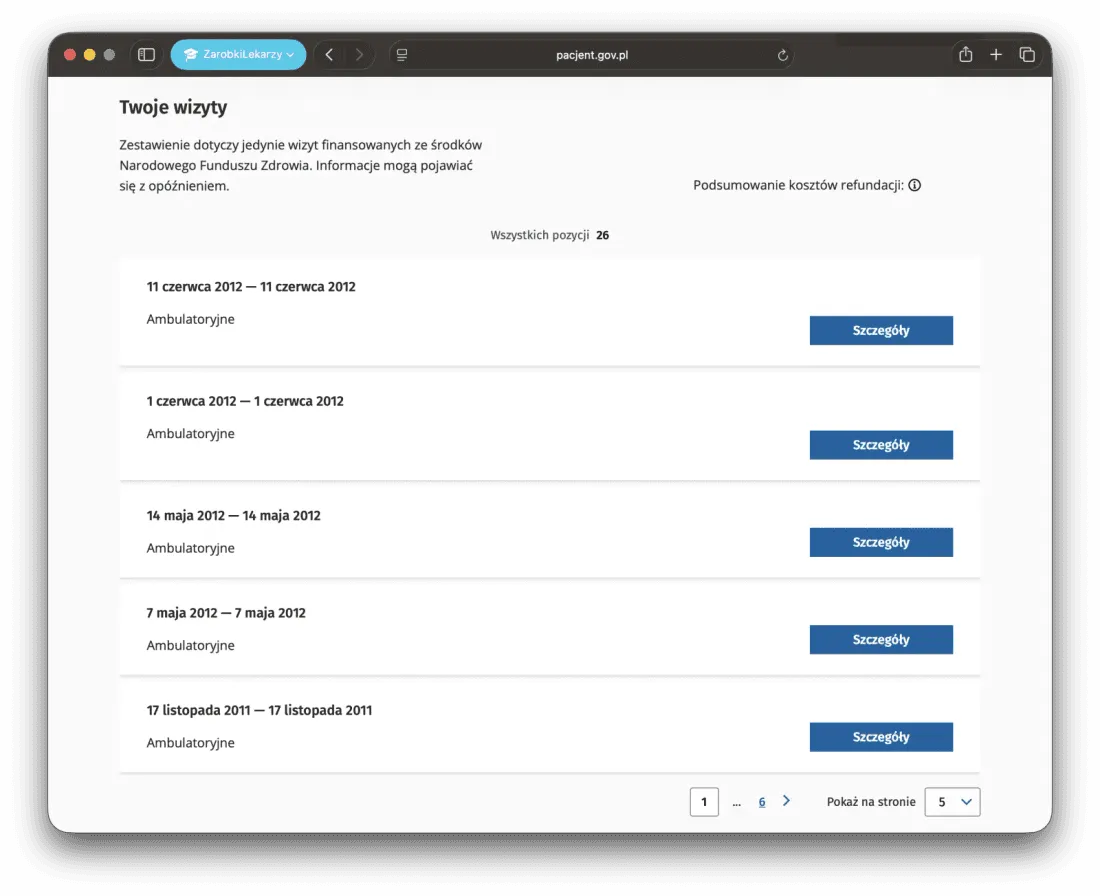
The National Health Fund (NFZ) pays for an entry in the system, not for the visit as such. You can check refunded visits from 2008 onwards in your Internet Patient Account (IKP). Below you can see the way there step by step before you log in.
The way to your visit history, step by step
Does an entry not add up?
In “Szczegóły” (details), choose “Zgłoś nieprawidłowość” (report an irregularity), fill in your contact details and send it. The report goes to the regional NFZ branch.
First rule out two false alarms: a teleconsultation is also recorded as a visit, and with subcontracting another facility’s name may appear even though the date is right.
These are only screenshots: you do not log in to anything here. Reports in 2024: almost 3,500 objections, more than 1,600 of them justified. Source: NFZ via Rynek Zdrowia.
Read more
Next: Why am I waiting so long? 4.2months on average for a specialist appointmentWHC Barometer, Sep/Oct 2025
04 · Waiting
Costs in the NFZ plan have roughly doubled since 2015 after inflation, and the average wait has grown by about 43%. Money alone cannot quickly be turned into doctors: it takes 11 to 13 years from admission to medical school to the specialist title, and shortages concern specific places and fields. Those who do not want to wait pay at the private practice next door.
You sign up today. Who for?
4.2 months
Visit around — Estimate
PLN 231.52 (≈ €53): the average price of a private visit to a specialist in 2025.
The number next to each name is months, and one field is a month in the queue. This is a calculation on an average, not your appointment: today’s date plus the average waiting time. Sources: WHC Barometer, Sep/Oct 2025, Statistics Poland (GUS), Local Data Bank, NFZ budget and queues, Why Poland is short of doctors.
Read more
 8situations, each with its own addressfull description on the patient rights page
05 · Something went wrong
Institutions do not pass cases on to each other, and a report sent to the wrong address is lost. Each situation shows who will deal with it. Expand it to see how much time you have and what it costs.
What happened?
The routes do not exclude each other. A complaint to the medical self-government can lead to the doctor being penalised, but it will not get you any money. The Patient Ombudsman will deal with a violation of your rights, but will not award damages. One important link: accepting a benefit from the Fund closes the route to court.
Read more
Take it with you
The most important rights, deadlines and numbers on a single card: for your handbag, for the folder with your medical records or for a parent. You print it on an ordinary sheet of A4, cut it and fold it.
This is not legal advice. We have collected what follows directly from the acts and from the official websites of public authorities, with links to the sources. For your own case, call the free helpline — it is answered by people who do this professionally.
Euro amounts are approximate, converted at the National Bank of Poland mid rate of 6 November 2026 (table 217/A/NBP/2026): 1 EUR = 4.3925 PLN.