The “budget” of the National Health Fund (NFZ) is in practice the Fund’s financial plan, and the plan goes through several versions in the course of a year: the draft, the plan approved before the start of the year, successive amendments and the final plan. After the year comes the report on how the plan was carried out. Each version gives a different amount, which is why figures from different sources easily diverge. Here we count every year the same way and show the other figures alongside, in separate columns.
One series, one definition
The main figure is total costs in the final NFZ financial plan, i.e. the amount the Fund could spend in a given year after all amendments to the plan. The plans are published in the NFZ Public Information Bulletin (BIP).1 The year 2026 is still under way, so we show the current plan, as amended on 5 October 2026 (order of the President of the NFZ no. 107/2026/DEF).2 This amount may still change.
From 2015 to 2025 costs in the NFZ plan more than tripled: from PLN 71.5 billion to PLN 220.2 billion.
Line chart. Total costs in the final NFZ financial plan, PLN billion: 2015 — 71.5; 2016 — 75.1; 2017 — 81.4; 2018 — 85.8; 2019 — 95.4; 2020 — 109.1; 2021 — 135.1; 2022 — 138.7; 2023 — 167.6; 2024 — 193.5; 2025 — 220.2. Dashed line: 2026 — plan in progress after the amendment of 5 October 2026, PLN 227.4 billion; 2027 — draft plan of July 2026, PLN 237.3 billion.
Money from the COVID-19 Response Fund (Fundusz Przeciwdziałania COVID-19), which operated outside the state budget, contributed to the jump in 2021, of 23.8%. According to the Supreme Audit Office (NIK), from 2020 to mid-2022 the Minister of Health spent PLN 40.8 billion (≈ €9.26 billion) from it on NFZ tasks and on refunding health contributions.3 The NFZ plan has no separate item for this money. Its structure shows that the money falls under other revenue, which rose from PLN 12.4 billion (≈ €2.81 billion) in 2020 to PLN 28.2 billion (≈ €6.4 billion) in 2021 and fell to PLN 7.8 billion (≈ €1.77 billion) in 2022. Costs in the plan then grew by only 2.6%.14 We write more about the COVID-19 Response Fund in our analysis COVID-19: billions without a transparent account.
Alongside costs we give revenue from the same plan and the outturn, i.e. operating costs from the Fund’s combined financial statements.4 The outturn is a checkpoint, not the same series: the financial statements group items differently from the plan. In 2025 the plan allowed the Fund to spend PLN 220.2 billion (≈ €50 billion), while operating costs amounted to PLN 210.2 billion (≈ €47.7 billion).
All columns of the series, year by year
| Year | Costs in the plan | Change in costs y/y | Revenue in the plan | Outturn: costs | State budget subsidy |
|---|---|---|---|---|---|
| 2015 | 71.5 | — | 69.9 | — | — |
| 2016 | 75.1 | +5.0% | 72.7 | — | — |
| 2017 | 81.4 | +8.4% | 79.8 | — | — |
| 2018 | 85.8 | +5.5% | 84.1 | — | — |
| 2019 | 95.4 | +11.1% | 93.2 | — | — |
| 2020 | 109.1 | +14.4% | 105.3 | 104.2 | 0.0 |
| 2021 | 135.1 | +23.8% | 135.1 | 125.5 | 2.6 |
| 2022 | 138.7 | +2.6% | 138.7 | 133.5 | 0.7 |
| 2023 | 167.6 | +20.8% | 145.9 | 162.8 | 0.2 |
| 2024 | 193.5 | +15.5% | 184.0 | 187.3 | 14.8 |
| 2025 | 220.2 | +13.8% | 216.6 | 210.2 | 32.9 |
| 2026 (plan in progress) | 227.4 | +3.3% | 225.2 | — | 33.6 |
In some years the final plan assumes higher costs than revenue, i.e. a negative financial result. In 2023 the difference was PLN 21.7 billion (≈ €4.93 billion), in 2024 PLN 9.4 billion (≈ €2.13 billion), and in 2025 PLN 3.5 billion (≈ €794 million).1 This is why we do not combine revenue and costs in a single series.
What it means in real terms
A zloty from 2015 is worth less today. According to Statistics Poland (GUS), consumer prices rose by a total of about 57% from 2015 to 2025.5 After adjusting for inflation, costs in the NFZ plan grew 1.97 times over that period, i.e. roughly doubled. This is our own calculation: nominal growth (3.08 times) divided by the rise in prices.
Since 2020 both costs in the final plan and the outturn have doubled: in both columns the growth to 2025 is 2.02 times.4 Prices rose by about 44% over that time, so in real terms costs in the plan grew by about 40%.5
~3.1times
the nominal growth of costs in the final plan: from PLN 71.5 billion to PLN 220.2 billion
ExactNFZ, financial plans
~2.0times
the growth after adjusting for inflation, in 2015 prices — our own calculation
EstimateNFZ and GUS
3.3%
by this much costs in the current plan for 2026 exceed those in the final plan for 2025
The 2026 plan: from PLN 217 billion to PLN 227 billion
The figure of PLN 217 billion that often comes up in connection with the NFZ budget for 2026 comes from the draft plan presented to the Sejm Health Committee in July 2025. Revenue and costs in it were PLN 217.4 billion (≈ €49.3 billion) each, including PLN 26 billion (≈ €5.9 billion) of subsidy from the state budget.6
In 2026 the plan was amended several times. By the end of July revenue had been increased, including the subsidy, which rose to PLN 33.6 billion (≈ €7.63 billion).7 After the amendment of 5 October 2026, costs stand at PLN 227.4 billion (≈ €51.6 billion) and revenue at PLN 225.2 billion (≈ €51.1 billion).2 That is 3.3% more than costs in the final plan for 2025. We compare the plan for the current year with the final plan for the previous year, not with its outturn, because these are two different quantities.
Articles about the NFZ also cite other amounts from the same plan, for example the costs of healthcare services. In the current plan for 2026 they come to PLN 212.7 billion (≈ €48.3 billion).2 This is part of total costs, not a competing version of the budget. We also write about how the plan changes during the year in our analysis Following the public zloty.
The media also write about a gap in the Fund’s finances. In June 2026 Rynek Zdrowia, a healthcare news site, put the “hole” in the NFZ budget at about PLN 16 billion (≈ €3.63 billion).8 This is an estimate, not an item in the plan. In the current plan for 2026, costs exceed revenue by PLN 2.2 billion (≈ €499 million).2
The draft plan for 2027, presented to the Sejm Health Committee in July 2026, is balanced, i.e. it has no deficit: revenue and costs in it are PLN 237.3 billion (≈ €53.9 billion) each, including PLN 35 billion (≈ €7.94 billion) of subsidy from the state budget.9 The draft budget act for 2027, however, provides for a subsidy for the NFZ of PLN 41.5 billion (≈ €9.42 billion), so — as the Fiscal Council (Rada Fiskalna) points out — the Fund’s plan is inconsistent with the draft budget in this respect.10 According to the Fiscal Council, which cites an estimate by its office, the NFZ’s funding shortfall in 2027 will be about PLN 16 billion (≈ €3.63 billion), and that is after taking the higher subsidy into account. This is an estimate, not an item in the plan. The Council also notes that in 2021–2025 the costs actually incurred by the NFZ exceeded the initial plan by about PLN 19–22 billion a year.10
The subsidy from the state budget
Until 2019 the NFZ plan contained no general subsidy (dotacja podmiotowa) from the state budget. It included only targeted subsidies, for example for emergency medical teams. In the plans for 2020–2023 the general subsidy did not exceed PLN 2.6 billion (≈ €590 million). In 2024 it rose to PLN 14.8 billion (≈ €3.36 billion), in 2025 to PLN 32.9 billion (≈ €7.47 billion), and in the current plan for 2026 it is PLN 33.6 billion (≈ €7.63 billion).12 That is about 15% of the Fund’s revenue.
Until 2023 the subsidy did not exceed PLN 2.6 billion. In 2026 it is PLN 33.6 billion.
Bar chart. General subsidy from the state budget in the NFZ financial plan, PLN billion: 2020 — 0.0; 2021 — 2.6; 2022 — 0.7; 2023 — 0.2; 2024 — 14.8; 2025 — 32.9; 2026 — 33.6 (current plan, year in progress).
35PLN bn
in the draft plan for 2027; PLN 41.5 billion in the draft state budget
We calculate the growth of the subsidy between final plans, or between a final plan and the current one. A comparison with the draft, or with the plan approved before the start of the year, gives a completely different result, because the subsidy is often raised during the year — for 2026 from PLN 26 billion (≈ €5.9 billion) in the draft to PLN 33.6 billion (≈ €7.63 billion).67 Why the health contribution does not cover the costs of services is explained in our analysis Following the public zloty.
How much of this is pay
The NFZ financial plan has no item for “pay of medical staff”. Money for salaries in hospitals and clinics is included in the costs of services, together with medicines, equipment and the facilities’ other costs. The plan shows separately only the pay of the Fund’s own staff, less than PLN 1 billion (≈ €227 million).2 How much the statutory pay rises in healthcare cost is therefore known only from estimates.
The cumulative cost of the act on minimum pay in healthcare came to about PLN 58 billion (≈ €13.2 billion) in 2025. This figure comes from analyses by the Federation of Polish Entrepreneurs (Federacja Przedsiębiorców Polskich, FPP), an employers’ organisation, cited by the broadcaster TVN24.11 For 2026 the NFZ vice-president spoke in April of PLN 72 billion (≈ €16.3 billion) out of a “PLN 220 billion” plan,12 and according to TVN24 — of at least PLN 71 billion (≈ €16.1 billion).11 Against the current plan (PLN 227.4 billion), PLN 72 billion is about 32% of costs, and about 34% of the costs of services. This is our own calculation. It is also roughly three times what the 2026 plan allocates to primary care (PLN 24.4 billion (≈ €5.54 billion)).2
A different figure is the PLN 9.25 billion from the June 2026 recommendation of the Agency for Health Technology Assessment and Tariff System (AOTMiT). According to the agency, NFZ spending will rise by this amount, mainly because of the July increases in minimum pay.13 This is an increase over 12 months, not the total cost of pay. According to Rynek Zdrowia, it comes to about PLN 4.5 billion (≈ €1.02 billion) by the end of 2026 and about PLN 9 billion (≈ €2.04 billion) in the whole of 2027.8 How pay rises feed into the prices of services is described in Pricing of services, and how the NFZ settles accounts with hospitals in The NFZ payment system.
Money and the waiting list
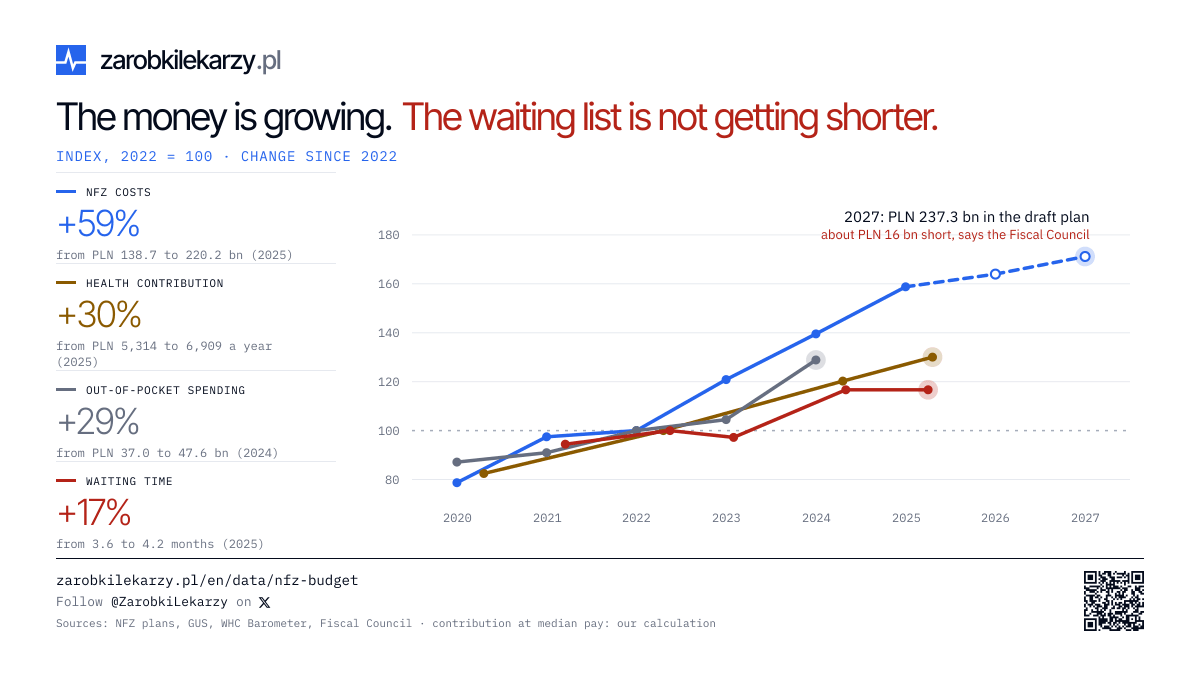
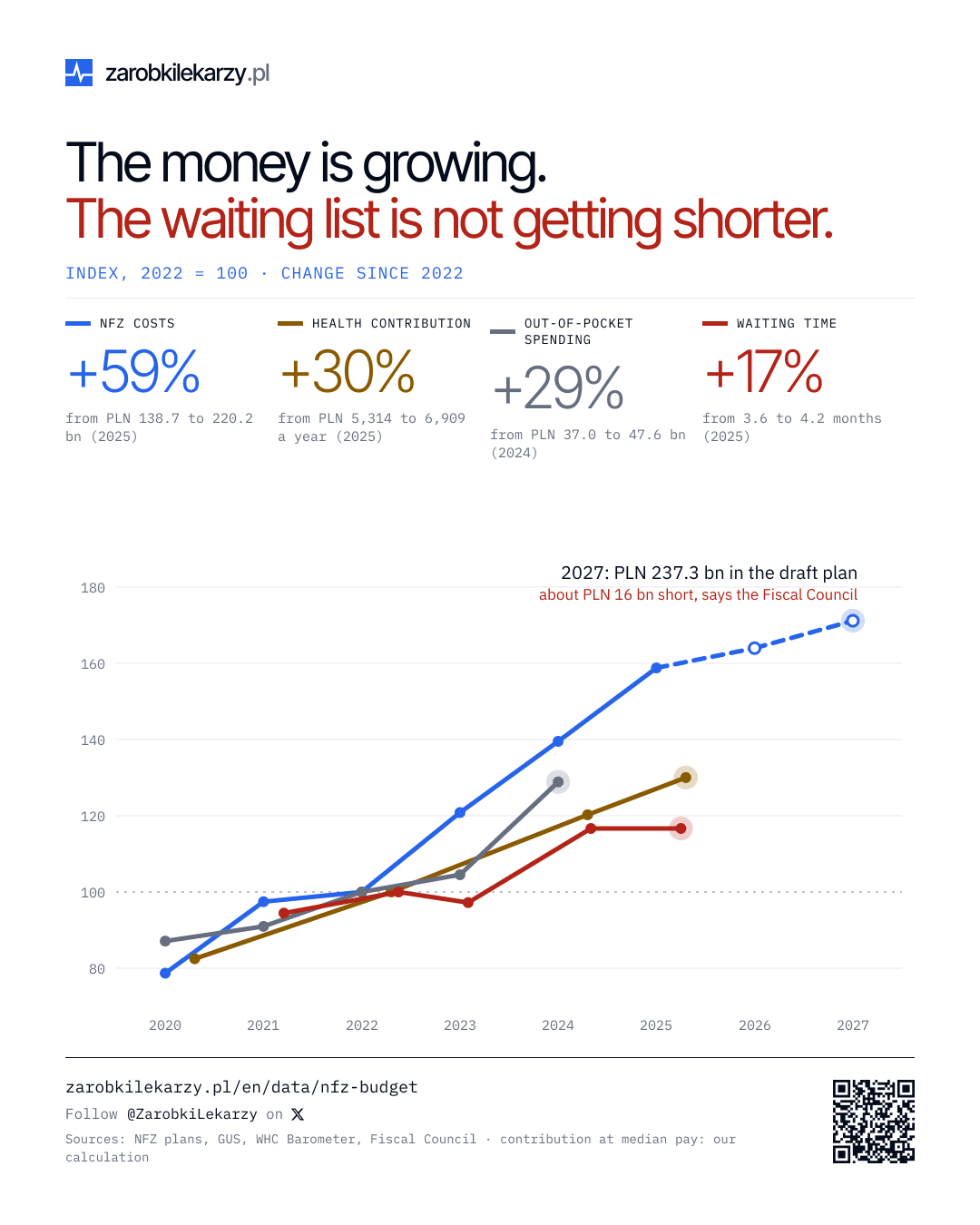
More money in the plan does not mean shorter waits. The chart shows both trends since 2015 on one scale: each line is calculated relative to 2015, which has the value 100. Costs are the same series as above, prices are the annual GUS indices, and the waiting time is the average waiting time for a service in the Barometer of the Watch Health Care Foundation (WHC).1515
Since 2015 costs in the NFZ plan have risen 3.1 times, prices by 57%, and the waiting time for a service by 43%.
Indices, 2015 = 100, 2015–2025. Costs in the final NFZ financial plan: from PLN 71.5 billion to PLN 220.2 billion, i.e. 3.08 times. Price level according to GUS: 56.6% higher. Average waiting time for a single service according to the WHC Barometer: from 2.9 months (average of three surveys in 2015) to 4.2 months (Sep/Oct 2025), up 43%; there was no Barometer in 2020.
The average waiting time for a single service grew from 2.9–3.0 months in 2015 to 4.2 months in September and October 2025. According to the Watch Health Care Foundation this is the longest since its measurements began.15 The waiting time did not grow evenly, however. At the turn of 2018 and 2019 it was 3.8 months, in September 2021 it was shorter (3.4 months), and then it grew again: to 3.5–3.6 months in 2022–2023 and to 4.2 months in 2024 and 2025.
The chart sets two trends side by side, but does not show what links them. The Barometer shows how access to services changes, but not why. How many doctors are missing and why is explained in our analysis Why Poland is short of doctors, and how the waiting list feeds into the price of a private visit in Private visits: the longer the waiting list, the higher the price.
Two measures of the WHC Barometer
The Watch Health Care Foundation checks waiting times using the “mystery patient” method: it phones facilities with an NFZ contract and asks for the first available appointment.15 From the results it calculates several averages. The chart shows one of them: the average waiting time for a single service, i.e. for about 215 visits, tests and procedures taken together.16 The other is the average waiting time for a specialist consultation, calculated for several dozen specialties.
In autumn 2025 the two measures gave the same result, but earlier they differed, so the pace of growth depends on which one is chosen. Since September 2021 the waiting time for a single service has grown from 3.4 to 4.2 months, and for a specialist consultation from 2.9 to 4.2 months.1715
4.2months
on average for a single service, Sep/Oct 2025 — the same for a specialist consultation
ExactWHC Barometer 2025
24%
the growth since Sep 2021 in the waiting time for a single service (3.4 → 4.2 months)
45%
the growth since Sep 2021 in the waiting time for a specialist consultation (2.9 → 4.2 months)
The longer view in figures
The table shows the same years in absolute terms, together with inflation and the minimum wage.1518 For waiting times we give both Barometer measures, each edition separately.19
| Year | Costs in the NFZ plan, PLN bn | Inflation, % | Minimum wage, PLN | WHC: service, months | WHC: specialist, months |
|---|---|---|---|---|---|
| 2015 | 71.5 | −0.9 | 1,750 | 2.9 · 2.9 · 3.0 | 2.4 · 2.3 · 2.4 |
| 2016 | 75.1 | −0.6 | 1,850 | 3.0 · 3.0 · 2.9 | — |
| 2017 | 81.4 | 2.0 | 2,000 | 3.0 · 3.1 | — |
| 2018 | 85.8 | 1.6 | 2,100 | 3.7 | — |
| 2019 | 95.4 | 2.3 | 2,250 | 3.8 | 4.0 |
| 2020 | 109.1 | 3.4 | 2,600 | no survey | no survey |
| 2021 | 135.1 | 5.1 | 2,800 | 3.4 | 2.9 |
| 2022 | 138.7 | 14.4 | 3,010 | 3.6 | 4.1 |
| 2023 | 167.6 | 11.4 | 3,490, from July 3,600 | 3.5 | 3.7 |
| 2024 | 193.5 | 3.6 | 4,242, from July 4,300 | 4.2 | 4.3 |
| 2025 | 220.2 | 3.6 | 4,666 | 4.2 | 4.2 |
| 2026 | 227.4 (plan in progress) | — | 4,806 | — | — |
The minimum wage rose from PLN 1,750 (≈ €397) in 2015 to PLN 4,666 (≈ €1,060) in 2025, i.e. 2.67 times, and in 2026 it is PLN 4,806 (≈ €1,090).18 We show it as a reference point, because people on the lowest pay also use public healthcare.
Waiting times depend on the specialist
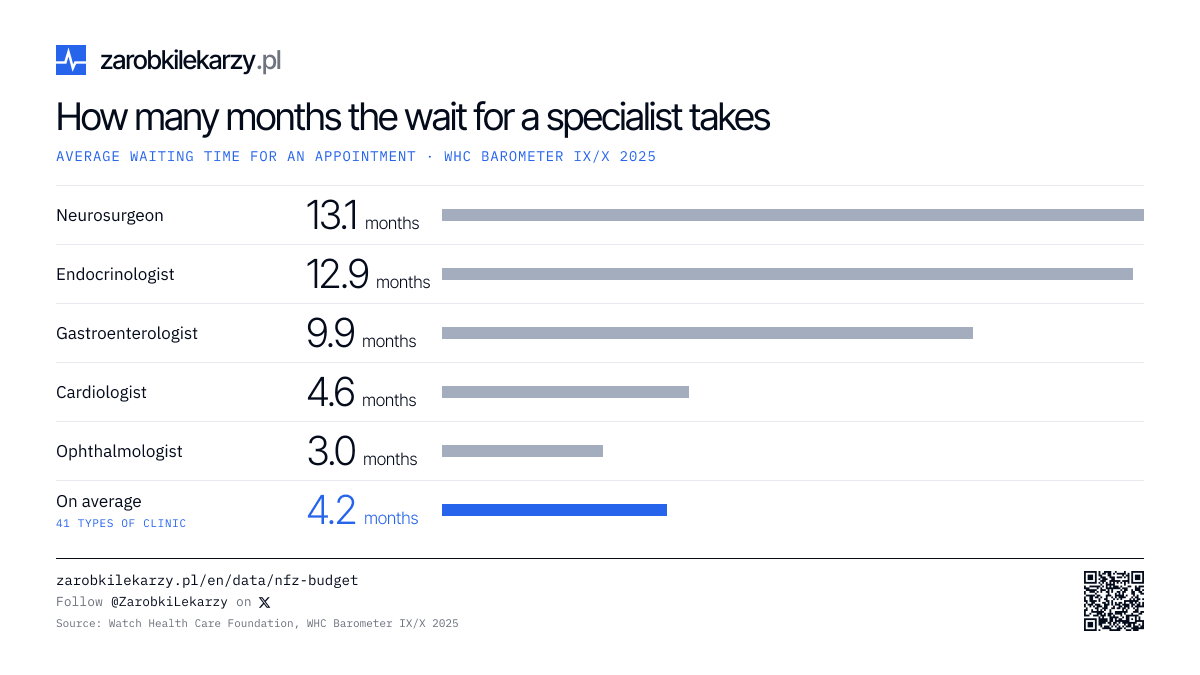
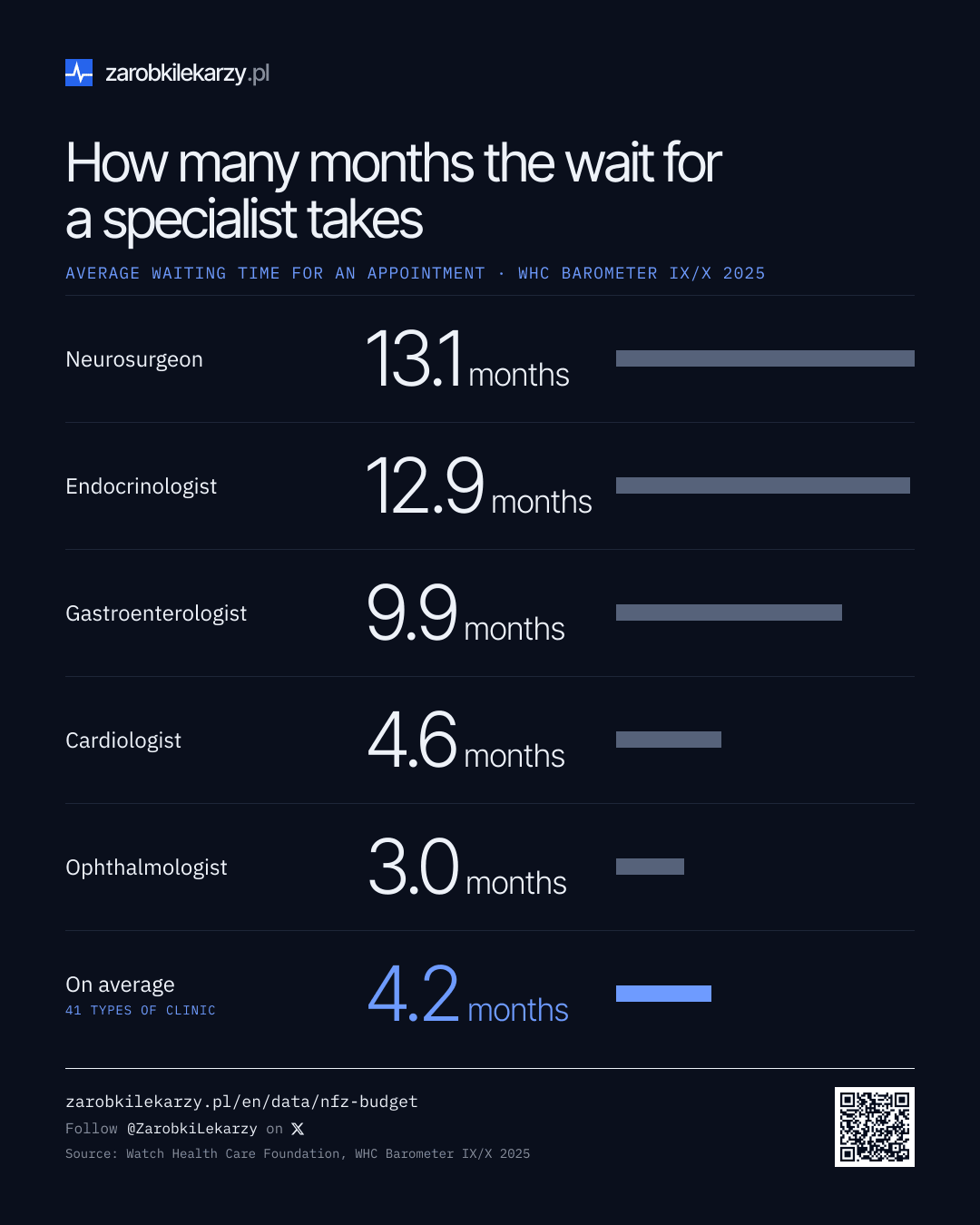
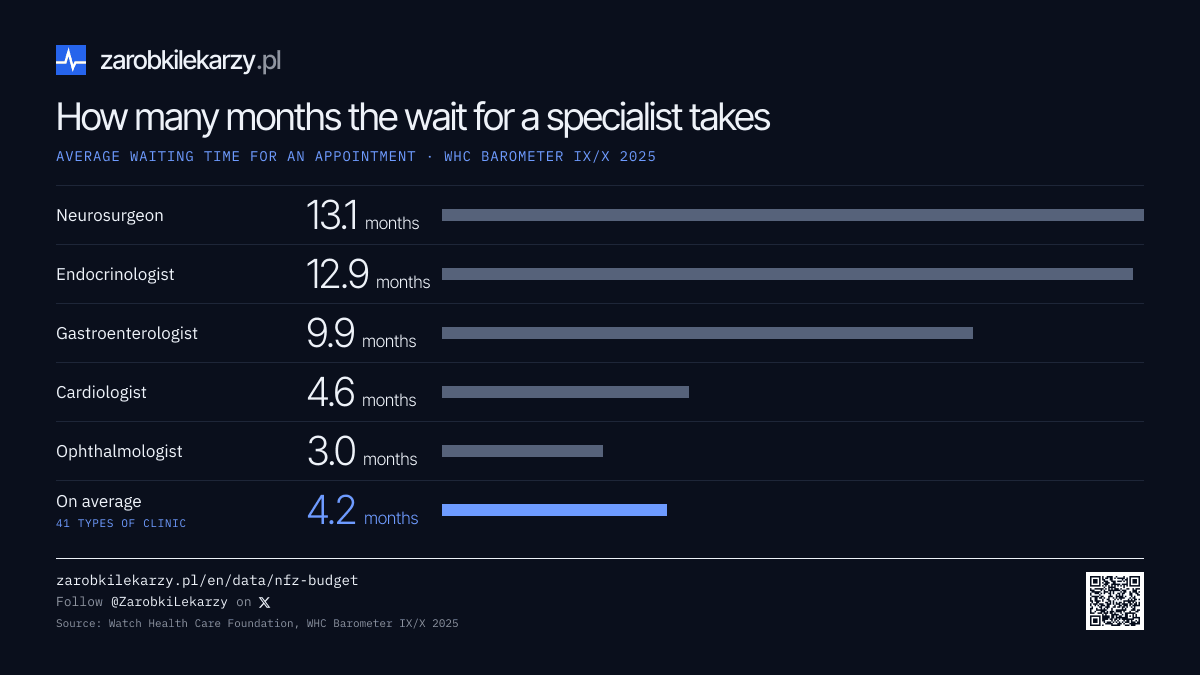
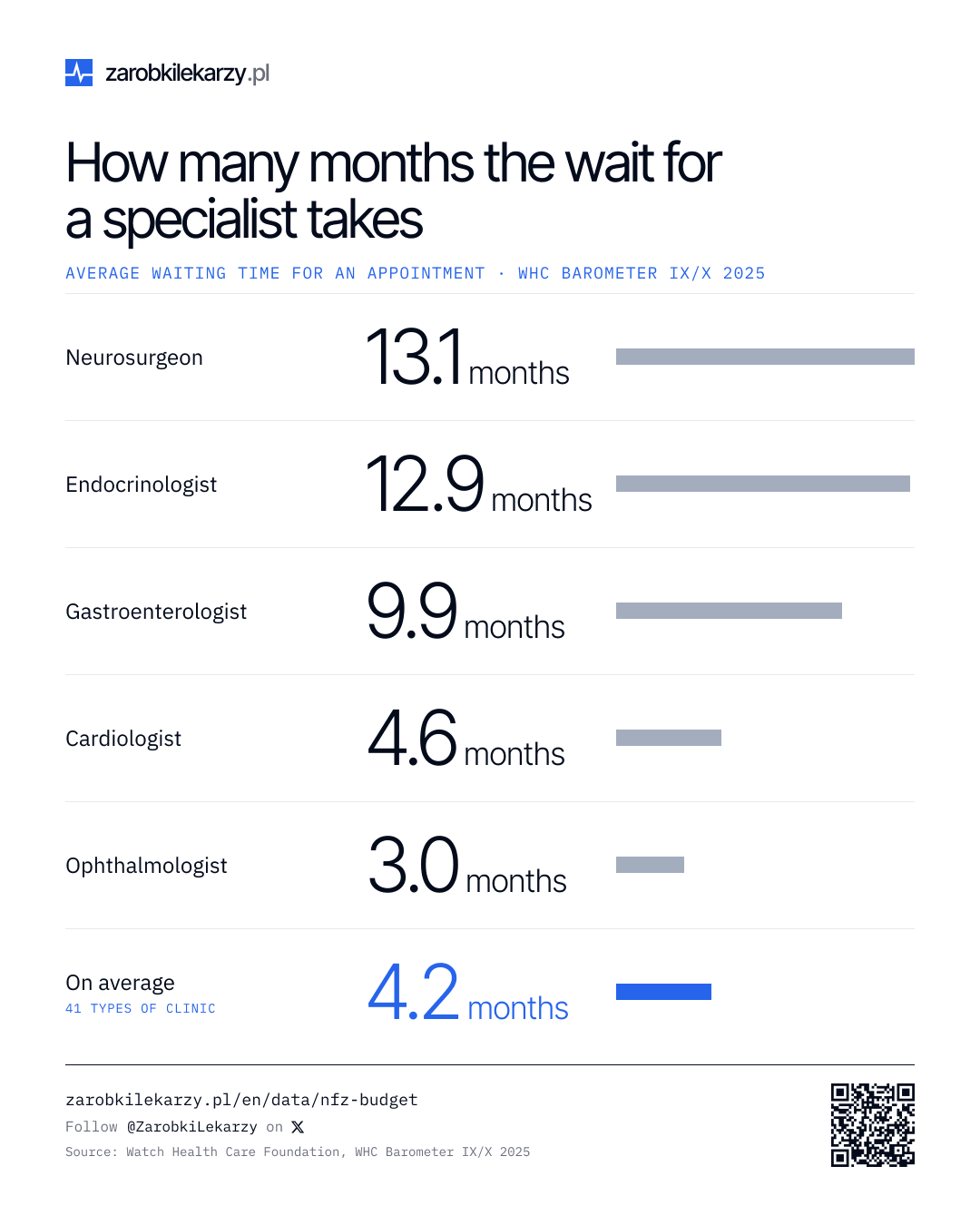
The wait for a neurosurgeon or an endocrinologist is over 12 months, three times longer than the average for a specialist.
These are appointments at clinics according to the WHC Barometer from September and October 2025.15 The wait for a neurosurgeon is 4.7 months longer than a year earlier, and for an endocrinologist 0.8 months longer. The result for a single specialist is based on a few facilities, so it is less certain than the average for all of them.
The NFZ also has its own data on waiting times. They are based on facilities’ reports on their waiting lists. According to data for the second quarter of 2025, described by the daily Gazeta Prawna, 225.8 thousand people were waiting for an appointment with an orthopaedist in the stable category, for 4.8 months on average.20 The same clinics have different results in the two sources, because these are two different measurements: the NFZ counts patients registered on the list, while WHC asks for the first available appointment.
The same clinic, two sources, two results
| Clinic | NFZ, Q2 2025 | WHC Barometer, Sep/Oct 2025 |
|---|---|---|
| Cardiologist | 4.2 months | 4.6 months |
| Ophthalmologist | 3.4 months | 3.0 months |
The NFZ also gives the waiting time for admission to a hospital ward, e.g. 5.8 months for neurosurgery.20 This is admission to hospital, not an appointment at a clinic, so it cannot be compared with the 13.1 months from the Barometer. How many training places and candidates there are in individual specialties is shown in our compilation Residents’ pay by specialty.
How much we pay ourselves
In 2024 households spent PLN 47.6 billion on healthcare out of their own pockets — 23% more than a year earlier.
This is money that patients pay directly, without insurance or a subscription. It comes from the GUS National Health Account.2122 In 2021–2023 this spending grew by 4–10% a year, and in 2024 by 23%. GUS data do not show what caused such a large jump. Per inhabitant it is about PLN 1,270 (≈ €288) in 2024. This is our own calculation: the GUS amount divided by 37.5 million inhabitants.23 Together with medical subscriptions and voluntary insurance, private spending on health came to PLN 66.4 billion (≈ €15.1 billion) in 2024.21
The second thing we pay ourselves is the health contribution. GUS does not say how much contribution a person on the median wage pays, so we calculate it ourselves. An employee pays 9% of the base, i.e. gross pay less 13.71% social insurance contributions.24 At the October 2025 median (PLN 7,414 (≈ €1,680) gross) this is about PLN 6,909 (≈ €1,570) a year, compared with about PLN 4,383 (≈ €995) in 2020.
Health contribution of an employee on the median wage — our calculation from GUS data
| Year | Median gross pay, October | Health contribution per year (our calculation) | GUS survey |
|---|---|---|---|
| 2020 | PLN 4,702.66 | about PLN 4,383 | “Structure of wages and salaries by occupation” |
| 2022 | PLN 5,701.62 | about PLN 5,314 | “Structure of wages and salaries by occupation” |
| 2024 | PLN 6,856.75 | about PLN 6,390 | “Distribution of wages and salaries” |
| 2025 | PLN 7,414.00 | about PLN 6,909 | “Distribution of wages and salaries” |
The amount alone does not say how much the burden has grown, however. Until the end of 2021, 7.75% of the base was deductible from income tax; since 2022 there has been no such deduction. At the same time the rules of income tax changed.25 We write more about this in our analysis Following the public zloty.
What the plan does not show
The NFZ plan says how much the Fund will spend on particular types of services, but not how much of it will reach specific people. Nobody publishes the total paid to one person from public money. What we know about doctors’ pay is shown in our compilation Doctor pay distribution, and we call for these totals to be made public: under a permanent identifier, without names.
How large the debts of public hospitals are is shown in our compilation Hospital debt.
Notes 25laws, data and statements we relied on
-
NFZ, Public Information Bulletin, “Finanse NFZ — plany finansowe” (“NFZ finances — financial plans”, in Polish). Final financial plans for 2015, 2016, 2017, 2018, 2019, 2020, 2021, 2022, 2023, 2024 and 2025 (in Polish), sheet “NFZ”, amounts in PLN thousand: total costs (item K; in the 2015 plan item O), total revenue (item J; in 2015 item N), general subsidy from the state budget (item A5 until 2022, item A4 from 2023). ↩ ↩2 ↩3 ↩4 ↩5 ↩6
-
NFZ, “Zarządzenie Prezesa NFZ nr 107/2026/DEF w sprawie zmiany planu finansowego Narodowego Funduszu Zdrowia na 2026 rok” (“Order of the President of the NFZ no. 107/2026/DEF amending the financial plan of the National Health Fund for 2026”, in Polish), 5.10.2026 (NFZ database of internal acts) — plan after the amendment: total costs PLN 227.35 billion, total revenue PLN 225.17 billion, costs of healthcare services PLN 212.72 billion, of which primary care PLN 24.41 billion; general subsidy PLN 33.6 billion; pay of NFZ staff PLN 0.81 billion. ↩ ↩2 ↩3 ↩4 ↩5 ↩6 ↩7
-
NIK, “Realizacja zadań finansowanych z Funduszu Przeciwdziałania COVID-19” (“Implementation of tasks financed from the COVID-19 Response Fund”, in Polish), audit report, 2023, p. 23 — spending by the Minister of Health from the Fund from 2020 to the end of the first half of 2022: PLN 52,222.4 million, of which PLN 40,776.9 million on NFZ tasks and on refunding the effects of exemption from health contributions. ↩
-
NFZ, combined financial statements of the Fund for 2020, 2021, 2022, 2023, 2024 and 2025 (in Polish) — operating costs in the profit and loss account; the statements for 2021 also show revenue reported as “środki z funduszu przeciwdziałania COVID-19” (“funds from the COVID-19 Response Fund”, note 10.2). ↩ ↩2 ↩3
-
GUS, “Roczne wskaźniki cen towarów i usług konsumpcyjnych” (“Annual consumer price indices”, in Polish) — annual average indices for 2016–2025; the price level in 2025 relative to 2015 is their product (our own calculation). ↩ ↩2 ↩3 ↩4
-
Sejm, “Pełny zapis przebiegu posiedzenia Komisji Zdrowia (nr 88)” (“Full record of the Health Committee sitting (no. 88)”, in Polish), 9.07.2025 — draft NFZ financial plan for 2026: revenue PLN 217,388,948 thousand, subsidy from the state budget PLN 26,000,000 thousand. ↩ ↩2
-
NFZ, “Zarządzenie Prezesa NFZ nr 73/2026/DEF” (“Order of the President of the NFZ no. 73/2026/DEF”, in Polish), 2026 (NFZ database of internal acts) — amendment of the financial plan for 2026; in the plan as at 23.07.2026 the general subsidy is PLN 33.6 billion. ↩ ↩2
-
Rynek Zdrowia, “9 mld zł na podwyżki dla medyków. Zapłaci Narodowy Fundusz Zdrowia” (“PLN 9 billion for pay rises for medical staff. The National Health Fund will pay”, in Polish), 11.06.2026. ↩ ↩2
-
Sejm, “Pełny zapis przebiegu posiedzenia Komisji Zdrowia (nr 152)” (“Full record of the Health Committee sitting (no. 152)”, in Polish), 2.07.2026 — draft NFZ financial plan for 2027: revenue PLN 237,342,389 thousand, costs PLN 237,342,389 thousand, subsidy from the state budget PLN 35,000,000 thousand. ↩
-
Fiscal Council, “Opinia Rady Fiskalnej o projekcie ustawy budżetowej na rok 2027 z dnia 27 sierpnia 2026 roku” (“Opinion of the Fiscal Council on the draft budget act for 2027 of 27 August 2026”, in Polish), 11.09.2026 — p. 29: NFZ funding shortfall in 2027 estimated by the Office of the Fiscal Council at about PLN 16 billion “already after taking into account a general subsidy of PLN 41.5 billion” (our translation); NFZ costs actually incurred in 2021–2025 higher than the initial plan by about PLN 19–22 billion a year; the NFZ plan inconsistent with the draft budget as regards the subsidy. Pp. 35–36: general subsidy for the NFZ in the draft budget act for 2027 — PLN 41.5 billion. ↩ ↩2
-
TVN24, “„Grzech pierworodny” ustawy. Kulisy finansowania płac minimalnych w ochronie zdrowia” (“The act’s ‘original sin’. Behind the funding of minimum pay in healthcare”, in Polish), 23.04.2026 — the cost in 2025 based on analyses by the Federation of Polish Entrepreneurs, in 2026 according to the NFZ vice-president at the European Economic Congress. ↩ ↩2
-
Forsal.pl, “Miliardy złotych na podwyżki w ochronie zdrowia” (“Billions of zloty for pay rises in healthcare”, in Polish), 23.04.2026 — statement by the NFZ vice-president at the European Economic Congress. ↩
-
Termedia, Menedżer Zdrowia, “Na podwyżki NFZ ma wydać ponad 9 mld zł. AOTMiT publikuje rekomendację” (“The NFZ is to spend over PLN 9 billion on pay rises. AOTMiT publishes its recommendation”, in Polish), 2.07.2026 — recommendation of the President of AOTMiT no. 84/2026 of 9.06.2026, the variant approved by the minister of health. ↩
-
Prawo.pl, the Federation of Polish Entrepreneurs’ analysis “Monitor finansowania ochrony zdrowia” (“Healthcare Financing Monitor”) (in Polish), 18.12.2023. ↩
-
Watch Health Care Foundation, “Barometr WHC — raport z IX/X 2025” (“WHC Barometer — report for Sep/Oct 2025”, in Polish) — fig. 2: average waiting time for a single service in all editions since 2012; survey method; specialist consultation 4.2 months (a year earlier 4.3 months); waiting times for individual specialists. ↩ ↩2 ↩3 ↩4 ↩5
-
Rynek Zdrowia, “Barometr Watch Health Care: średni czas oczekiwania na leczenie w 2025 r. to ponad 4 miesiące” (“Watch Health Care Barometer: the average waiting time for treatment in 2025 is over 4 months”, in Polish) — average of 215 services. ↩
-
Watch Health Care Foundation, “Barometr WHC — raport z września 2021” (“WHC Barometer — report for September 2021”, in Polish) — single service 3.4 months, specialist consultation 2.9 months. ↩
-
Regulations of the Council of Ministers on the minimum wage, issued every September for the following year, e.g. for 2021 (Dz.U. 2020 item 1596, Journal of Laws, in Polish). ↩ ↩2
-
Watch Health Care Foundation, WHC Barometer reports (in Polish) — specialist consultations from the texts of the reports for individual editions: 2015 (three editions), Dec/Jan 2019, Sep 2021, Nov 2022, Jul/Aug 2023, Oct/Nov 2024 and Sep/Oct 2025. ↩
-
Gazeta Prawna, “NFZ podał najnowsze dane o kolejkach. Do tych specjalistów nie ma już wolnych terminów” (“The NFZ has released the latest waiting-list data. There are no free appointments left with these specialists”, in Polish), 12.11.2025 — NFZ data for Q2 2025: clinics (orthopaedist 4.8 months, 225.8 thousand waiting; cardiologist 4.2; ophthalmologist 3.4) and hospital wards (neurosurgery 5.8 months). ↩ ↩2
-
“Obwieszczenie Prezesa GUS z 30 września 2026 r. w sprawie Narodowego Rachunku Zdrowia za 2024 r.” (“Notice of the President of GUS of 30 September 2026 on the National Health Account for 2024”, M.P. 2026 item 971, in Polish) — direct household spending PLN 47,640.5 million, total private spending PLN 66,377.7 million. ↩ ↩2
-
GUS, “Wydatki na ochronę zdrowia w latach 2021–2023” (“Health expenditure in 2021–2023”, in Polish) — direct household spending: PLN 33,625.3 million (2021), PLN 36,963.4 million (2022), PLN 38,633.2 million (2023); for 2020 (PLN 32.2 billion): Prawo.pl, “Wydatki gospodarstw domowych na zdrowie w 2020 r.” (“Household spending on health in 2020”, in Polish), based on GUS data. ↩
-
GUS, “Zasoby kadrowe w wybranych zawodach medycznych na podstawie źródeł administracyjnych w 2024 r.” (“Human resources in selected medical professions based on administrative sources in 2024”, in Polish) — population used as the denominator of the indicators (37,489,087). ↩
-
GUS, median gross pay in October: 2020 and 2022 (“Structure of wages and salaries by occupation”), 2024 (“Distribution of wages and salaries in the national economy”); 2025: Prawo.pl, “Mediana wynagrodzeń w październiku 2025 r.” (“Median pay in October 2025”), based on GUS (all in Polish). We calculate the contribution ourselves: 9% × (median − 13.71%) × 12. ↩
-
Commissioner for Human Rights, “Składka zdrowotna — brak możliwości odliczenia od podatku. Odpowiedź MZ” (“Health contribution — no deduction from tax. Reply of the Ministry of Health”, in Polish) — until 2021 a deduction of up to 7.75% of the base, abolished from 1.01.2022. ↩
Infographics to download
2 graphics · portrait and landscape, light and dark
Graphics to share in two formats — portrait 1080×1350 (Instagram, Facebook, X) and landscape 1200×675 (X, LinkedIn, presentations) — light and dark. The sources, the page address and a QR code to the page are on the graphic.
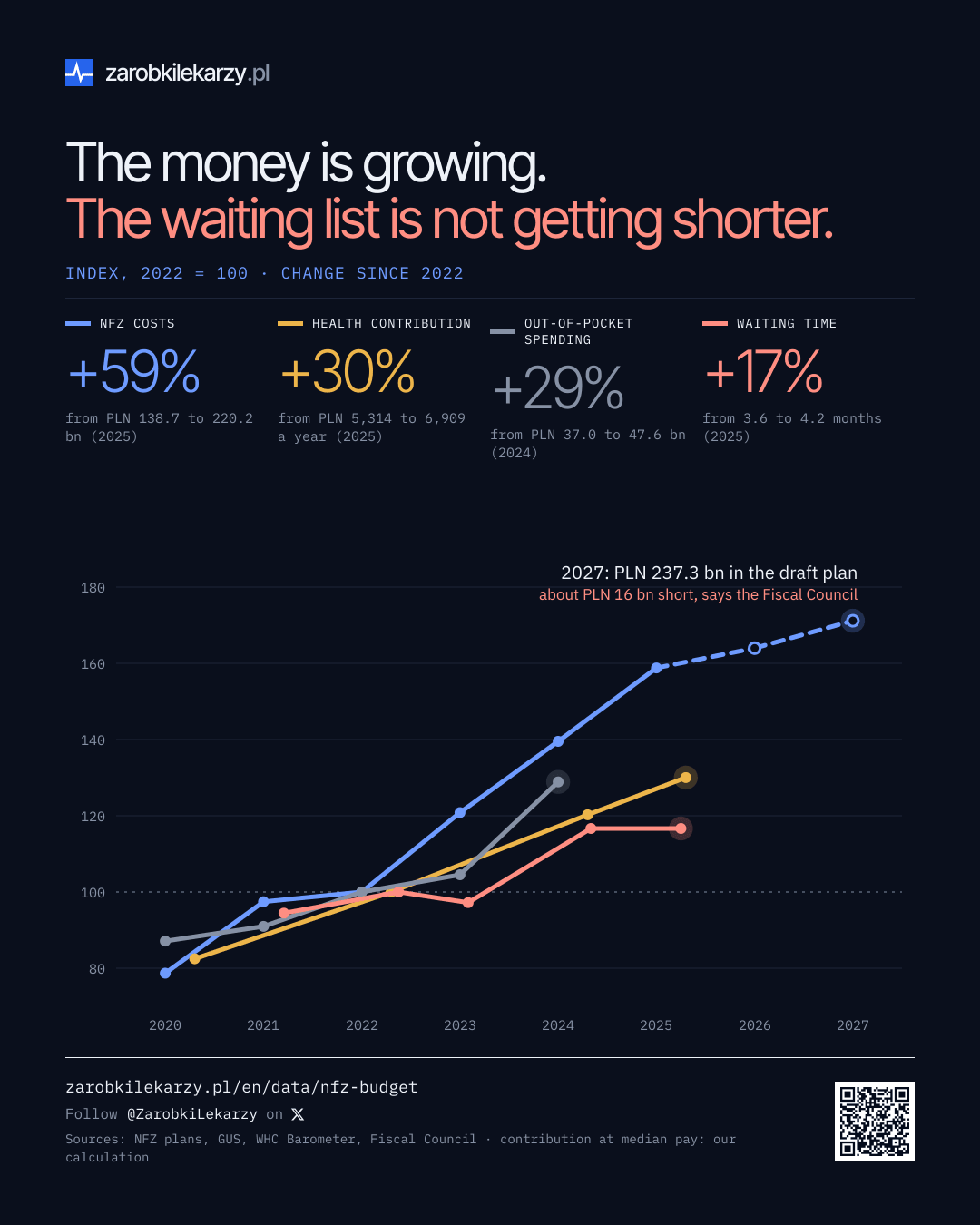
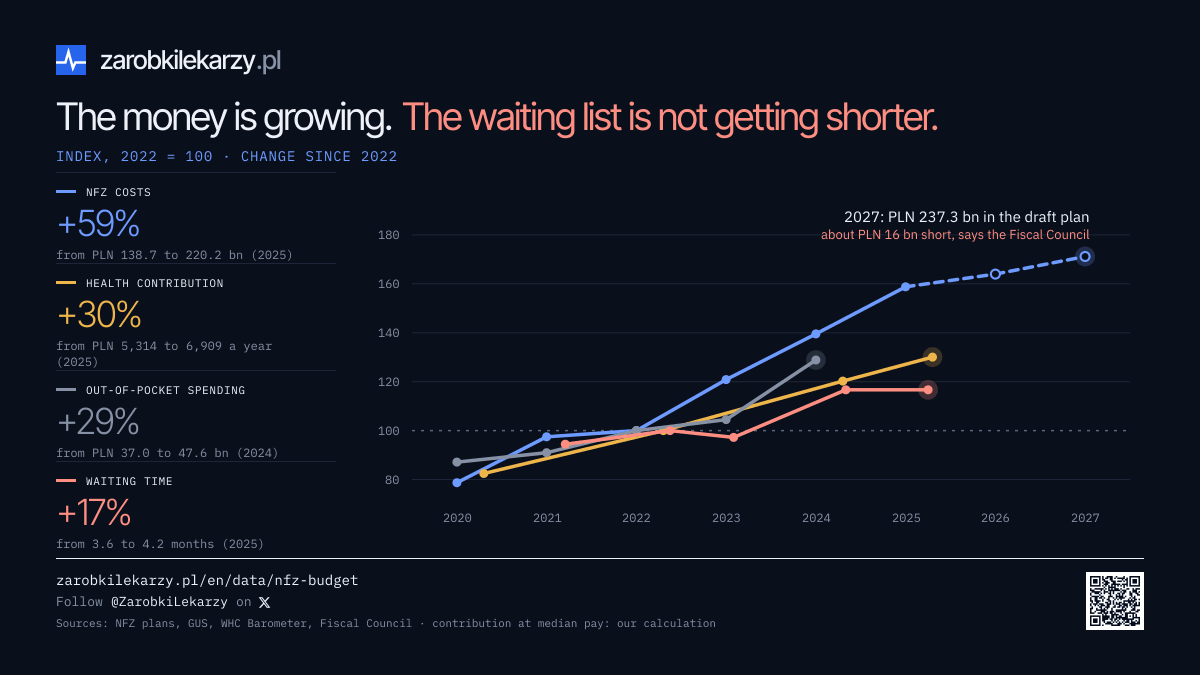
The money is growing. The waiting list is not getting shorter.
How many months the wait for a specialist takes