The mechanism: an entry is money
The National Health Fund (NFZ) does not see what happens in the consulting room. It sees what the facility reports: the type of service, the date, the patient. Each such record has a price in points — and it is the record, not the visit itself, that turns into a bank transfer.
On top of that there is the plan. A network hospital that in a settlement period reports at least 98% of the points on which its current lump sum was based keeps the lump sum at the full basis in the next period; if it reports less, the basis becomes the number of points actually reported.1 How this works is described in our text NFZ payment system. When points are lacking at the end of the period, the numbers can be “made up” in three ways:
- admit more patients — that is, do what the system is meant to encourage;
- report the services performed as more expensive than they really were (so-called upcoding);
- enter a service that never happened at all.
The third route is the hardest to detect, because the records look correct. The only witness outside the facility–NFZ relationship who knows that the visit did not take place is the patient.
Scale: thousands of reports, half of them justified
~3.5thousand
objections by patients to services shown in the IKP in 2024
EstimateNFZ via Rynek Zdrowia
According to NFZ data cited by the health portal Rynek Zdrowia, in 2024 patients lodged almost 3.5 thousand objections to services shown in the Internet Patient Account (Internetowe Konto Pacjenta, IKP).2 More than 1.6 thousand of them turned out to be justified. Most concerned dentistry and rehabilitation — services that are cheap per service, billed in large numbers and rarely checked by patients.
Examples described in the media:3
- a visit to a rheumatologist at a clinic where the patient had never been treated,
- a denture billed to the NFZ, although the patient never received it,
- rehabilitation reported as reimbursed, even though the patient paid for it privately.
Why it has to be the patient who catches it
NFZ inspections are selective: they cover selected facilities and periods, often with a delay. In the first quarter of 2026 the Fund’s inspection departments carried out 490 inspections and verification activities, including 294 inspections under Article 61a of the Act on publicly funded healthcare services.4
The total financial effect — exactly PLN 54,356,609 (≈ €12.3 million) — was made up of refunds of funds paid out unduly (PLN 23.6 million (≈ €5.36 million)), contractual penalties (almost PLN 30.5 million (≈ €6.92 million)) and damages (more than PLN 213,000 (≈ €48,300)).
The largest single penalty in this period — PLN 1,870,003 (≈ €424,000) — was imposed, as Bankier.pl reported, on a hospital in Rzeszów.5 According to reports, instead of the procedures actually performed, the facility submitted for settlement much more expensive procedures that had not been carried out.
There are too few inspectors to check every entry. There are enough patients. Anyone who looks at their own visit history becomes part of a distributed audit.
Check your IKP — instructions
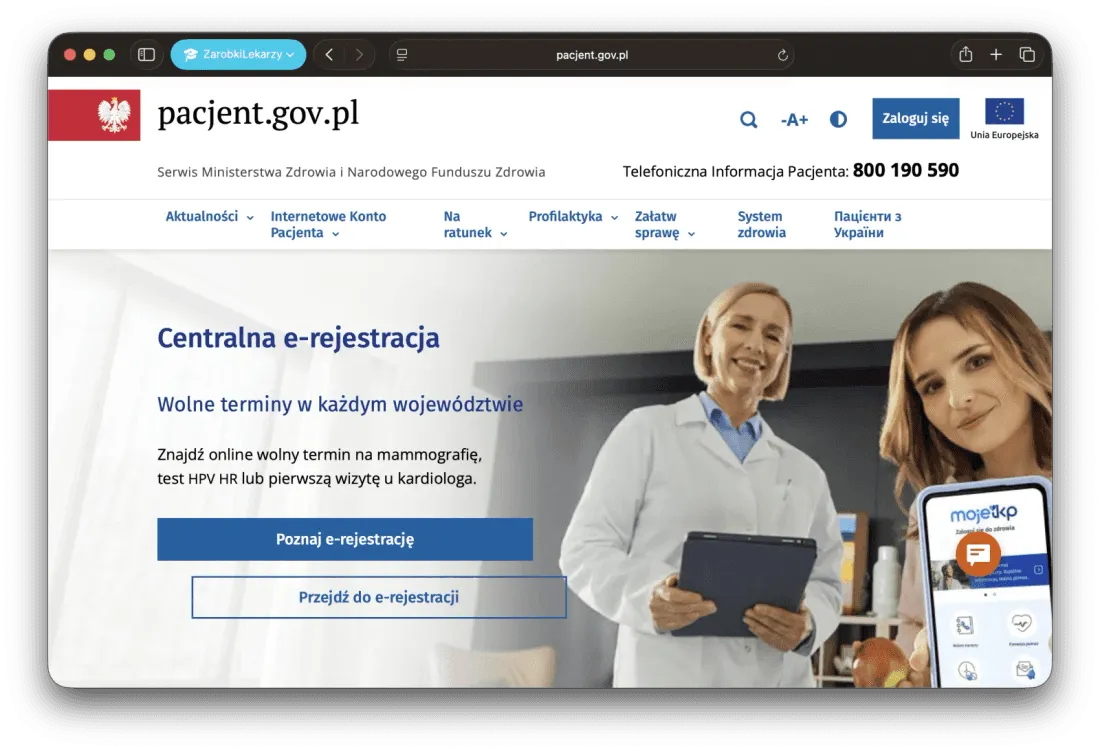
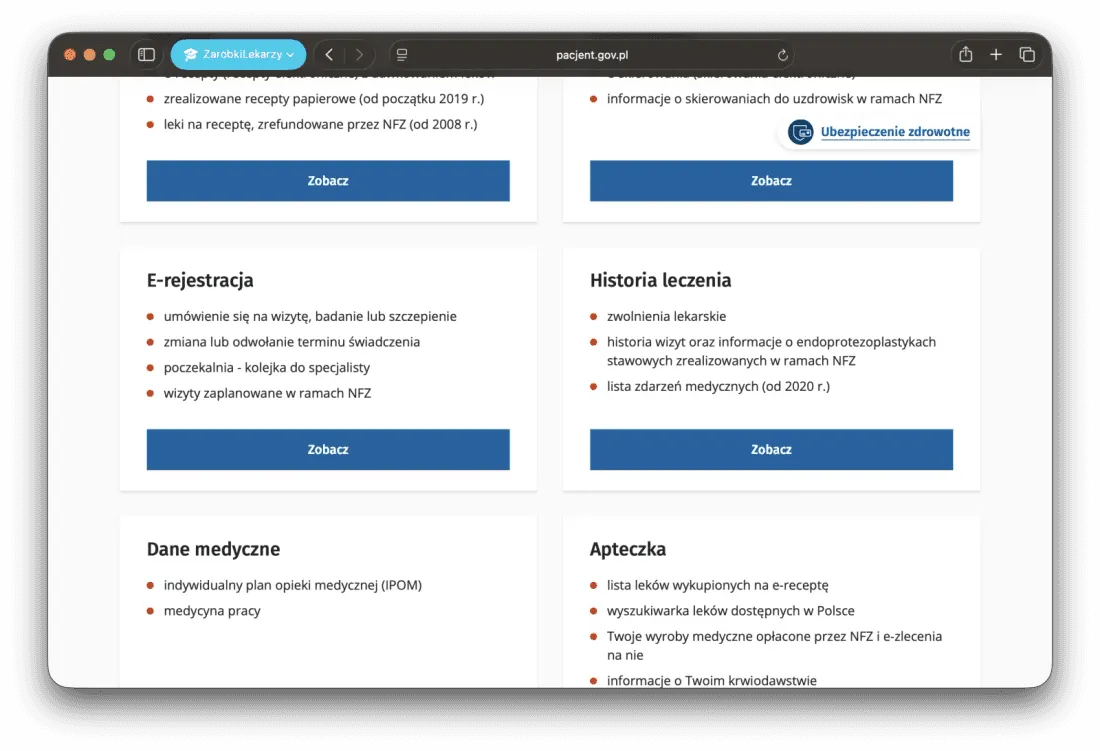
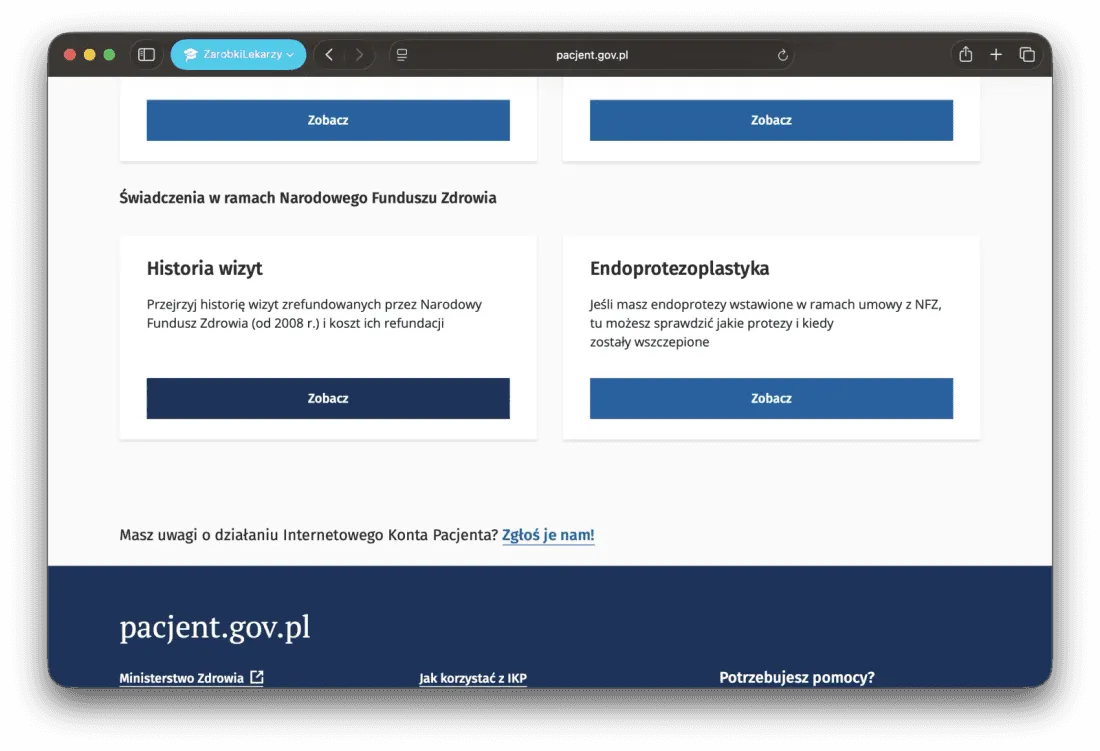
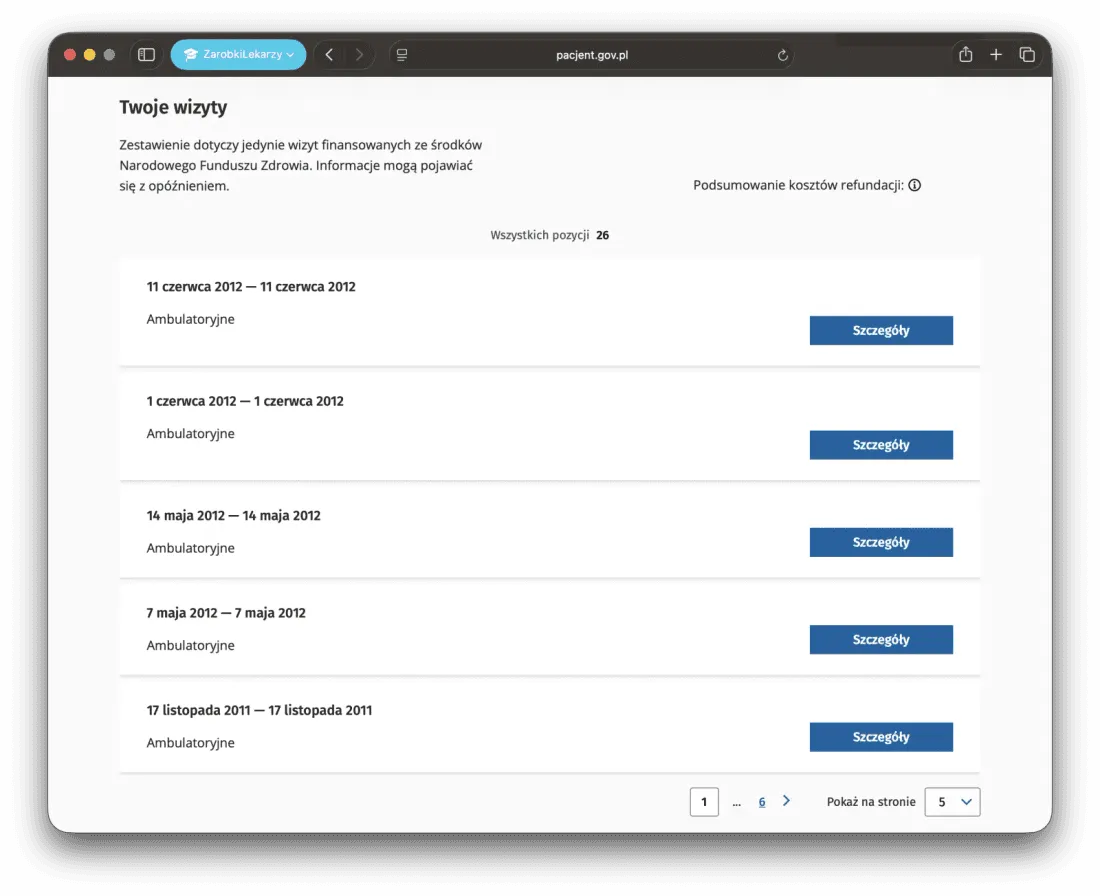
The screenshots show the Polish version of the site, so button and menu names are given in Polish, with a translation.
10 steps · about 5 minutes
-
Go to pacjent.gov.pl and choose “Zaloguj się” (“Log in”) in the top right-hand corner.6
-
Confirm your identity: with a trusted profile (profil zaufany), in the mObywatel app, with an e-ID card or through your bank. You can set up a trusted profile in online banking.
-
Find the “Historia leczenia” (“Treatment history”) tile and click “Zobacz” (“View”).
-
Go to the section “Świadczenia w ramach Narodowego Funduszu Zdrowia” (“Services under the National Health Fund”) and open “Historia wizyt” (“Visit history”). It lists visits reimbursed by the NFZ since 2008 — together with the cost of reimbursement.7
-
On the “Twoje wizyty” (“Your visits”) list, increase the number of items per page (by default only 5 are shown). Look at the counter of all items and the cost summary. New entries may appear with a delay.
-
Look for facilities you do not know, dates on which you did not see a doctor, and services you paid for privately that nevertheless appear as reimbursed. Go through dentistry, rehabilitation and medical devices with particular care. The “Szczegóły” (“Details”) button shows exactly what was billed and for how much.
-
Before you report an entry, rule out two false alarms: a teleconsultation is also recorded as a visit, and with subcontracting a different facility name may appear, even though the date matches.
-
If the entry is still unclear, in “Szczegóły” (“Details”) choose “Zgłoś nieprawidłowość” (“Report an irregularity”), fill in your contact details and send it. The report will go to the regional branch of the NFZ.8
-
Do not send the same matter several times — wait for a reply.
-
Also check your child’s account (you have full access until their 18th birthday) and the accounts of relatives, if they have authorised you.
Follow the topic on X

Arkadiusz Chwaścik
@Arkadiu02582322
A Wrocław city councillor who actively deals with NFZ settlements.
Notes 8laws, data and statements we relied on
-
Regulation of the Minister of Health of 22 September 2017 on the method of setting the lump sum of the basic hospital system for securing healthcare services, consolidated text: Dz.U. 2025 item 878 (in Polish), § 3(1)(3)–(4); amended by Dz.U. 2026 item 105. ↩
-
Rynek Zdrowia, “Zgłoszenia nieprawdziwych świadczeń widocznych w IKP — skala i przykłady” (“Reports of false services shown in the IKP — scale and examples”, in Polish), 10.08.2024. ↩
-
Rzeczpospolita, “Pacjenci odkrywają na swoich kontach świadczenia, z których nie korzystali” (“Patients discover services on their accounts that they never used”, in Polish), 08.08.2024. ↩
-
NFZ, “Sprawozdanie z działalności Departamentu Kontroli za I kwartał 2026 r.” (“Report on the activities of the Inspection Department for Q1 2026”, in Polish), pp. 4 and 9 — the figure of 490 also includes inspections of prescribing and of pharmacies. ↩
-
Bankier.pl, “Wyniki kontroli NFZ w I kwartale 2026 r. i kara dla szpitala w Rzeszowie” (“Results of NFZ inspections in Q1 2026 and a penalty for a hospital in Rzeszów”, in Polish), 07.2026. ↩
-
pacjent.gov.pl, “Internetowe Konto Pacjenta” (“Internet Patient Account”, in Polish). ↩
-
pacjent.gov.pl, “Centrum wsparcia IKP — pytania i odpowiedzi” (“IKP support centre — questions and answers”, in Polish). ↩
-
NFZ, “Zgłaszanie nieprawidłowości przez IKP” (“Reporting irregularities through the IKP”, in Polish). ↩