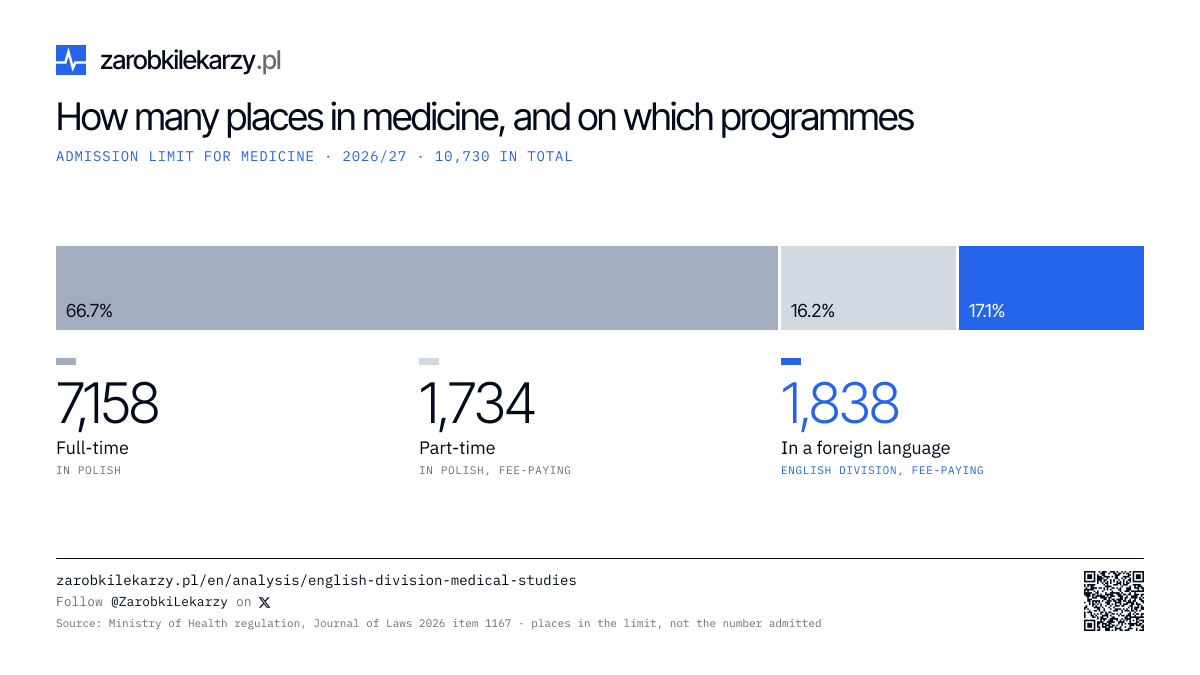
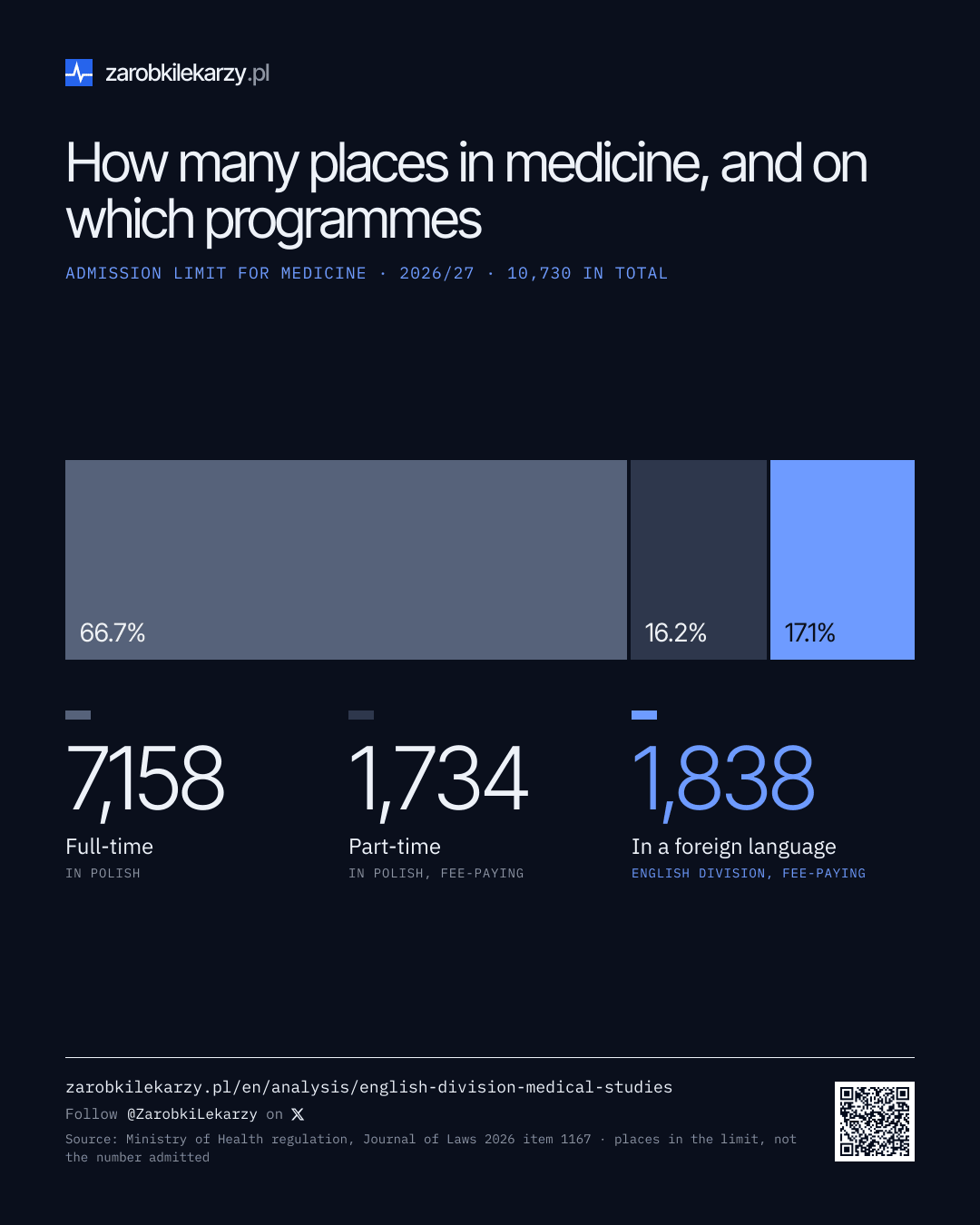
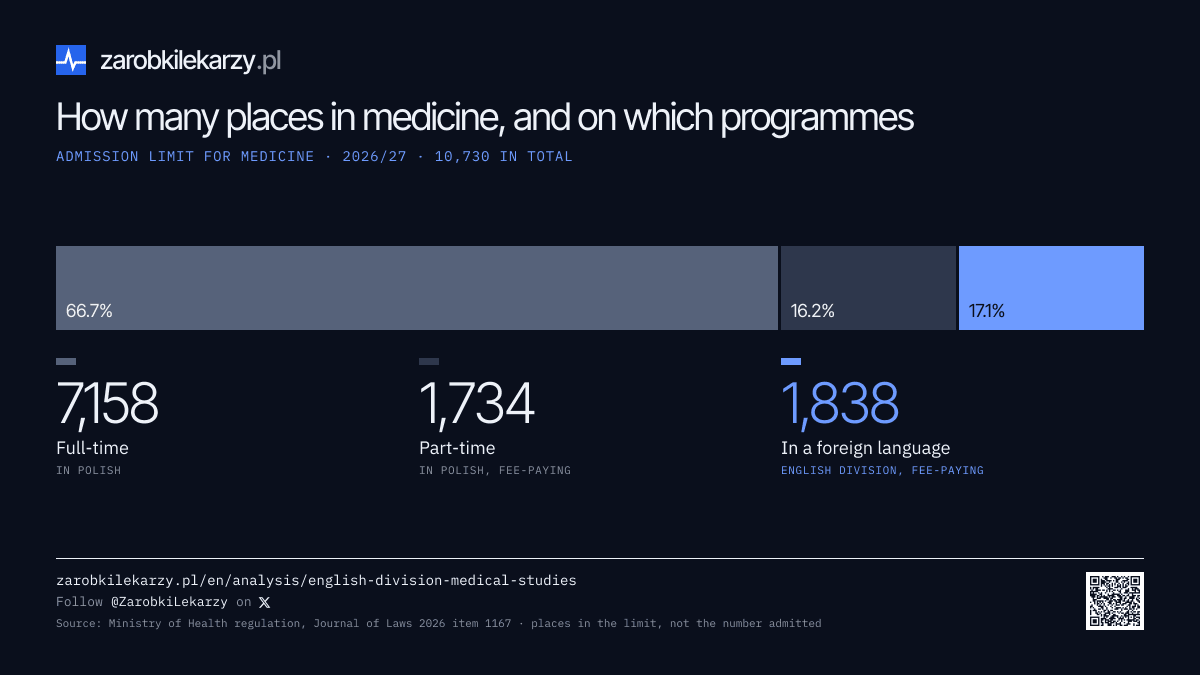
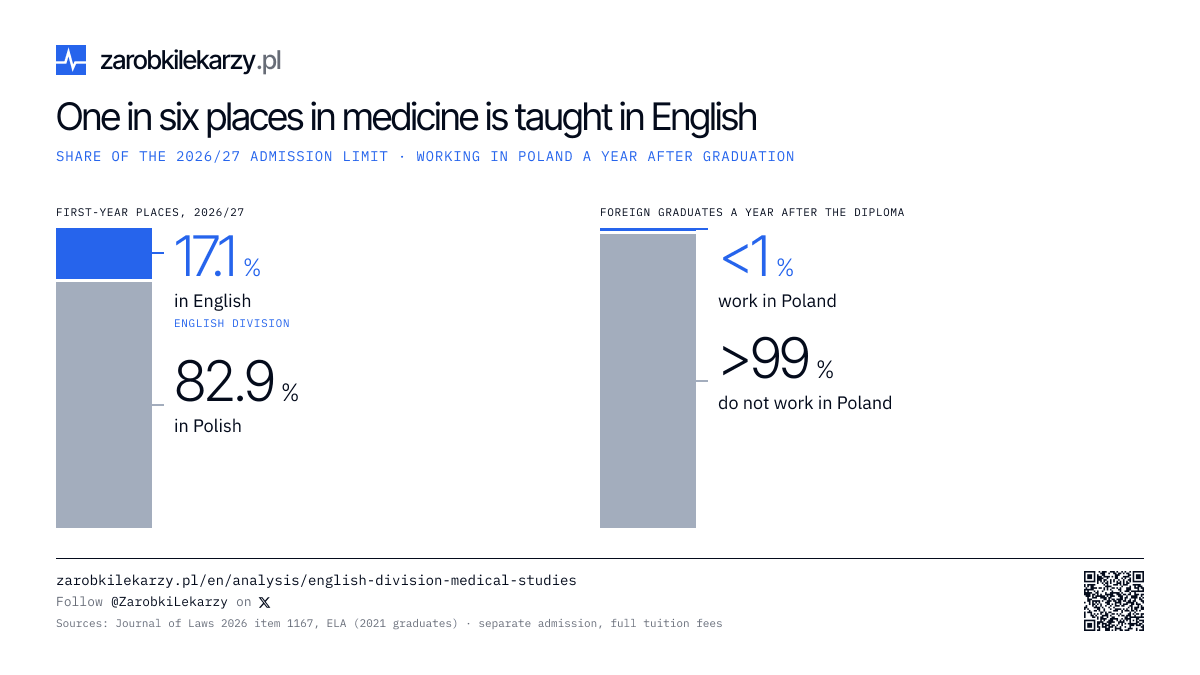
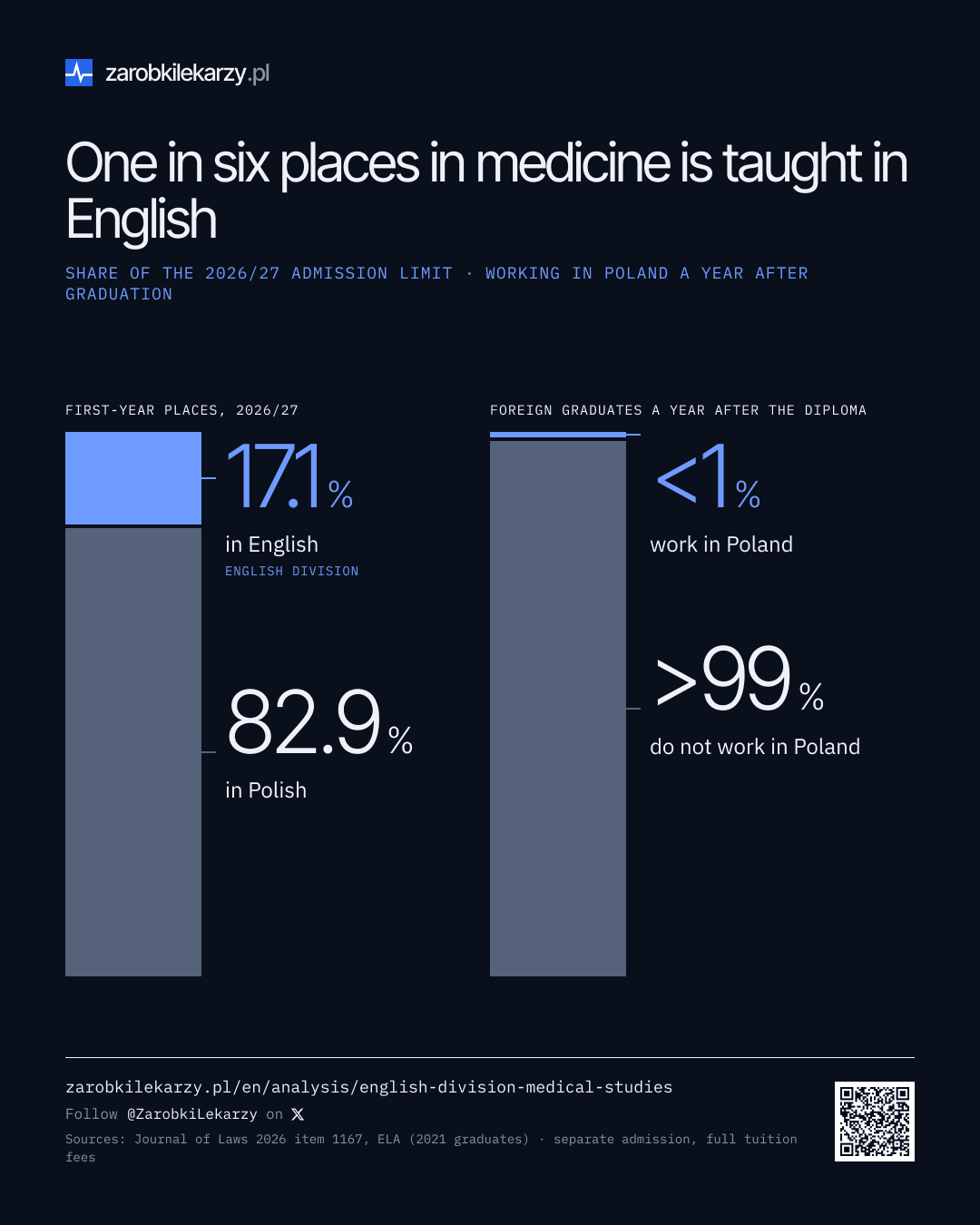
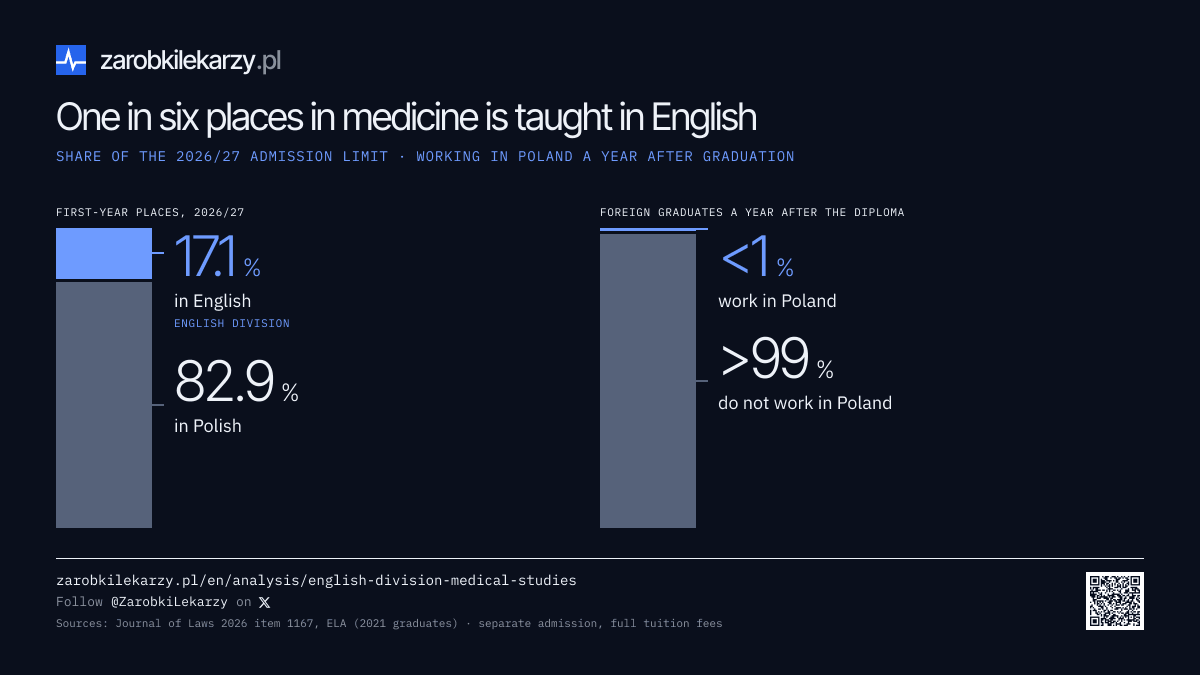
Admission to medicine (kierunek lekarski, the six-year medical degree programme) in Poland runs separately for programmes taught in Polish and programmes taught in a foreign language — in practice in English, commonly called the English Division. In the 2026/27 academic year the latter pool accounts for 1,838 of the 10,730 places in the admission limit (limit przyjęć), or roughly one place in six.1 Its students are mainly foreigners who pay full tuition fees and who, after graduating, usually do not work in Poland.
We look at how this pool has changed since 2012, how many of its graduates then take up work in Poland, what the degree costs and how much universities pay per hour of teaching in English. It is a legal, fee-paying educational service, and its prices and rates are published to the last zloty — unlike the amounts of the contracts on which most specialist doctors work (see Contract or employment).
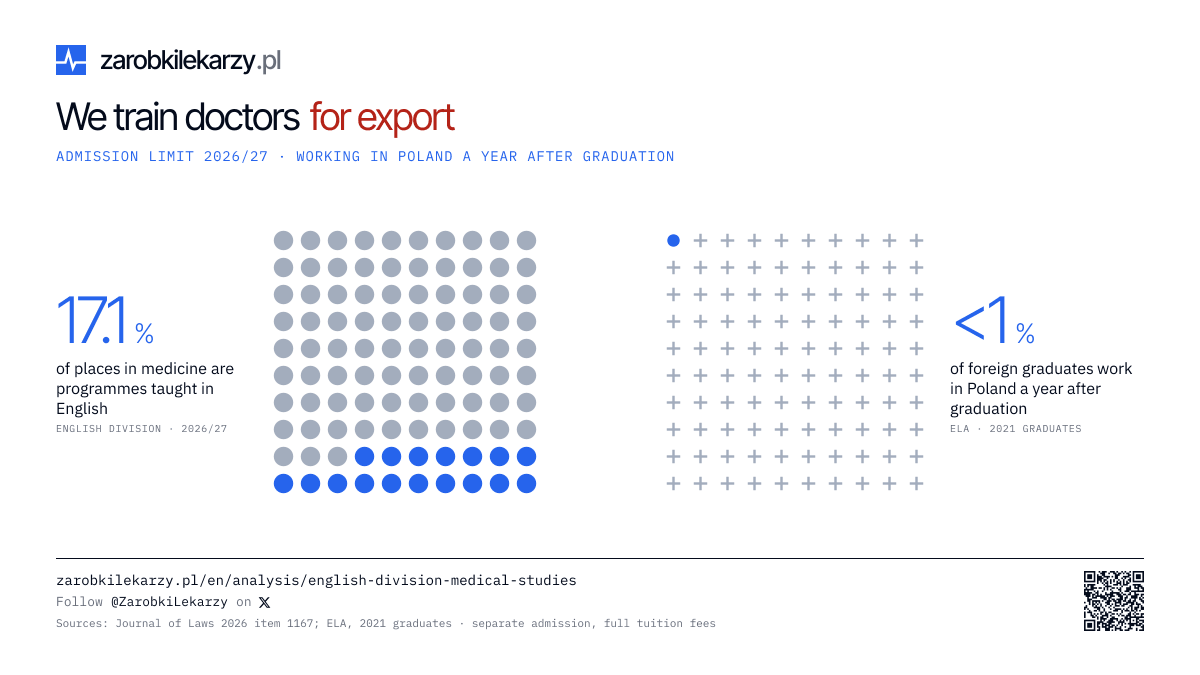
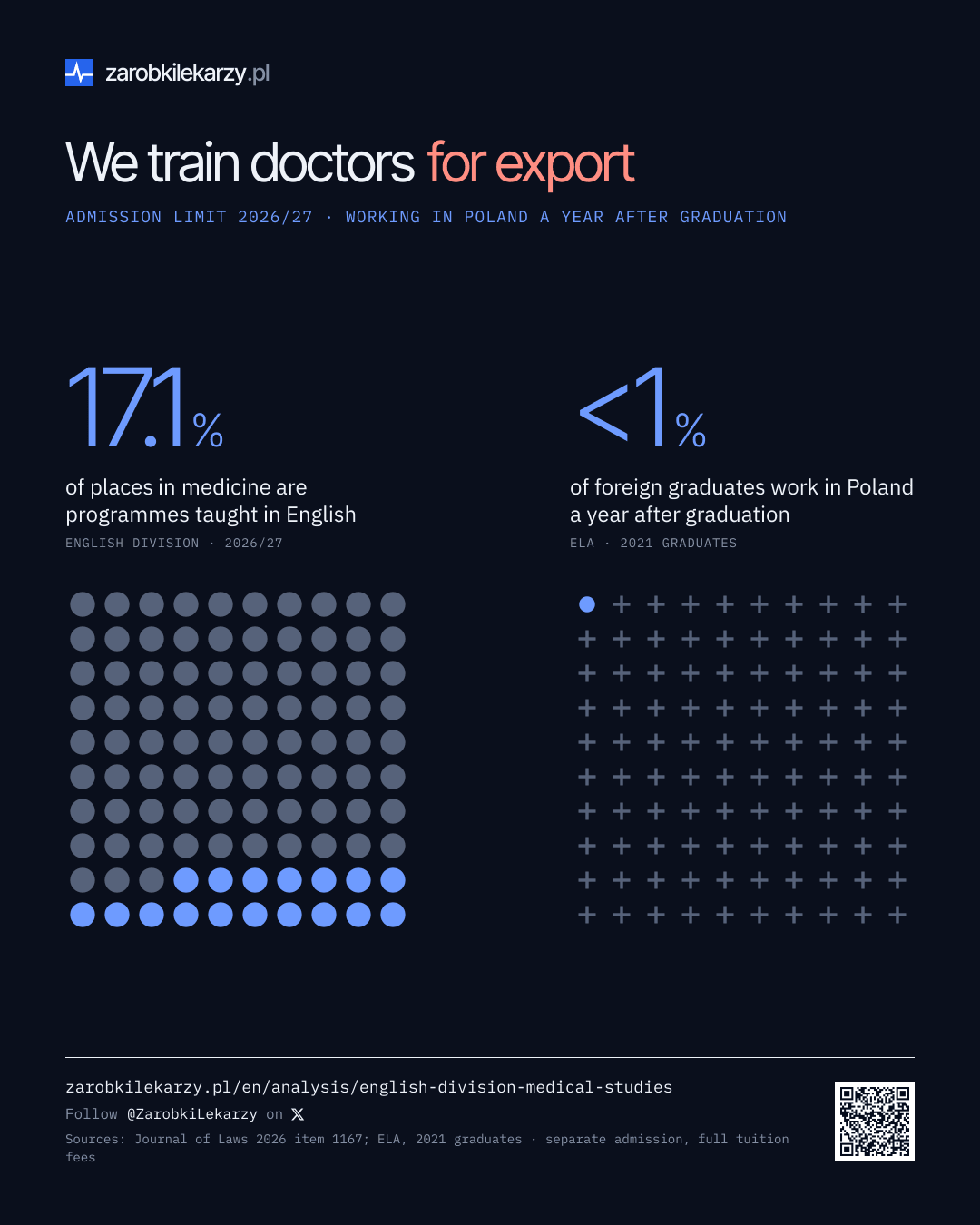
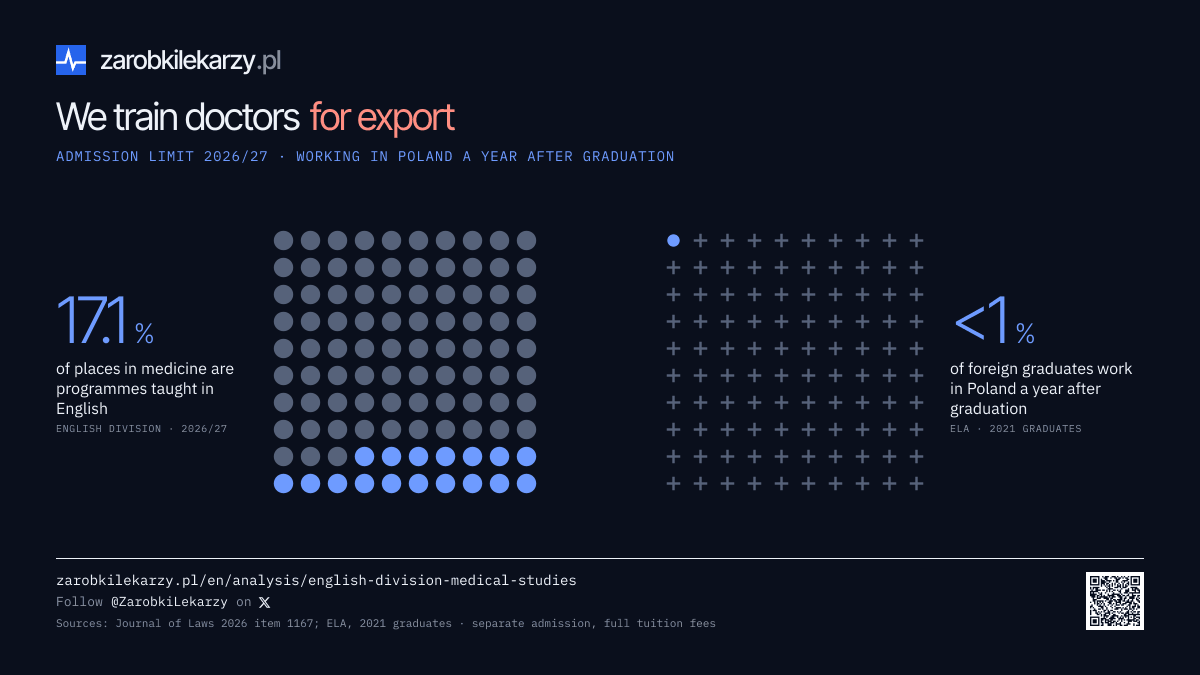
17.1%
of places in the admission limit for medicine in 2026/27 are in programmes taught in a foreign language — 1,838 of 10,730
<1%
of foreign graduates in medical and health sciences work in Poland one year after graduation (2021 graduates)
ExactELA, 8th round
485thousand PLN
is the cost of six years of medicine in English in Poznań for the 2026/27 intake (≈ €110,000) — the most in our compilation
A separate pool, a separate admission process
The admission limit for medicine is set every year by the Minister of Health in a regulation. Its annex lists each university and divides its places into four columns: full-time programmes in Polish (studia stacjonarne), separate places for foreigners on those programmes, part-time programmes in Polish (studia niestacjonarne) and programmes “in a language other than Polish”. The last column is the English Division.
Programmes in a foreign language have a separate admission process, and they are fee-paying for foreigners and Poles alike. That is why Konkret24, the fact-checking service of the TVN24 news channel, found two frequently repeated claims to be false: that foreigners take places from Polish candidates and that Polish taxpayers pay for their studies.2
Nor is the English Division only for foreigners. According to a report by the National Information Processing Institute (OPI PIB), foreigners make up 91% of students of medicine taught in a foreign language — the rest are Poles.3
How many places are in a foreign language
We added up the “in a language other than Polish” column across all universities in successive regulations, starting from the 2012/13 academic year.4
The foreign-language pool is 43% larger than in 2012/13, but has stayed at a similar level since 2017/18 — and its share of the limit has fallen from 24.8% to 17.1%
| Acad. year | Total limitfinal version, with amendments | In a foreign language | Share | Dz.U. |
|---|---|---|---|---|
| 2012/13 | 5,202 | 1,288 | 24.8% | 2012 item 864 |
| 2013/14 | 5,352 | 1,361 | 25.4% | 2013 item 986 |
| 2014/15 | 5,510 | 1,451 | 26.3% | 2014 item 1125 |
| 2015/16* | 6,188 | 1,551 | 25.1% | 2015 item 1119 |
| 2016/17 | 7,100 | 1,741 | 24.5% | 2016 item 982 |
| 2017/18 | 7,587 | 1,865 | 24.6% | 2017 item 1251 |
| 2018/19 | 8,014 | 1,891 | 23.6% | 2018 item 1381 + 1845 |
| 2019/20 | 8,170 | 1,892 | 23.2% | 2019 item 1344 + 1713 |
| 2020/21 | 8,309 | 1,967 | 23.7% | 2020 item 1272 |
| 2021/22 | 9,039 | 1,824 | 20.2% | 2021 item 1359 |
| 2022/23 | 9,481 | 1,879 | 19.8% | 2022 item 1655 + 2023 |
| 2023/24 | 10,289 | 1,829 | 17.8% | 2023 item 1322 + 2027 |
| 2024/25 | 10,065 | 1,839 | 18.3% | 2024 item 1085 + 1419 |
| 2025/26 | 10,504 | 1,888 | 18.0% | 2025 item 1086 |
| 2026/27 | 10,730 | 1,838 | 17.1% | 2026 item 1167 |
| Total | 121,540 | 26,104 | 21.5% |
Until 2017/18 the pool grew every year: from 1,288 to 1,865 places, or by 45%. Since then it has stayed within a narrow range of 1,824–1,967 places. In 2025/26 there were 1,888, 47% more than in 2012/13, and in 2026/27 — 1,838. Over the same period the Polish-language part grew much faster, from 3,914 to 8,892 places, more than doubling. That is why the share of programmes in a foreign language is falling: it was highest in 2014/15 (26.3%) and today stands at 17.1%.
Over 15 intakes the regulations contained a total of 26,104 places in a foreign language. These are places in the limits, not the number of students admitted or doctors trained: the limit sets the upper bound on admissions, and it is not known to what extent universities fill it.
We count the limit in its final version: the regulation together with the amendments issued in the same admission round. In five years amendments added places in Polish-language programmes, most in 2023/24 (from 9,804 to 10,289) and in 2024/25 (from 9,882 to 10,065); none of them changed the foreign-language column.4 The final versions for these two years were also given by the Ministry of Science and Higher Education in its reply to a parliamentary question (interpelacja).5 The same table is used in our analysis of cuts to admission limits for medicine.
Seventeen universities, the most places in Poznań
In 2026/27, 17 universities are admitting students to medicine taught in a foreign language. The largest pool is at Poznan University of Medical Sciences, ahead of Lublin and the Medical University of Warsaw.
Poznań has the most places in a foreign language: 220 of 1,838
A year earlier the pool was 50 places larger. It was reduced most by the Silesian Academy (from 130 to 60 places) and Andrzej Frycz Modrzewski Krakow University (from 80 to 40). It was increased above all by Lublin (from 170 to 200), the Medical University of Gdańsk (from 50 to 72), and Poznań and the Medical University of Warsaw (by 20 places each).6
How many graduates then work in Poland
Graduates’ careers are tracked by a state system, Economic Careers of Graduates (Ekonomiczne Losy Absolwentów, ELA). It links diploma data from the POL-on higher education information system with the records of the Social Insurance Institution (ZUS), so it sees everyone who, after graduating, works in Poland as an employee or runs a business. A graduate who works only abroad does not appear in these records.7
According to the 8th round of ELA, in 2021 foreigners accounted for more than 17% of graduates of medical programmes, i.e. future doctors and dentists. Of foreign graduates of long-cycle master’s programmes (jednolite studia magisterskie) in medical and health sciences, fewer than 1% were working in Poland one year after graduation.8
Who are these students? The largest group of foreigners studying medicine comes from Norway (17.5%), followed by India, Germany, Ireland, Taiwan and Sweden — these six countries account for 51.7% of the total.3 Norway funds its citizens’ studies abroad.2 Graduates of such programmes may take the Medical Final Examination (Lekarski Egzamin Końcowy, LEK) in the language in which they studied — as provided by the Act on the professions of physician and dentist, as worded by a 2020 amendment.9
How to read the total limit
The total limit — 10,730 places in 2026/27 — includes the foreign-language pool. Programmes in Polish have 8,892 places.1 When the question is how many doctors will join the Polish system, the second number is a better starting point, because only a fraction of foreign graduates work in Poland.
This is also how the authors of forecasts of a doctor surplus count. An analysis published by the Supreme Medical Chamber (NIL) in June 2024, according to which “we are heading towards a significant surplus of doctors” (our translation), was based on about 7,800 places in Polish-language programmes.10 The Ministry of Health, writing about the forecast surplus of doctors by 2034, gives the number of graduates of Polish nationality: 4,755 in 2023/24.11 Anyone who sets the total limit against such forecasts should therefore subtract the foreign-language pool from it — otherwise they are comparing two different quantities.
The split by language, however, is not a split by citizenship. About 9% of students in a foreign language are Poles, and foreigners also study in Polish-language programmes — in 2026/27 the limit provides 107 separate places for them.1 How the limits translate into the number of doctors over the coming decades is shown by the doctor supply simulator (in Polish).
What the degree costs
Programmes in English are fee-paying from the first year. Universities publish tuition fees on their websites, usually separately for each intake and in advance for the whole programme.
Six years of medicine in English cost from PLN 385,000 to PLN 485,000
| University | Annual fee | Whole programme (6 years) | Source |
|---|---|---|---|
| Poznan University of Medical Sciences | PLN 71,000 (≈ €16,100) (years 1–2), PLN 85,750 (≈ €19,500) (years 3–6) | PLN 485,000 (≈ €110,000) | university website |
| Wroclaw Medical University | PLN 67,900 (≈ €15,400) | PLN 407,400 (≈ €92,500) | university website |
| Medical University of Silesia | PLN 65,500 (≈ €14,900), 2 × PLN 32,750 | PLN 393,000 (≈ €89,200) | university website |
| Medical University of Gdańsk | PLN 64,200 (≈ €14,600) | PLN 385,200 (≈ €87,400) | university website |
| Jagiellonian University | €16,000 | €96,000 | university website |
Prices are rising. In Poznań the 2025/26 intake pays PLN 442,000 (≈ €100,000) for the whole programme, and the 2026/27 intake PLN 485,000 (≈ €110,000), 9.7% more.12 Jagiellonian University has published fees for successive intakes since 2019/20: they rose from €14,000 to €16,000 a year, or by 14.3% in seven years.13
How much money this means for universities
How much universities earn from programmes in English cannot be seen in public financial reports. One example: in Wroclaw Medical University’s report on the execution of its material and financial plan for 2020, tuition fees fall under a single item — fees for educational services. They amounted to PLN 69.7 million (≈ €15.8 million) out of PLN 301.2 million (≈ €68.4 million) of operating revenue, or about 23%.14
This item, however, covers all fee-paying programmes, including part-time programmes in Polish and postgraduate studies, so it is not known how much of it is tuition for programmes in English. It is the most recent report from this university with a breakdown of revenue that we have found.
A nationwide estimate
About 6,300 foreigners study medicine — 6.0% of the 105,090 foreigners studying in Poland (the report counts each programme studied separately), according to 2024 data.3 If each of them paid the tuition for programmes in English, from PLN 64,200 (≈ €14,600) (Gdańsk) to PLN 71,000 (≈ €16,100) (Poznań) a year, universities would collect from PLN 0.40 billion (≈ €91.9 million) to PLN 0.45 billion (≈ €102 million) a year.
This assumption inflates the result. Some foreigners study in Polish, and there the university may, but does not have to, charge them fees; some groups, including citizens of the European Union and people with permanent residence, are exempt.2 On the other hand, the result is lowered by Poles, who make up about 9% of students in a foreign language and also pay, and by higher fees in later years at some universities. The result is therefore an order of magnitude — about PLN 0.4 billion (≈ €90.8 million) a year — and not an amount from financial reports, because nobody publishes such an amount.
How much universities pay per hour of teaching in English
Programmes in English also affect the pay of teaching staff. For a teaching hour in a programme in English universities pay more than for comparable classes in Polish, and they set the rates in rectors’ orders (zarządzenia rektora) and pay regulations.
At the Medical University of Warsaw (WUM) both rates — for classes in English-language programmes and in part-time programmes in Polish — are set by the same rules for awarding additional pay from the university’s own revenue, which include tuition fees: the first in annex 1, the second in annex 2.15 This is the same category of pay — an allowance for teaching in fee-paying programmes — which is why we compare the two. We do not compare them with the rate for an overtime hour in full-time programmes in Polish, because that is a different kind of pay, which depends on the post.
At WUM the rate for an hour of lecturing in English can be up to 2.08 times higher than in part-time programmes in Polish
| Programme | Lecture | Seminar | Classes | Source |
|---|---|---|---|---|
| English-language (maximum rate) | PLN 250 | PLN 150 | PLN 90 | annex 1 |
| Part-time in Polish | PLN 120 | PLN 74 | PLN 65 | annex 2 |
| Ratio | 2.08× | 2.03× | 1.38× | — |
It is clearest at the Medical University of Lublin. Its pay regulations set the rate for an overtime hour according to the post, and separately an allowance for teaching English-language students: PLN 60 (≈ €14) on top of every lecture hour and PLN 50 (≈ €11) on top of other overtime classes, and within the teaching load (pensum) — PLN 60 (≈ €14) and PLN 40 (≈ €9). The same teacher gets more for the same hour solely because of the language. For supervising a thesis in a foreign language the rate is doubled.16
In Lublin an overtime hour in English pays PLN 50–60 more for every post
| In Polish | Lecture in English | Other classes in English | |
|---|---|---|---|
| Professor | PLN 98 | PLN 158 | PLN 148 |
| University professor, assistant professor with habilitation | PLN 83 | PLN 143 | PLN 133 |
| Assistant professor | PLN 69 | PLN 129 | PLN 119 |
| Assistant, junior assistant | PLN 54 | PLN 114 | PLN 104 |
What is public and what is not
Programmes in English are a rare case in which the money around the medical profession is visible almost in full. The number of places at each university is announced in a regulation, the price by the university, and the hourly teaching rate in an order or pay regulations. One figure is missing: how much universities earn from these programmes in total.
Public to the last zloty
- The limit of places in a foreign language at each university — regulation of the Minister of Health
- Tuition fees for each intake, in advance for six years — university websites
- The hourly rate for teaching in English — rectors’ orders and pay regulations
- Universities’ revenue from tuition fees — reports in the Public Information Bulletin (BIP), though not always with a full breakdown
Not visible
- What part of tuition revenue comes from English Division fees
- The amounts of doctors’ contracts in public hospitals
- Total payments from public money to one person, from all payers together
This asymmetry is one of the reasons for our proposal: open pseudonymised data, i.e. the total paid to each person from public money, under a permanent identifier, without names. The universities’ rates show that pay from a public institution can be described to the last zloty — on the side of contracts, there is no such transparency today.
Notes 16laws, data and statements we relied on
-
Regulation of the Minister of Health of 28 August 2026 on the admission limit for medicine and dentistry, Dz.U. 2026 item 1167 (in Polish), annex 1. Totals across 39 universities — our calculations: 1,838 places in a foreign language, 8,892 in Polish, including 107 places for foreigners in full-time programmes. ↩ ↩2 ↩3
-
Konkret24 (TVN24), fact-check of claims about foreigners at medical schools (in Polish), 20.10.2024: separate admission, fees for programmes in English and in Polish, fee exemptions, Norway’s funding of its citizens’ studies abroad. ↩ ↩2 ↩3
-
OPI PIB, “Cudzoziemcy na uczelniach w Polsce 2024” (“Foreigners at higher education institutions in Poland 2024”, in Polish), POL-on data as of 1.07.2025: 91.0% foreigners among students of medicine in a foreign language; medicine accounts for 6.0% of the 105,090 foreigners; Norway 17.5%, six countries together 51.7%. ↩ ↩2 ↩3
-
Successive regulations of the Minister of Health on the admission limit for medicine and dentistry, annex 1 (medicine), in their final version — with the amending regulations from the same admission round: Dz.U. 2018 item 1845, 2019 item 1713, 2022 item 2023, 2023 item 2027 and 2024 item 1419 (in Polish). The table links to each act. We re-checked the totals for 2015/16, 2019/20 and 2023/24–2026/27 in the text of the acts on 15.10.2026, and the amendments on 16.10.2026. ↩ ↩2
-
Ministry of Science and Higher Education, reply to parliamentary question No. 9177 (in Polish), 28.04.2025 — limit for medicine: 10,289 places in 2023/24 (Dz.U. 2023 items 1322 and 2027) and 10,065 in 2024/25 (Dz.U. 2024 items 1085 and 1419), broken down into four types of programme. ↩
-
Regulation of the Minister of Health of 7 August 2025 on the admission limit for medicine and dentistry, Dz.U. 2025 item 1086 (in Polish), annex 1. ↩
-
ELA, study description — 10th edition (in Polish), 2025: data sources (ZUS and POL-on registers) and the reasons why a graduate may be absent from ZUS records, including working only abroad. ↩
-
Ekonomiczne Losy Absolwentów, “Absolwenci obcokrajowcy na polskim rynku pracy” (“Foreign graduates on the Polish labour market”, in Polish), data from the 8th round of monitoring (2021 graduates). ↩
-
Act of 16 July 2020 amending the Act on the professions of physician and dentist and certain other acts, Dz.U. 2020 item 1291 (in Polish) — new wording of Article 5(4) of the Act on the professions of physician and dentist. ↩
-
Supreme Medical Chamber (NIL), analysis of admission limits and the cost of training doctors (in Polish), 11.06.2024. The page states that the analysis is not an official position of the Supreme Medical Council. ↩
-
Ministry of Health, Kształcenie i liczba lekarzy — trendy i wyzwania (“Medical education and the number of doctors — trends and challenges”, in Polish), 7.11.2025. ↩
-
Poznan University of Medical Sciences, tuition fees for English-language programmes — tables for the intakes admitted in 2025 and 2026. ↩
-
Jagiellonian University, Medical School, tuition fees by year of admission. ↩
-
Wroclaw Medical University, material and financial plans and reports in the Public Information Bulletin (BIP) (in Polish): report on the execution of the plan for 2020, annex to University Council resolution No. 8/2021 — fees for educational services PLN 69,743.4 thousand, operating revenue PLN 301,165.6 thousand. ↩
-
Medical University of Warsaw, Rector’s Order No. 36/2017 as amended: annex 1 — English-language programmes, annex 2 — part-time programmes (in Polish; annexes to the rules for awarding additional pay from the university’s own revenue). ↩
-
Medical University of Lublin, annexes to the pay regulations (in Polish), consolidated text of 18.01.2021: annex 5 (overtime hours), annex 6 (allowances for teaching English-language students), annex 7 (thesis supervision). ↩
Infographics to download
3 graphics · portrait and landscape, light and dark
Graphics to share in two formats — portrait 1080×1350 (Instagram, Facebook, X) and landscape 1200×675 (X, LinkedIn, presentations) — light and dark. The sources, the page address and a QR code to the page are on the graphic.
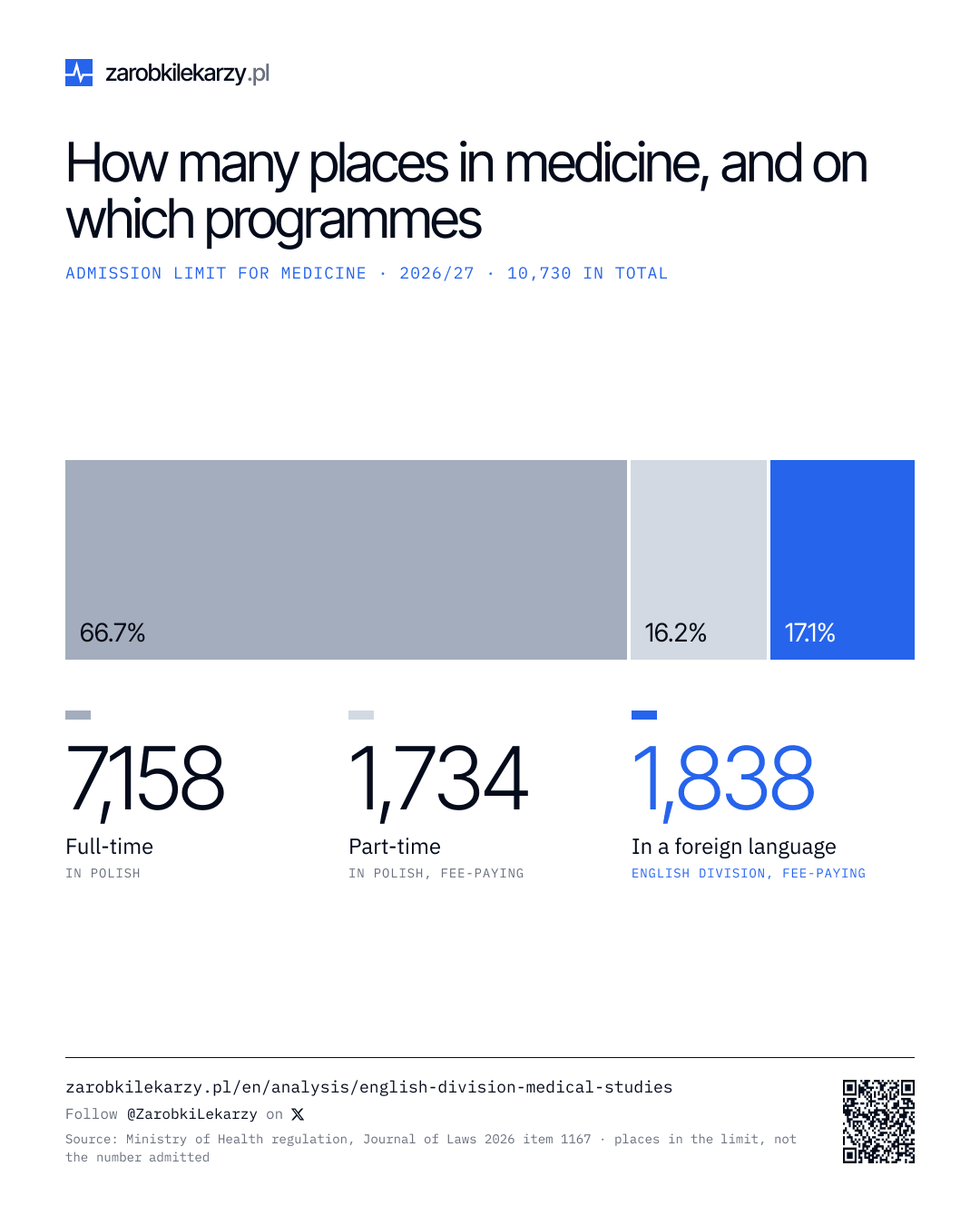
How many places in medicine, and on which programmes
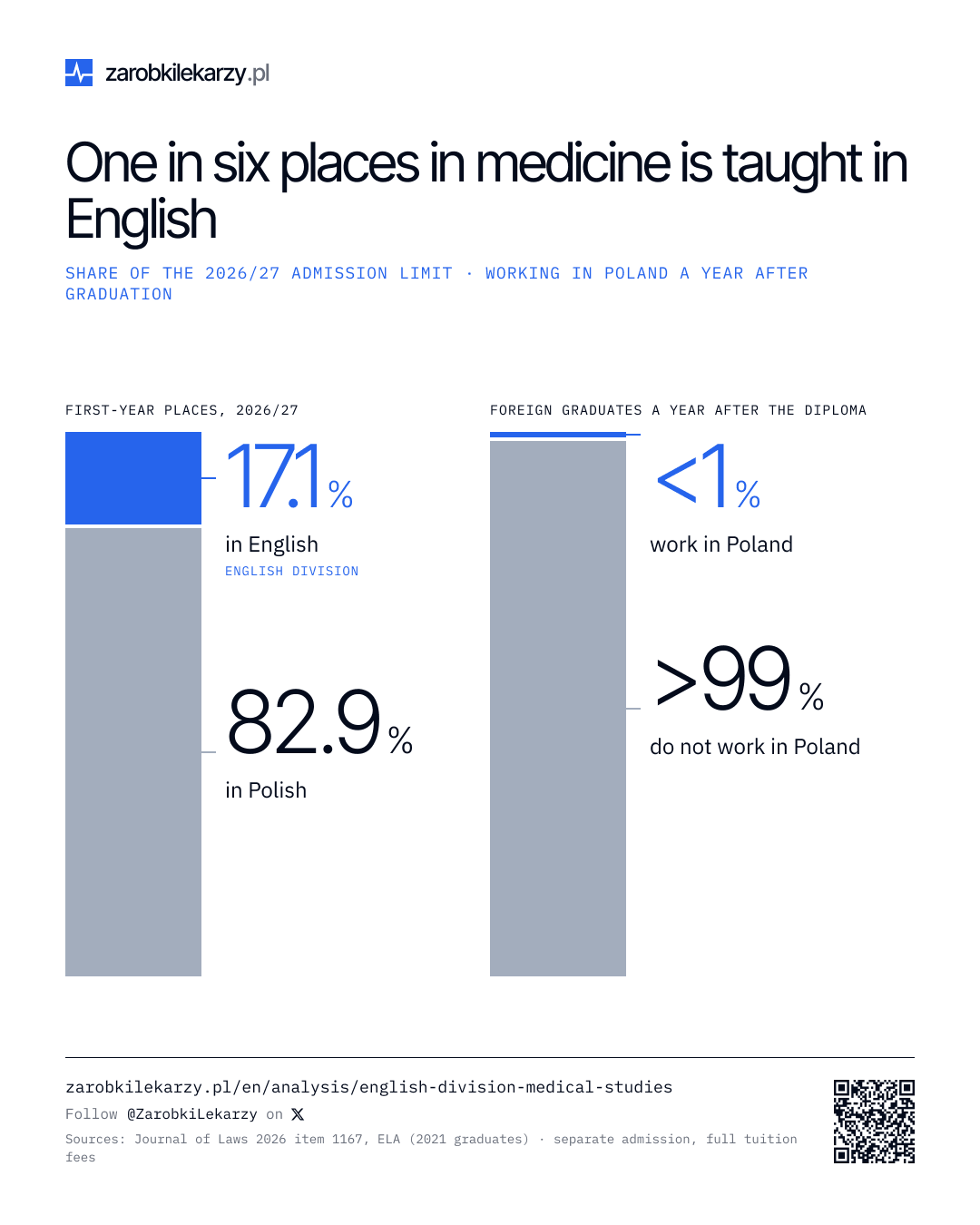
One in six places in medicine is taught in English
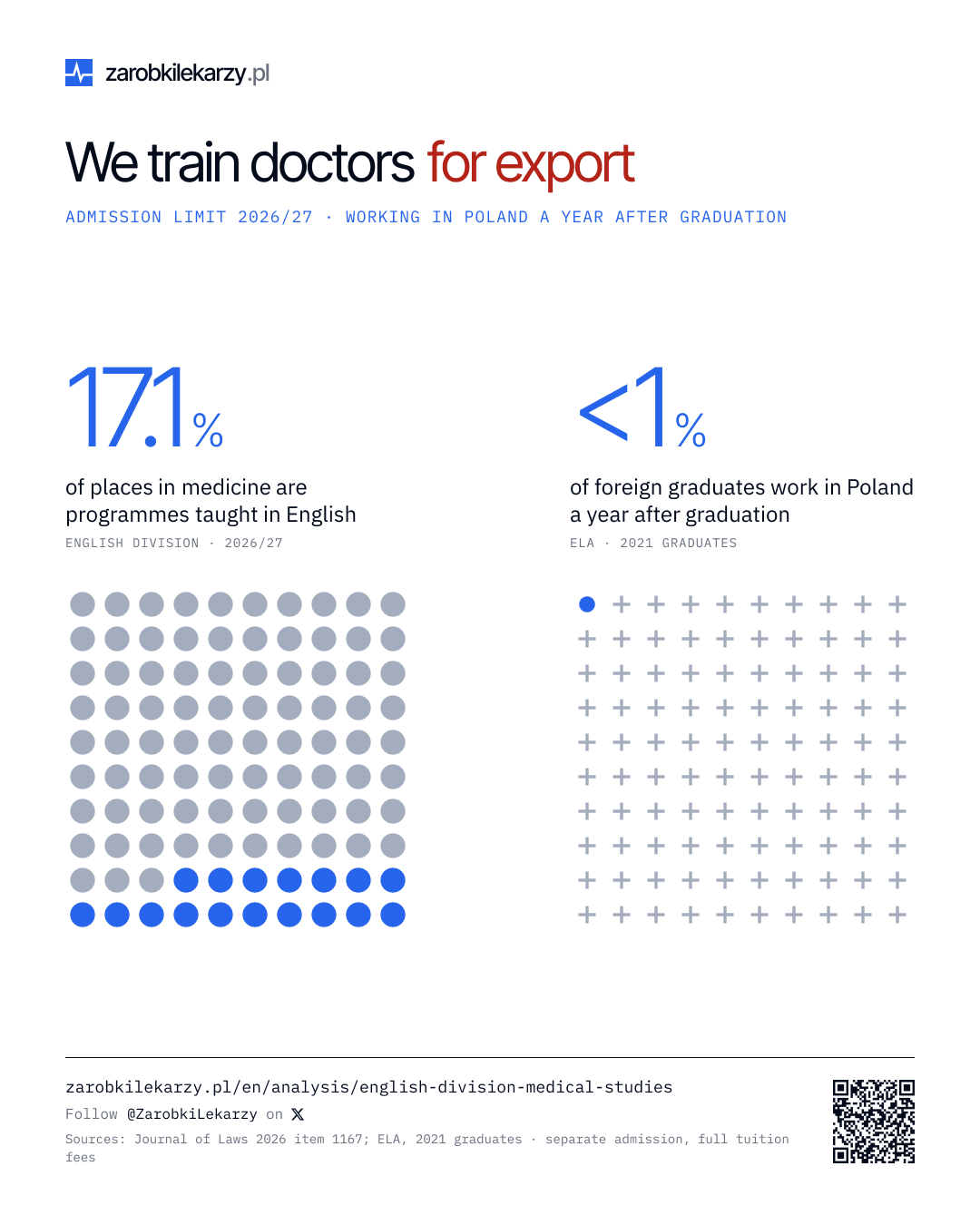
We train doctors for export