How many new doctors there will be, and in which fields, is not decided by a single institution. Between the secondary-school leaving exam and the title of specialist there are at least four gates: medical school, the licence to practise, a specialisation place and a supervisor who will oversee the training. Each is guarded by someone else, with a different instrument.
This text describes those gates — who sets them and on what basis. Why doctors are in short supply despite growing limits, and how many specialisation places remain empty, we show in our analysis Why Poland is short of doctors.
10,730places
in the limit of admissions to medicine for 2026/27, set by a regulation of the minister of health
3doctors
can be trained at the same time by one specialisation supervisor; four — exceptionally, with the consent of the national consultant
34of 533
voivodeship–field pairs had, in spring 2025, a lowest score of a person admitted to residency of at least 90% of the points
Who guards which door
Most of the rules are laid down in the Act on the professions of doctor and dentist, and the rules for creating study programmes in the Law on higher education.12 The table shows who decides at successive stages.
The state sets the limits; the medical self-government mainly gives opinions
| Who decides | Instrument | |
|---|---|---|
| New medical programme | Minister of science; the Polish Accreditation Committee (PKA) gives an opinion | Permission to run the programme |
| Places at medical school | Minister of health; the medical self-government gives an opinion on the draft | Annual regulation with a limit for each university |
| Licence to practise | Regional medical council | Grant of the licence after the diploma, the postgraduate internship and the Medical Final Examination (LEK) |
| Residency places | Minister of health | Allocates places by field and pays the resident’s salary from the state budget |
| Training facility | Director of the CMKP on the basis of an opinion of an expert team | Accreditation and a maximum number of training places for 5 years |
| Specialisation supervisor | Head of the facility appoints; the national consultant agrees to an exception | At most 3 trainees at a time, exceptionally 4 |
| Order of candidates | Director of the CMKP, through the voivodes | Ranking by score as a percentage of the maximum number of points |
| Diploma from outside the European Union | Regional medical council; in the simplified procedure the minister of health | Recognition of the diploma or the LEW examination; the minister’s consent for a specified scope, period and place |
In this arrangement the medical self-government has no right of veto over the limits. It gives opinions on draft regulations, and by virtue of the act it acts in two places: regional medical councils grant the licence to practise to people who meet the statutory conditions, and the Supreme Medical Council (NRL) proposes one of the five members of the teams assessing facilities that want to train specialists.1
Medical school: the minister of health sets the limit
How many people may begin studying medicine is set every year by the minister of health in a regulation, separately for each university. For the 2026/27 academic year it is 10,730 places, 226 more than a year earlier, when the limit was 10,504.34 The limit is an upper bound on admissions, not the number of people admitted. How it has grown over the last decade and why more places do not immediately mean more doctors, we describe in our analysis Why Poland is short of doctors.
In June 2026 the deputy minister of health said that the limit no longer needs to be increased and that in the coming years it may even fall.5 There is no shortage of applicants: for medicine at Adam Mickiewicz University in Poznań, the July 2026 recruitment had more than 22 candidates per place — the most of any programme at that university.6 This is the result of one university, not a national average.
New programmes: the minister’s permission and the PKA opinion
Since an amendment of November 2021, doctors may also be educated by universities that do not have academic status. Permission for a new programme is issued by the minister responsible for higher education, and the quality of education is assessed by the Polish Accreditation Committee (PKA). Its opinion was not binding on the minister: in 2022–2023 17 universities received permission, 11 of them without a positive PKA opinion, and nine started teaching despite a negative opinion.2 These are numbers of universities, not of programmes.
The second gate is the limit set by the minister of health. In the regulation for 2024/25 nine universities received no places,2 and in the draft for 2025/26 the ministry left out six universities without a positive PKA opinion.7 Whether the new programmes educate worse than the older ones, we examine in our analysis Who drops out of medicine and who leaves the country.
The position of the self-government
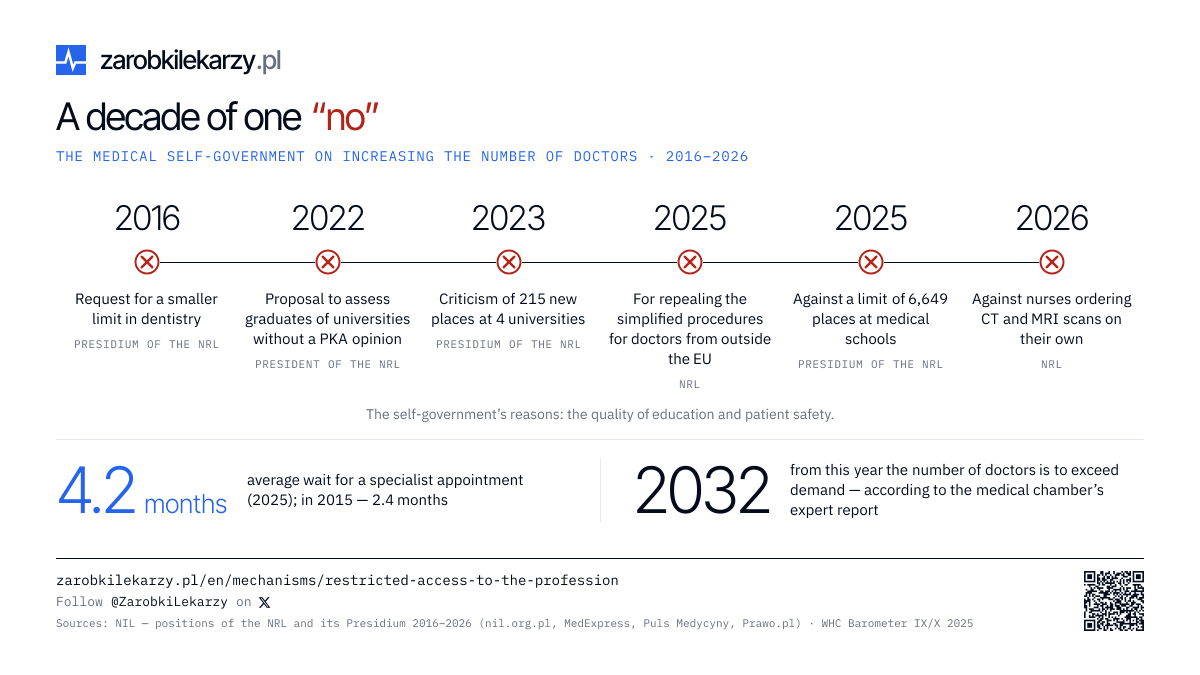
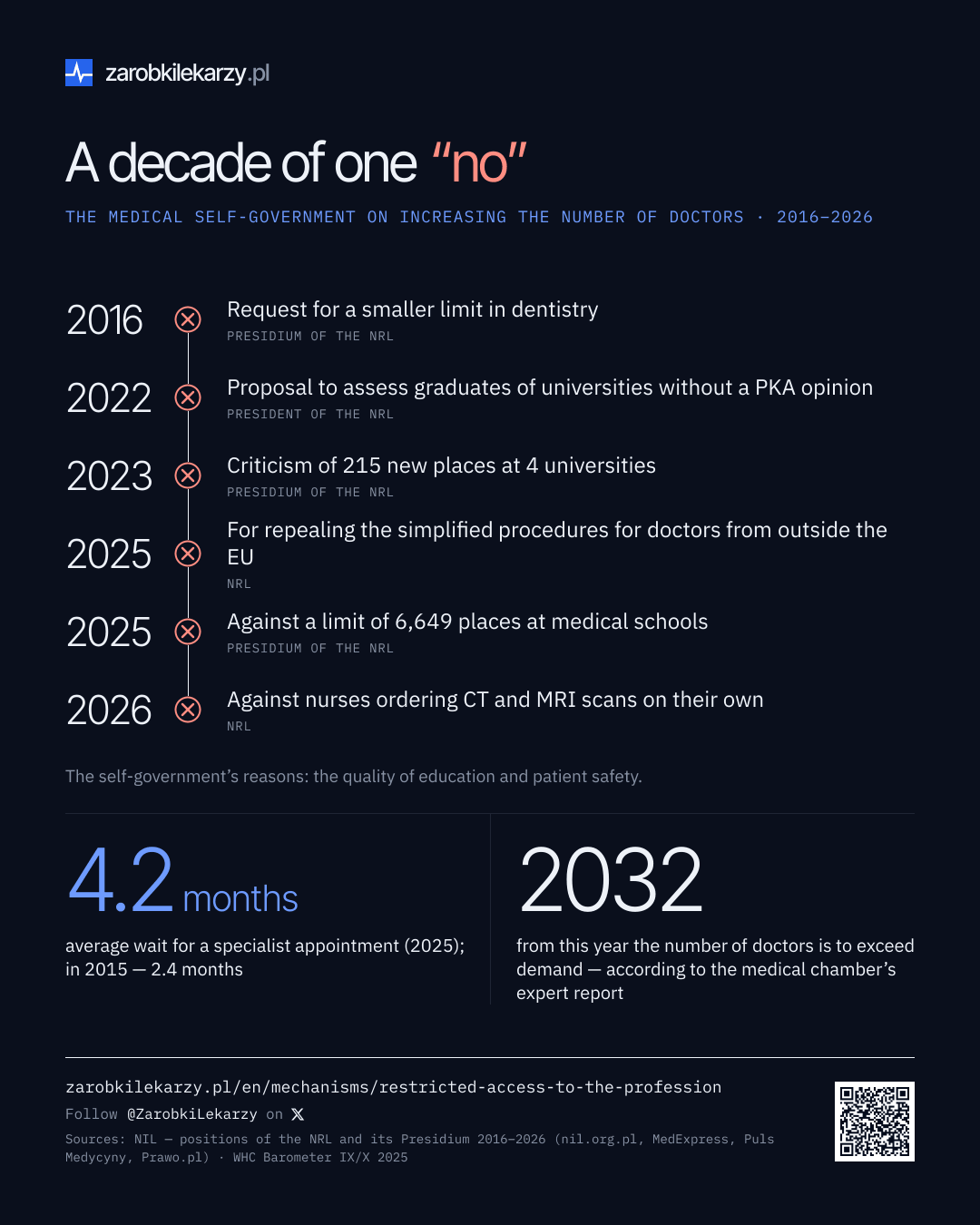
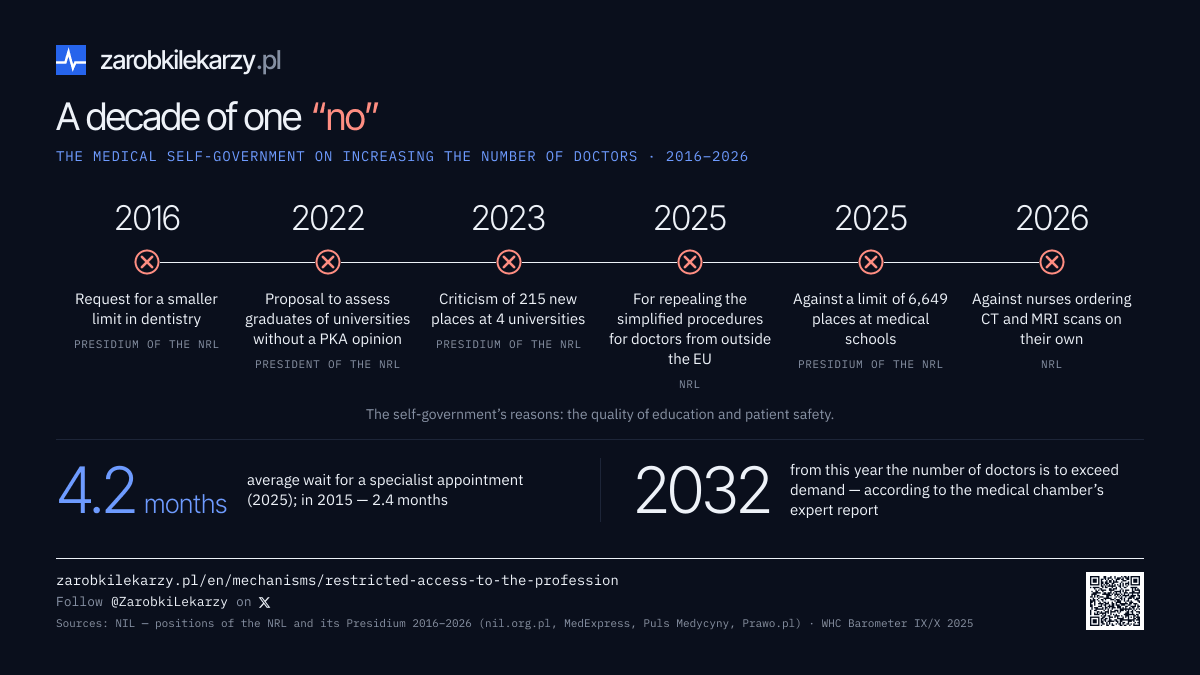
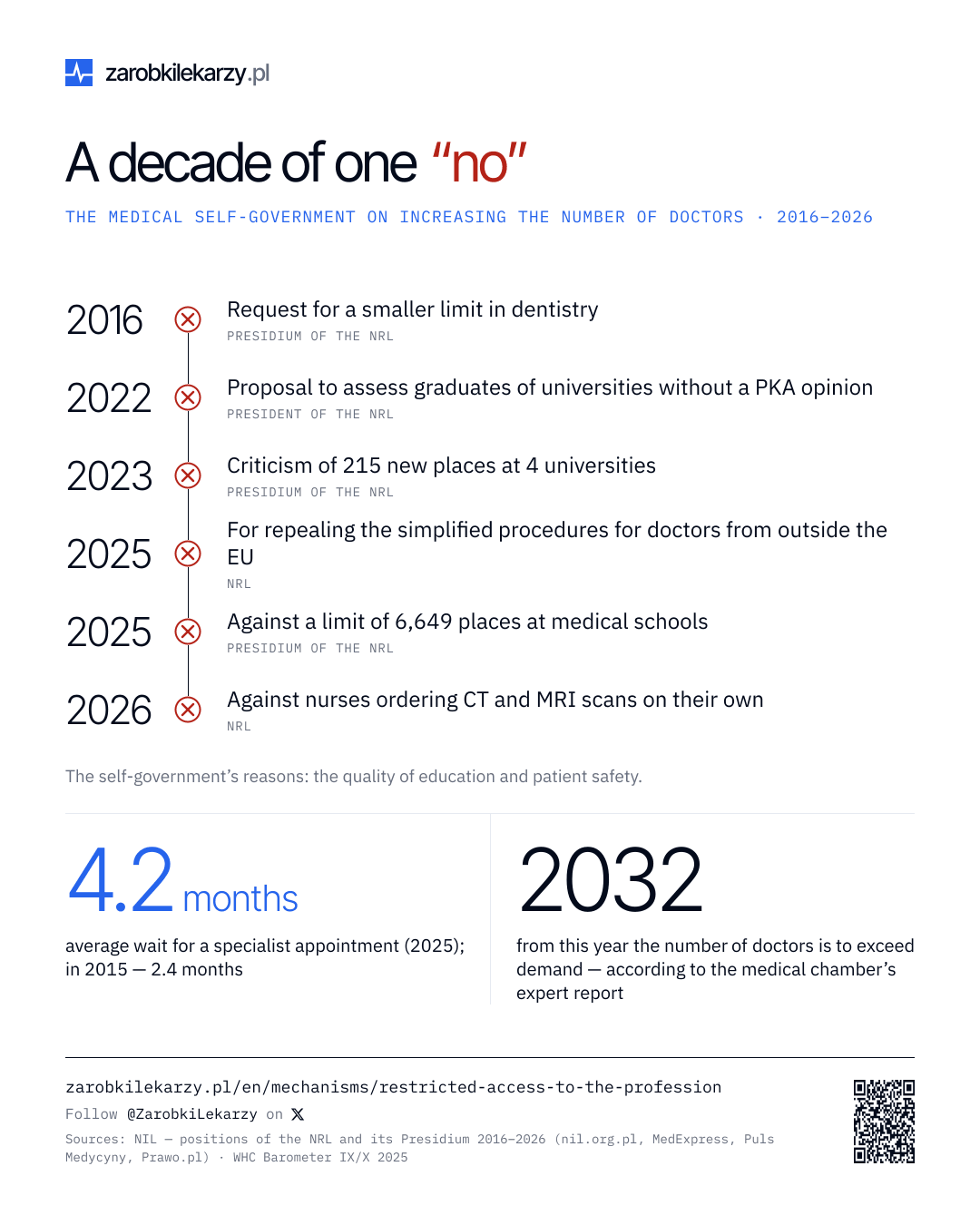
The medical self-government opposes increasing admissions outside the universities it considers proven. In June 2025 the Presidium of the Supreme Medical Council criticised the draft limit, which provided for 6,649 places on full-time medical programmes taught in Polish, about 200 more than a year earlier. It cited concern for the standard of education and patient safety, an expert report commissioned by the chamber according to which the number of doctors will exceed the demand for services in 2032, and the claim that waiting lists result largely from the inefficiency of the system.8
In June 2026, after reports of possible corruption in the issuing of PKA opinions on new programmes, the Presidium demanded the replacement of the committee’s entire membership and the re-accreditation of all medical universities, especially newly opened ones.9 The argument about quality is supported by negative opinions of the PKA itself.2 The forecast of a surplus of doctors, on the other hand, is a claim of the chamber’s expert report. How it compares with the ministry’s forecast and with data on waiting lists, we describe in our analysis Why Poland is short of doctors.
The self-government has not always spoken of a surplus. In October 2019 the vice-president of the Supreme Medical Council estimated in a press interview that Poland was short of about 68,000 doctors. As the basis he gave a recalculation of data from the Central Register of Doctors, without describing the method. The then minister of health spoke of “a methodology unknown to me” (our translation), although he admitted that there were too few doctors; the vice-president himself also referred to the shortfall of 50,000 officially cited at the time.10 The same text gave a ratio of 2.4 doctors per 1,000 population. It came from GUS data for 2010, calculated using the old method.11 According to the OECD, in 2023 Poland had 3.9 practising doctors per 1,000 population, compared with an EU average of 4.3.12 We describe the definitions and the change in counting method in our analysis Why Poland is short of doctors.
Specialisation: three limits on one place
After the postgraduate internship and the Medical Final Examination (LEK), a doctor applies for a specialisation. Here the number of places is determined by three limits, set by different institutions:
- The pool of residencies. Residency places in particular fields are allocated by the minister of health, who also pays the resident’s salary from the state budget. The remaining vacant places in accredited facilities are non-residency places — the doctor’s work is then paid for by the facility.1
- Accreditation of the facility. Only a unit entered on the list of the director of the Centre of Postgraduate Medical Education (CMKP) may provide training. It must have, among other things, a ward of the right profile, equipment, a sufficient number of services and at least one specialist who agrees to be a specialisation supervisor. The application is assessed by a five-member team: the chair and one member are proposed by the national consultant, one each by the scientific society and the Supreme Medical Council, and the fifth member is a representative of the consultant. The director of the CMKP enters the facility on the list and sets its maximum number of training places for five years.1
- The specialisation supervisor. Every doctor in training has a supervisor with a second-degree specialisation or the title of specialist in the field. One supervisor may oversee at most three doctors at a time, and in cases justified by staffing needs, with the consent of the national consultant, four. The same limit applies to an internship supervisor, and a specialisation supervisor may additionally oversee a specialty placement of at most two doctors. For supervision the supervisor receives an allowance: PLN 500 (≈ €113) a month for one doctor and PLN 1,000 (≈ €227) for more than one, from the voivode’s budget.1
A facility therefore cannot have more doctors in training at once than four times the number of its specialisation supervisors, nor more than its accreditation allows. The act also provides for adjustments in both directions: when a facility with vacant places does not admit a doctor referred to it, the voivode (the government’s regional representative) applies for its limit to be reduced, and when a field lacks training places, the minister of health may ask a hospital to apply for accreditation.1 How often the limit of supervisors or of accreditation actually closes the path to specialisation cannot be checked in the data we have been able to access.
Overall there are more places than applicants, and the places that remain empty are mainly non-residency ones: in spring 2026 nobody confirmed admission to 52% of residency places and 89% of non-residency places.13 We describe successive sessions and the reasons for this difference in our analysis Why Poland is short of doctors. In the fields for which candidates compete most fiercely, entry is therefore decided by the pool of residencies, the places in accredited facilities and the ranking.
At the end of the training there is no longer any limit on places. The written part of the State Specialisation Examination (PES) is passed by everyone who scores at least 60% of the points,1 and in 2016–2025 between 73.0% and 80.6% of attempts passed it each year.14 The Medical Examinations Centre (CEM) does not publish the results of the oral part.
The ranking: what counts is the percentage of the maximum
When there are more applicants than places, the order is set by a competitive procedure. Its result is a percentage of the maximum number of points. For residency, the LEK score counts together with additional points for a doctorate and publications, and in the non-residency procedure also, among other things, for three years of work in an accredited facility. With equal scores, the average grade from medical school decides, and then the time of submitting the application. In the application one may indicate up to 15 options: field, voivodeship and mode of training.1
From the lists of those qualified after the spring 2025 session, we read off, for each voivodeship and field, the lowest score of a person who was given a residency. A score of at least 90% occurred in 34 of 533 such pairs, i.e. in about 6% of them, and the median was about 81%.15 The highest thresholds were in endocrinology, dermatology and plastic surgery.
In three fields, residency in spring 2025 went only to doctors who scored above 90%
| Lowest score of a person admitted to residency | Voivodeships with admissions | |
|---|---|---|
| Endocrinology | 91.3–93.4% | 8 |
| Dermatology and venereology | 91.2–92.8% | 9 |
| Plastic surgery | 90.2–91.9% | 4 |
| Ophthalmology | 86.0–88.4% | 12 |
| Cardiology | 63.8–88.5% | 16 |
| Internal medicine | 54.4–80.2% | 16 |
The same three fields had the most candidates per place in autumn 2025.16 None of them is on the list of priority fields, so a resident in them earns less than, for example, in internal medicine.17 We compile residents’ pay, rates, places and competition in each field by specialty.
A diploma from outside the European Union
A doctor with a diploma from outside the EU usually has to obtain recognition of the diploma in Poland or pass the Medical Verification Examination (LEW), demonstrate knowledge of Polish, complete an internship and pass the LEK. The licence to practise is then granted by a regional medical council.1
Alongside this path, the act has a simplified procedure. The minister of health may — after consulting, if the minister considers it necessary, a national or regional consultant — agree that a specialist with a diploma from outside the EU may work within a specified scope, period and place — in the hospital that employs them. The conditions include three years of experience as a specialist, legalised diplomas and a declaration of knowledge of Polish; recognition of the diploma and the LEW and LEK examinations are not among the conditions. On the basis of the minister’s decision, the chamber grants a licence to practise for at most five years, with no possibility of extension, and for the first year the doctor works under the supervision of a mentor. A second procedure, the conditional licence to practise, is permitted by the act in a state of epidemic threat or epidemic.1
In March 2025 the Supreme Medical Council demanded the repeal of both simplified procedures.18 Since 5 March 2026 the separate path under the act on assistance to citizens of Ukraine, including the minister’s consent to practise as a doctor, has ceased to operate. Doctors who used it are now covered by the provisions on the conditional licence to practise.19 The simplified procedure under the Act on the professions of doctor remained in the text of the act as of June 2026.1 A 2026 draft by the ministry provides for applications under this procedure to be accepted only until the end of 2026, and from 1 May 2026 doctors from the simplified paths had to demonstrate knowledge of Polish at B1 level or their licence to practise would expire. We describe this path into the profession, with figures and sources, in our analysis Doctors from outside the EU.
Does restricting entry raise earnings
The debate often features the claim that fewer doctors means higher rates. In this form there is no evidence for it in Poland. The economic literature formulates it more narrowly. According to a Becker Friedman Institute brief based on a 2026 paper by Gottlieb and Nicholson, limits on places at medical schools and in residencies in the USA — especially in the best-paid specialties — ration entry to the profession and allow those who obtain these places to earn high incomes. The authors refer to a 1945 paper by Friedman and Kuznets, which compared the incomes of doctors and dentists.20 This is a description of a rent for those who are already in, in the American market.
Cross-country comparisons are less clear-cut. According to an OECD report on doctors’ remuneration in 14 countries, differences in the number of general practitioners per population do not seem to have a large effect on differences in their earnings. In Czechia and Finland there were few general practitioners, and they earned relatively little.21
In Poland a coincidence can be seen: the fields with the fewest residencies have the highest thresholds and the most candidates per place. Whether this translates into higher earnings for these specialists remains a hypothesis — a coincidence is not proof of cause. We show the rates from job advertisements in particular fields by specialty, and other explanations of high contract rates, including the shift to civil-law contracts and pay as a percentage of NFZ revenue, in our analysis Why Poland is short of doctors.
Nor can the effect on patients be attributed to a single mechanism. In 2024, 5.2% of people in Poland who needed medical care did not receive it because of cost, waiting time or distance; the EU average for this indicator was 3.6% (2023).12
The last of these gaps would be filled by open pseudonymised data: the total paid to each person from public money, under a permanent identifier, without names. This is the site’s proposal.
Notes 21laws, data and statements we relied on
-
Act of 5 December 1996 on the professions of doctor and dentist, consolidated text Dz.U. 2026 poz. 37 (in Polish) — Article 5 (licence to practise), Article 7(1) and (2a)–(2k) (diplomas from outside the EU, simplified procedure for a period of up to 5 years), (9)–(22) (conditional licence to practise in a state of epidemic threat or epidemic), Article 16c(1), (1d) and (9)–(11) (residency and non-residency places, up to 15 options, ranking as a percentage of the maximum number of points), Article 16j(1) (residency funded by the minister of health), Article 16m(1a), (2), (4) and (5) (specialisation supervisor, allowance, limit of three, exceptionally four doctors), Article 16s(4) (60% threshold in the written part of the PES), Article 19f(2), (5), (7), (13) and (14) (accreditation, composition of the expert team, maximum number of places for 5 years). Later amendments (Dz.U. 2026 poz. 203 and 791) do not change these provisions, apart from repealing the provisions on work for persons covered by the act on assistance to citizens of Ukraine. ↩ ↩2 ↩3 ↩4 ↩5 ↩6 ↩7 ↩8 ↩9 ↩10 ↩11
-
Konkret24, “Likwidują kierunki lekarskie. Jaki problem ma dziewięć uczelni” (“Medical programmes being closed. What problem do nine universities have”, in Polish), 17.06.2024 — the November 2021 amendment, the minister’s permissions for 17 universities in 2022–2023, 11 without PKA accreditation, 9 teaching despite a negative opinion; PKA opinions not binding on the minister; no places for nine universities in the limit for 2024/25. ↩ ↩2 ↩3 ↩4
-
Regulation of the Minister of Health of 28 August 2026 on the limit of admissions to medicine and dentistry, Dz.U. 2026 poz. 1167 (in Polish), annex 1 — academic year 2026/27, legal basis: Article 444(2) of the Law on higher education and science. The sum across universities is our calculation, as in our analysis English Division. ↩
-
Regulation of the Minister of Health of 7 August 2025, Dz.U. 2025 poz. 1086 (in Polish), annex 1 — academic year 2025/26, original wording; the sum across universities is our calculation. ↩
-
Rynek Zdrowia, “Koniec rekordowych limitów przyjęć na medycynę. To może być ostatni tak liczny nabór” (“The end of record admission limits for medicine. This may be the last intake this large”, in Polish), June 2026 — statement by the deputy minister of health that there is no need to increase the limit further. ↩
-
Rzeczpospolita, “Ponad dwudziestu kandydatów na jedno miejsce. Oblężenie na kierunku lekarskim” (“More than twenty candidates per place. Medicine under siege”, in Polish), 10.07.2026 — recruitment at Adam Mickiewicz University in Poznań; medicine with the highest number of candidates per place at that university. ↩
-
Rynek Zdrowia, “Nowe limity przyjęć na medycynę w roku 2025/2026. Sześć uczelni wypada z listy” (“New admission limits for medicine in 2025/2026. Six universities drop off the list”, in Polish), 12.06.2025 — discussion of the draft regulation. ↩
-
Supreme Medical Chamber, position of the Presidium of the NRL No. 54/25/P-IX on the draft admission limit (in Polish), 26.06.2025 — 6,649 places on full-time programmes taught in Polish, about 200 more than a year earlier; arguments about the quality of education, an expert report on demand being exceeded in 2032, waiting lists as a result of the inefficiency of the system. ↩
-
Supreme Medical Chamber, position of the Presidium of the NRL No. 40/26/P-IX (in Polish), 8.06.2026 — demand to replace the membership of the PKA and to re-accredit medical universities, especially newly opened ones. ↩
-
Bankier.pl (PAP), “W Polsce brakuje 68 tys. lekarzy” (“Poland is short of 68,000 doctors”, in Polish), 26.10.2019 — estimate by the vice-president of the NRL from an interview for “Nasz Dziennik”, based on data from the Central Register of Doctors; reaction of the minister of health; a ratio of 2.4 doctors per 1,000 population compared with 3.6 in Europe. ↩
-
Rynek Zdrowia, “GUS policzył lekarzy i pielęgniarki nową metodą” (“GUS counted doctors and nurses using a new method”, in Polish), 20.09.2023 — the ratio of 2.4 doctors per 1,000 population from 2010, the former MZ-88 survey and the new method based on administrative registers. ↩
-
OECD and European Observatory on Health Systems and Policies, State of Health in the EU: Poland, Country Health Profile 2025 — p. 7: 3.9 practising doctors per 1,000 population in 2023 compared with 4.3 in the EU; section 5.2: unmet needs for medical care due to cost, waiting time or distance among people who reported a need for care — 5.2% in Poland in 2024, 3.6% on average in the EU in 2023. ↩ ↩2
-
CMKP, final results of recruitment for specialisations in the spring 2026 session (in Polish), 14.04.2026 — 4,039 residency places and 8,221 non-residency places, 1,927 and 941 confirmations of acceptance of a place; the percentage of places without confirmation is our calculation, with the same definition as in our analysis Why Poland is short of doctors. ↩
-
Medical Examinations Centre, results of the written part of the PES (in Polish) — lists of results of the spring and autumn sessions of 2016–2025 in all fields, all attempts (one code number = one attempt); annual percentages are our calculation. The CEM publishes only the results of the test (Article 16w(1) of the Act on the professions of doctor and dentist). ↩
-
Medical Training Monitoring System (SMK), ranking list of doctors and dentists qualified after the spring 2025 qualification procedure (in Polish), published 16.04.2025 — all voivodeships. Our calculation: the lowest score of a person qualified in the residency mode for each voivodeship × field pair (533 pairs, including dental fields), excluding separate lists of doctoral places. ↩
-
beautyrazem.pl, compilation by the director of the CMKP from the autumn 2025 recruitment (in Polish), 10.12.2025 — candidates per place: plastic surgery 7.47, dermatology 6.94, endocrinology 5.88. Secondary source. ↩
-
Regulation of the Minister of Health of 25 June 2026 on the basic monthly salary of doctors and dentists undergoing specialist training in residency, Dz.U. 2026 poz. 856 (in Polish) — § 1 (priority fields with a higher rate), § 2 (other fields); from 1 July 2026. ↩
-
Prawo.pl, “Zniesienie uproszczonego trybu dostępu do zawodu lekarza — postulaty NRL” (“Abolishing the simplified procedure of access to the medical profession — demands of the NRL”, in Polish), 11.03.2025 — the NRL in favour of repealing Article 7(2a)–(2k) and (9)–(24) of the Act on the professions of doctor and dentist. ↩
-
Act of 23 January 2026 on phasing out the solutions resulting from the act on assistance to citizens of Ukraine in connection with the armed conflict on the territory of that state, Dz.U. 2026 poz. 203 (in Polish) — Article 3 (amendments to Article 7 of the Act on the professions of doctor), Article 17 point 44 (repeal of, among others, Article 61 of the act on assistance to citizens of Ukraine), Article 50(1) (persons with consent under Article 61 — provisions of Article 7(9)–(22) of the Act on the professions of doctor), Article 54 (entry into force on 5.03.2026). ↩
-
Becker Friedman Institute, University of Chicago, “Physician Competition: Entry and Substitution” — research brief, May 2026, based on BFI Working Paper No. 2026-48 (J.D. Gottlieb, S. Nicholson). Concerns the USA. ↩
-
R. Fujisawa, G. Lafortune, “The Remuneration of General Practitioners and Specialists in 14 OECD Countries”, OECD Health Working Papers No. 41, 2008, point 9. ↩
Infographic to download
1 graphic · portrait and landscape, light and dark
A graphic to share in two formats — portrait 1080×1350 (Instagram, Facebook, X) and landscape 1200×675 (X, LinkedIn, presentations) — light and dark. The sources, the page address and a QR code to the page are on the graphic.
A decade of one “no”