Two common beliefs circulate about medical studies in Poland: that students drop out in large numbers and that graduates emigrate in large numbers. Both can be checked in an application of the Ministry of Health that combines data from the POL-on higher education information system, the Social Insurance Institution (ZUS) and the National Health Fund (NFZ).1 It shows that roughly one in five Poles who start medicine does not finish on time, that most of those who drop out do so in the first year, and that six years after graduation 5% of graduates pay no ZUS contributions in Poland. One thing the state does not collect at all: why students drop out.
80%
the ratio of Polish graduates in 2023/24 to first-semester students in 2018/19 — graduation within the nominal time
16.7%
of first-year students were removed from the student register during the 2023/24 academic year
5.0%
of graduates from the 2016/17 cohort paid no ZUS contributions in Poland in 2023
Three numbers that are easy to misread
Anyone looking for data on dropout from medical school usually comes across three numbers. None of them measures what it is taken to measure.
- “29% drop out”. The result from the National Information Processing Institute (OPI) concerns the whole field of medical sciences, not medicine alone, and cohorts that started studying in 2012–2017. In that comparison medical sciences had the lowest dropout rate, on a par with the arts; the average for all fields was 40%.2
- “Up to two-thirds of those admitted withdraw”. This is a feature of admissions, not of studies: candidates enrol at several universities at once and give up the places they will not use.3
- Certificates for work abroad. The medical self-government issued 4,884 of them in 2018–2022 (up to the end of September 2022), to doctors, dentists and specialists combined. The Supreme Audit Office (NIK) cautions, however, that the number of certificates is not the number of people who left: it also includes those who only intend to work in another EU country.4
One in five does not finish on time
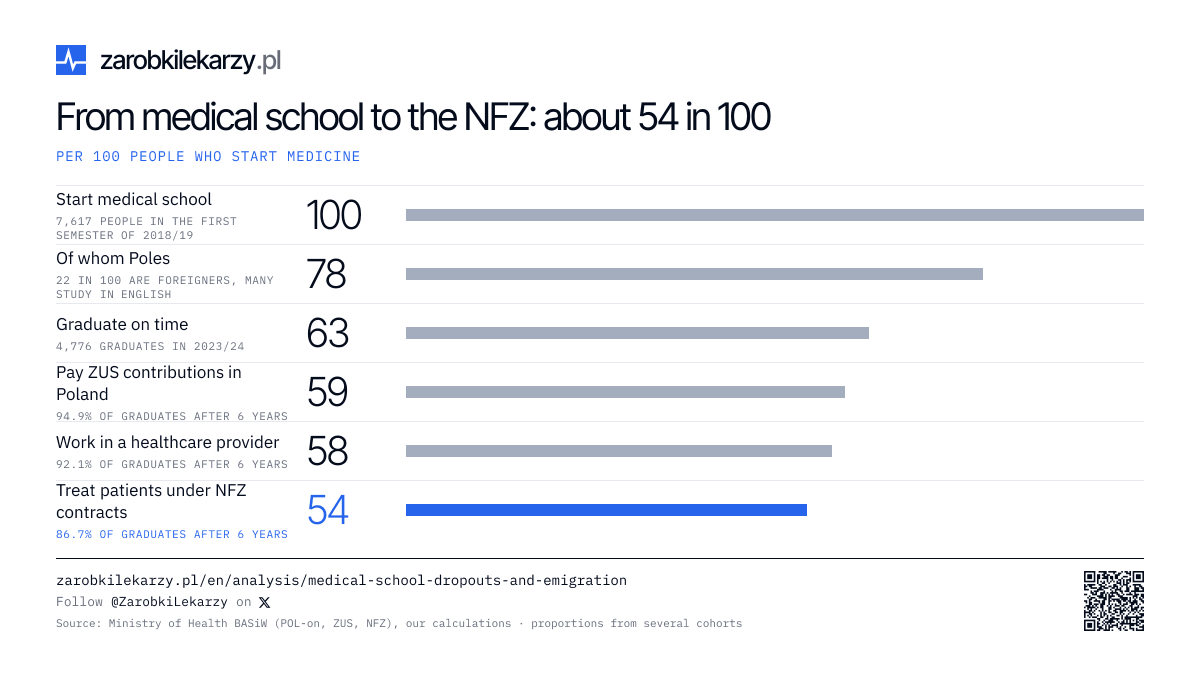
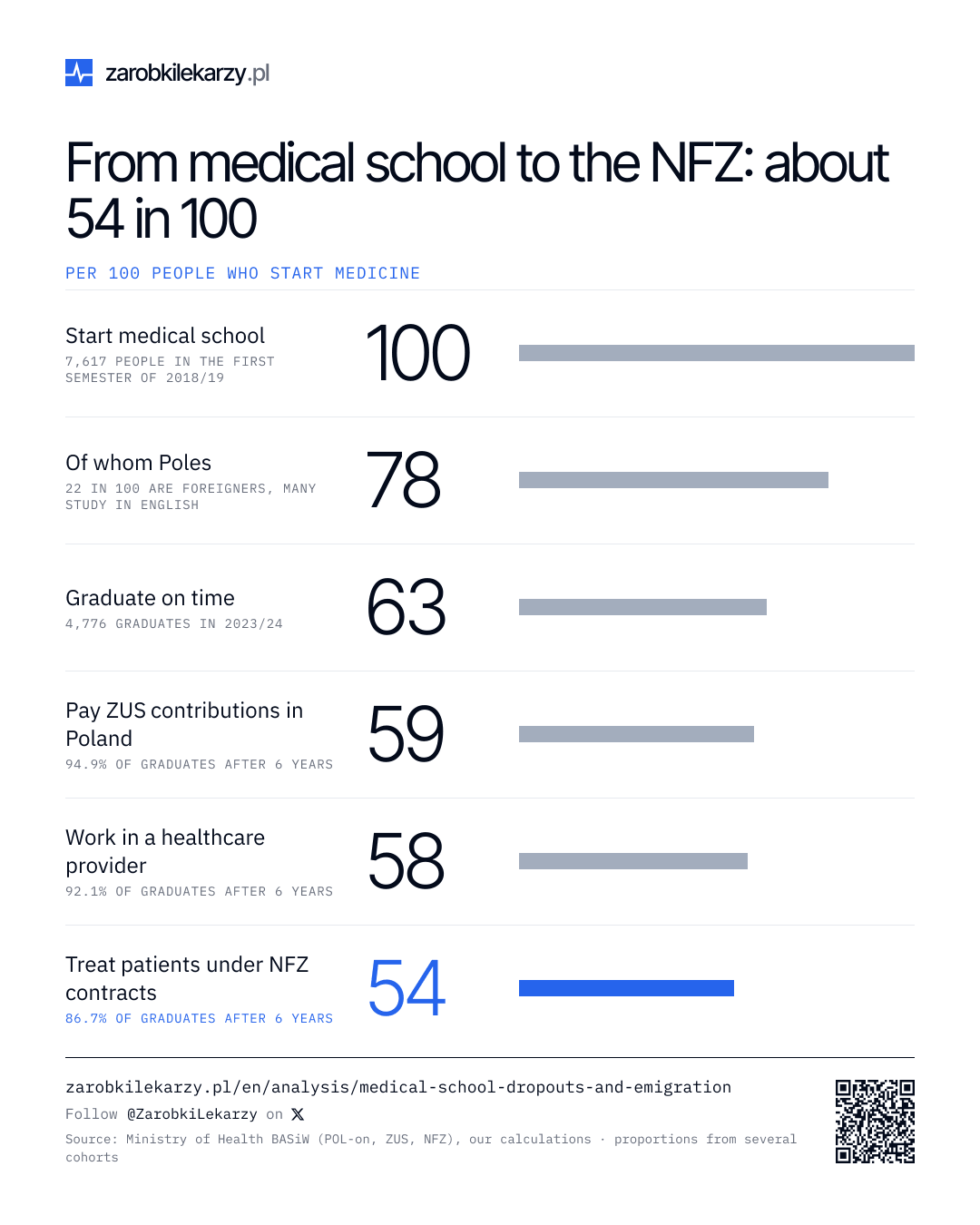
The simplest fair measure is to compare the graduates of a given year with first-semester students in the cohort that should be graduating then. Those who started in the 2018/19 academic year finish within the nominal time in 2023/24. That year 4,776 people of Polish nationality graduated, while there had been 5,954 of them in the first semester in 2018/19 — 80%. In the four most recent closed cohorts, graduating in 2020/21–2023/24, the result falls within 80–82%, and among foreigners within 69–74%.1
This compares cohorts; it does not follow the same people. Some students finish late, some arrive from other universities or from abroad, some repeat the first year; transfers between Polish universities cancel out nationally. That is why “one in five does not finish on time” does not mean that one in five gives up medicine.
Dropout is a first-year matter
In the 2023/24 academic year there were 8,710 students of Polish nationality in the first semester of medicine. Before the end of the year 1,457 of them were removed from the student register, or 16.7% — roughly one in six. The first year accounted for 71% of all removals from the programme in that academic year, the first three years for 88%, and years four to six for only 12%.1
Today one student in six is removed in the first year; until 2018/19 it was one in five
This is a gross figure. It includes people who moved to another university or programme in the first weeks and those who later returned to their studies. In its report on the quality of education, the Medical University of Warsaw (WUM) describes students who withdraw before they even turn up for classes, and notes that such cases artificially inflate the dropout rate.5
In 2015/16–2018/19, 20.5 to 22.3% of students were removed in the first year, and from 2019/20 — 14.7 to 17.0%.1 The break coincides with three changes. From 2019/20 all universities had to apply new study regulations issued under the 2018 act.6 In the same year the way students were reported to POL-on changed, with the move to POL-on 2.0.7 In March 2020 classes at universities were suspended because of the pandemic and remote teaching was allowed.8 The data do not show which of these changes was decisive.
The 2019/20 cohort, the first after the break, is the most telling. It had the lowest first-year removal rate in the whole series — 14.7% — and already in its second semester its classes moved online. Within the nominal time, in 2024/25, 4,874 Poles graduated, or 78% of the 6,251 who started — fewer than in previous cohorts.1 The data for 2024/25 may still be incomplete, but so far lower dropout at the start has not translated into more graduates on time. This suggests that part of the fall in removals may have meant longer studies or a change in record-keeping, rather than fewer departures.
Old and new universities
According to the Ministry of Health application, 15 universities ran a medicine programme in 2015, and 37 in 2025.1 This is the number of universities that had the programme (a long-cycle master’s programme) in POL-on in a given year, not the number of universities admitting students. There are fewer of those: in the draft regulation on admission limits for 2025/26 the ministry left out six universities without a positive opinion from the Polish Accreditation Committee (PKA).9 That is why comparisons based on the limits give smaller numbers for the same years.
In 2022–2023 the minister approved a new medicine programme at 17 universities, 11 of which did not have a positive PKA opinion. Nine of them started teaching despite a negative opinion, because it does not bind the minister.10 Do the new programmes teach worse? Public data allow two things to be compared.
First-year dropout by university
The Supreme Medical Chamber (NIL) asked universities what share of students in each year were not promoted to the next year in 2023/24.11 Nineteen universities completed the survey. The first-year result can be read for 18 of them — eight “old” and ten “new” ones in NIL’s classification; the data of the Medical University of Gdańsk for medicine could not be interpreted. The survey does not include, among others, the Jagiellonian University Medical College (UJ CM) or the Medical University of Lublin.12
In the first year the results range from 0 to 24%, while from the fourth year they are 0–2% almost everywhere. The median of the two groups is similar: 10% among the “old” universities and 10.5% among the “new” ones. If two new universities with a result of zero, which may not yet have completed their first cohort, are left out, the median for the “new” ones rises to 14%.12
These numbers need to be read with caution. The universities reported them themselves, NIL did not define “not promoted” and did not separate English-language programmes, where dropout is sometimes much higher. The highest result — 24% at WUM — matches, to the percentage point, the combined data for the Polish and English tracks in the university’s report. In the Polish track alone, 17.8% of students were removed in the first year.13
First year: from 0 to 24% of students not promoted, depending on the university
Final examination results
A more comparable measure is the Medical Final Examination (LEK). Everyone sits the same test, and the Medical Examinations Centre (CEM) publishes the results of each university separately and keeps the examination taken in English apart.14 Sessions differ in difficulty, so we compare each university’s average score with the session average. In six sessions from spring 2024 to autumn 2026, first-time candidates who graduated from “old” universities scored on average 0.3 points above the session average, and those from “new” ones 1.7 points below it (out of a possible 200). At the first attempt, 97.2% of candidates from “old” and 95.4% from “new” universities passed.
The difference is largely made by one university. Graduates of the Silesian Academy (Akademia Śląska) scored 16.4 points below the session average, and 85% of them passed; without this university the average for the “new” ones would be close to the session average (about −0.1 points). The best result in the whole comparison, in turn, was achieved by a new programme at the University of Opole (+6.2 points), while two medical universities, in Gdańsk and in Białystok, were in the lower part of the field.14
Final examination: “old” and “new” universities are mixed together, one clearly stands out
- University of Opole · new+6.2 points relative to the session average; 99.0% passed
- Collegium Medicum UMK (Bydgoszcz)+5.0 points relative to the session average; 98.6% passed
- Poznan University of Medical Sciences+4.5 points relative to the session average; 98.6% passed
- Wroclaw Medical University+3.6 points relative to the session average; 98.1% passed
- Radom University · new+3.0 points relative to the session average; 96.9% passed
- University of Warmia and Mazury in Olsztyn+1.7 points relative to the session average; 95.8% passed
- Jagiellonian University CM (Kraków)+1.4 points relative to the session average; 98.1% passed
- Medical University of Silesia in Katowice+1.2 points relative to the session average; 97.2% passed
- University of Rzeszów · new+0.9 points relative to the session average; 97.8% passed
- Medical University of Lublin0.0 points relative to the session average; 96.0% passed
- Pomeranian Medical University in Szczecin0.0 points relative to the session average; 97.2% passed
- Medical University of Lodz−1.0 points relative to the session average; 97.1% passed
- Medical University of Warsaw−1.1 points relative to the session average; 96.7% passed
- Cardinal Stefan Wyszyński University in Warsaw · new−2.2 points relative to the session average; 96.1% passed
- Jan Kochanowski University in Kielce · new−2.5 points relative to the session average; 95.8% passed
- Andrzej Frycz Modrzewski Krakow University · new−3.0 points relative to the session average; 95.5% passed
- Medical University of Bialystok−4.5 points relative to the session average; 94.7% passed
- University of Zielona Góra · new−5.2 points relative to the session average; 93.1% passed
- Medical University of Gdańsk−5.6 points relative to the session average; 97.0% passed
- Silesian Academy (Akademia Śląska) · new−16.4 points relative to the session average; 85.2% passed
Both comparisons cover only universities whose students have already reached the final examination. The youngest programmes — among others at the Wrocław University of Science and Technology, in Częstochowa, Siedlce, Elbląg and at the University of Warsaw — are not yet in the LEK statistics, so the data say nothing about their results.14 The NIL survey series cannot be extended backwards: earlier editions gave only the number of students not promoted, without a breakdown by year of study.15
Why do students drop out? Not even POL-on records it
The POL-on system, to which universities report every student, stores the date of removal from the student register but not its reason. The act lists only the date of removal in the register of students,16 and the regulation on data in POL-on does not extend that scope.17 The reason — withdrawal, failing the year, lack of progress, non-payment of fees — appears only in the removal decision issued by the university.18 Anyone wishing to learn the reasons nationally would have to ask each university separately.
Only isolated data are publicly available:
- Jagiellonian University Medical College, 2020/21: of 287 first-year students, 60 were removed — most often for failing to pass the year on time (35 people), less often because of withdrawal (23). The table in the report does not fully add up, and the year fell during the pandemic.19
- Medical University of Lodz, military intake 2022/23: of 200 admitted, 111 were studying on the day the report was drawn up. The university points to removals for failed basic subjects and calls the situation unprecedented.20
- WUM study regulations: in 2023/24 nobody repeated the first year there, because a failed year ended in removal from the register. Such a rule raises the dropout statistic regardless of which students started.13
Surveys on “considering withdrawal” measure declarations, not withdrawals. A review of international research found academic performance — earlier performance and performance at the start of studies — to be the only consistent risk factor.21
How many of those removed return to their studies
Public data do not allow us to count this. It can only be estimated from a balance: checking how many students appear in higher semesters from outside the intake — after resuming their studies, after transferring from abroad or from another programme. In 2016/17–2019/20 this was between 905 and 1,345 people of Polish nationality a year, in 2023/24 — 236.1 The fall is clear, but its meaning is not: anyone who returns after removal through a new admission to the first year is invisible in this calculation. The Ministry of Science and OPI could count it precisely, because POL-on identifies each student by their PESEL number (national identification number).16
After graduation, the vast majority work in Poland
The ministry’s application also shows the careers of successive cohorts of graduates of Polish nationality. Of the 2016/17 cohort of 3,305 people, in 2023, six years after graduation:1
- 94.9% had ZUS contributions paid in Poland,
- 92.1% worked at a healthcare provider,
- 86.7% provided services under contracts with the NFZ,
- 5.0% had no ZUS contributions in Poland.
Six years after graduation, 5% of graduates pay no ZUS contributions in Poland
The share without contributions is lowest in the internship year and then rises to 4–5% after five to six years.1 This is an upper bound on emigration, because it also includes career breaks, leave and gaps in the data. The ministry has already used these data: in its reply to the 2023 NIK audit it stated that in 2019 more than 90% of medicine graduates from 2014–2019 were working in Poland.22 This was a response to NIK’s finding that the ministry had not analysed the scale of emigration of medical staff.4
The window of these data has its limits, however. In a 2023 survey by the Centre of Migration Research at the University of Warsaw, 13% of final-year students ruled out leaving entirely, and most postponed any decision until after the internship or after specialist training.23 ZUS data so far reach no more than six years after graduation, so departures after specialist training are at best only partly visible in them.
The OECD gives a broader picture. Around 2017/18 about 11,300 doctors with a Polish degree were working in other OECD countries, or 11% of all those trained in Poland. This is a stock built up over entire careers, including foreigners who studied in Poland. In Romania the same indicator was 33%, in Slovakia 26%, in Hungary 19%, in Lithuania 9% and in Czechia 8%.24
Foreigners make up about one-fifth of graduates: in 2023/24 — 1,231 of 6,007.1 Many of them study in fee-paying English-language programmes and leave after graduation. According to the Graduate Tracking System (Ekonomiczne Losy Absolwentów, ELA), fewer than 1% of foreign graduates in medical and health sciences are visible in Polish ZUS data.25 A growing number of graduates therefore does not translate directly into the future workforce of the Polish system.
Of 100 Poles who start medicine, about 80 finish on time and about 76 then pay ZUS contributions in Poland
From a university place to a licence to practise
The same funnel can be calculated another way: by comparing university places with the number of doctors who a few years later hold a licence to practise (PWZ). The medical chamber does not publish how many such licences it grants each year, but it does give the age structure of doctors. In mid-2026, 20,457 doctors aged 26–30, counting by year of birth, held a PWZ.26 These are roughly those who started their studies in 2015–2019, when admission limits totalled 37,059 places.27 So about 55% of places lead to a licence to practise. Most of the difference of about 16.6 thousand, however, is not dropout — as becomes clear when it is calculated step by step from the same sources:
Of 37.1 thousand places at medical school, 20.5 thousand doctors reach a licence to practise — about 55%
| Step of the calculation | Number |
|---|---|
| Admission limits 2015/16–2019/20five regulations of the Minister of Health | 37,059 |
| Places in programmes taught in a foreign language and the pool for foreigners8,940 and 374; their graduates usually leave Poland | −9,314 |
| Places in Polish for Poles | 27,745 |
| There were more Poles in the first semester than such placesamong others, students repeating the first year and Poles in English-language programmes | +806 |
| Poles in the first semester in those yearsPOL-on | 28,551 |
| Did not graduate on time | −5,524 |
| Polish graduates 2020/21–2024/25POL-on; 2024/25 may be incomplete | 23,027 |
| Graduates outside the 26–30 age group or without a licence to practisenet of doctors with foreign degrees — these groups cannot be separated | −2,570 |
| Doctors with a licence to practise aged 26–30NIL, 30.06.2026 | 20,457 |
The largest part of the difference, about 9.3 thousand (25% of the limit), consists of places in foreign-language programmes and for foreigners; their graduates usually leave Poland.27 Poles who did not finish on time account for about 5.5 thousand (15%).1 The last step, about 2.6 thousand (7%), combines groups that cannot be separated: graduates who started their studies later than at 19 and fall outside the age range, people who did not take up a PWZ, and — with the opposite sign — doctors with foreign degrees, who raise the number of doctors with a PWZ. The difference is in turn reduced by about 0.8 thousand (2%): that is how many more Poles there were in the first semester than there were places in Polish. Together this gives 16.6 thousand.
Doctors with a foreign degree are not few. At the end of 2024, 5,927 people held a PWZ for the duration of the internship,28 while there were 4,776 Polish graduates in 2023/24.1 In 2024–2026, between 860 and 1,210 people with a degree from a foreign university sat the LEK for the first time each year.14 The loss at Polish universities is therefore largely made up by inflows from abroad. How many of these doctors are Poles who studied in other countries is not known — nobody publishes such statistics, just as nobody publishes data on repeating a year or on leave of absence from studies.
The three flows described in this analysis — 80% finishing their studies, 5% of graduates not working in Poland and about 1,000 doctors with a foreign degree a year — are the default settings of the doctor supply simulator (in Polish). In this model, halving dropout (90% finishing instead of 80%) gives as many new doctors each year as about 1,110 additional places would at today’s limit for programmes in Polish, which stands at 8,892 places (2026/27).29
Specialist training: here the data stop
Almost every step up to the licence to practise can be traced; beyond it, the data stop. What is known:
- 7.2–8.2 thousand people a year confirm acceptance of a specialist training place (2023–2025). This is the sum of the spring and autumn sessions, including dentists and second specialisations, so figures for a single session or for residencies alone are smaller;30
- 63.9% of doctors working with patients have a specialisation (2025; a year earlier 64.5%) — the share is falling because new doctors are being added faster than specialists;31
- the latest measurement of withdrawals from residencies comes from a 2016 NIK audit and stands at 5.2% for the 2011–2014 intakes;32
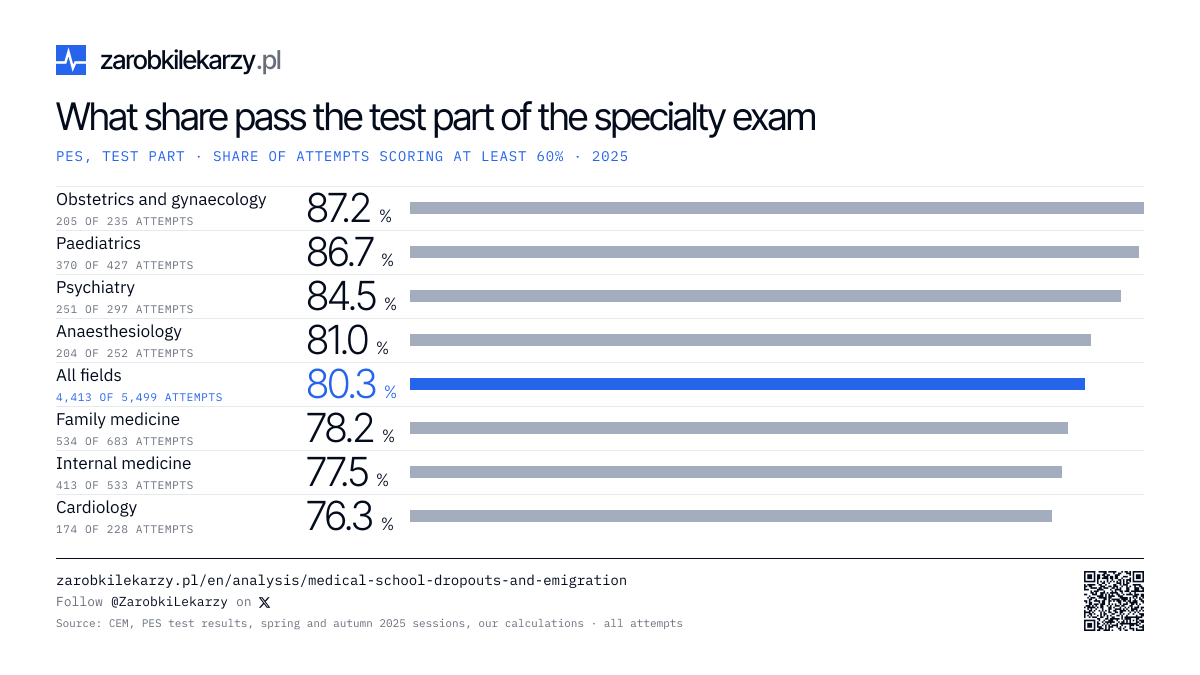
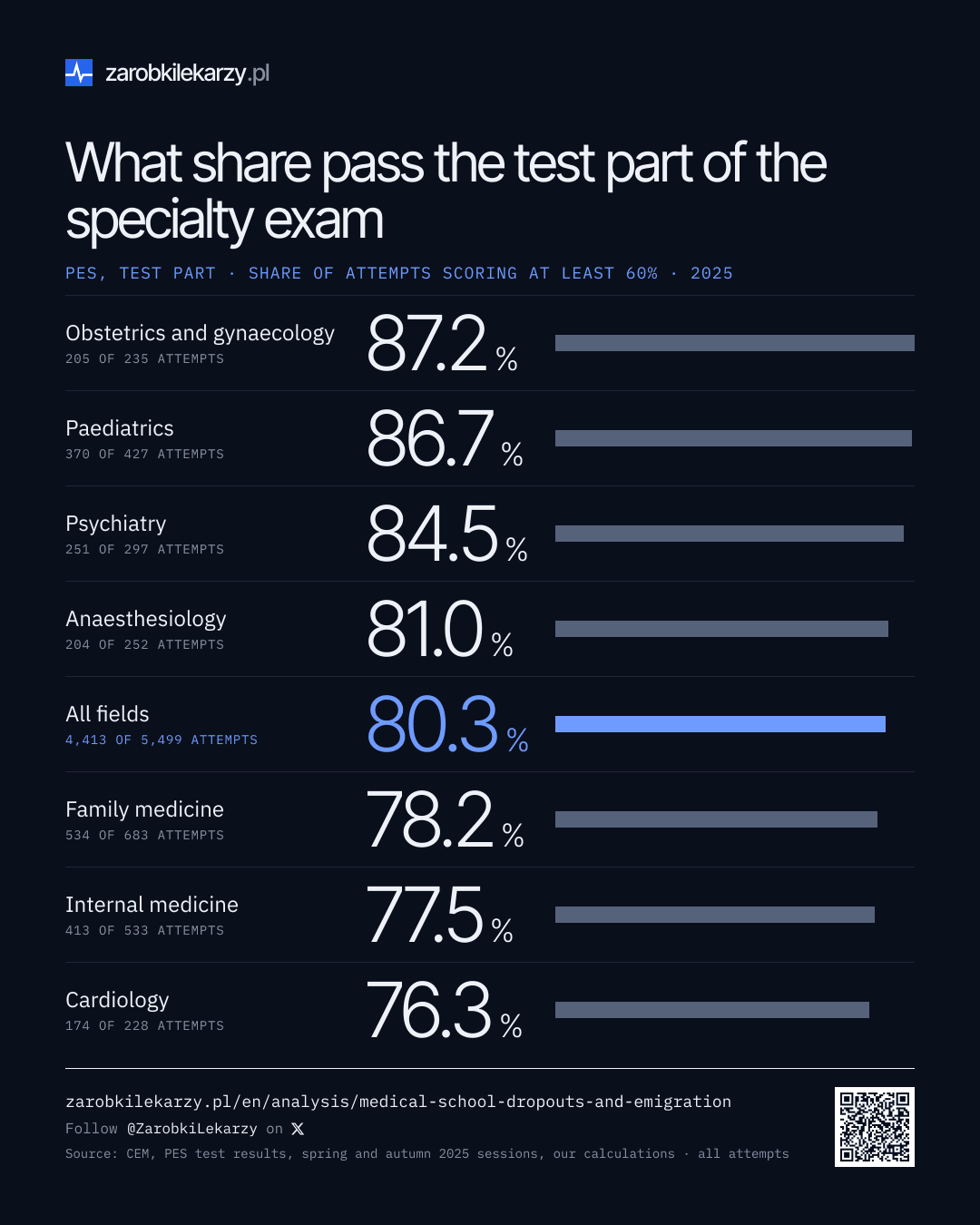
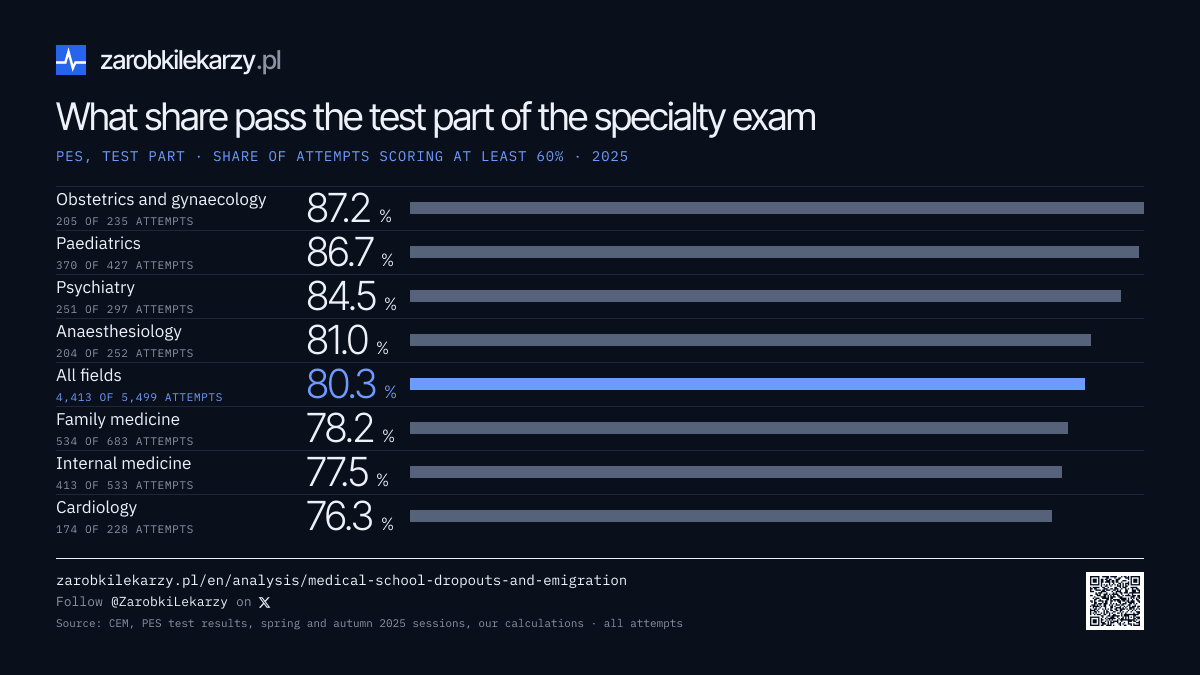
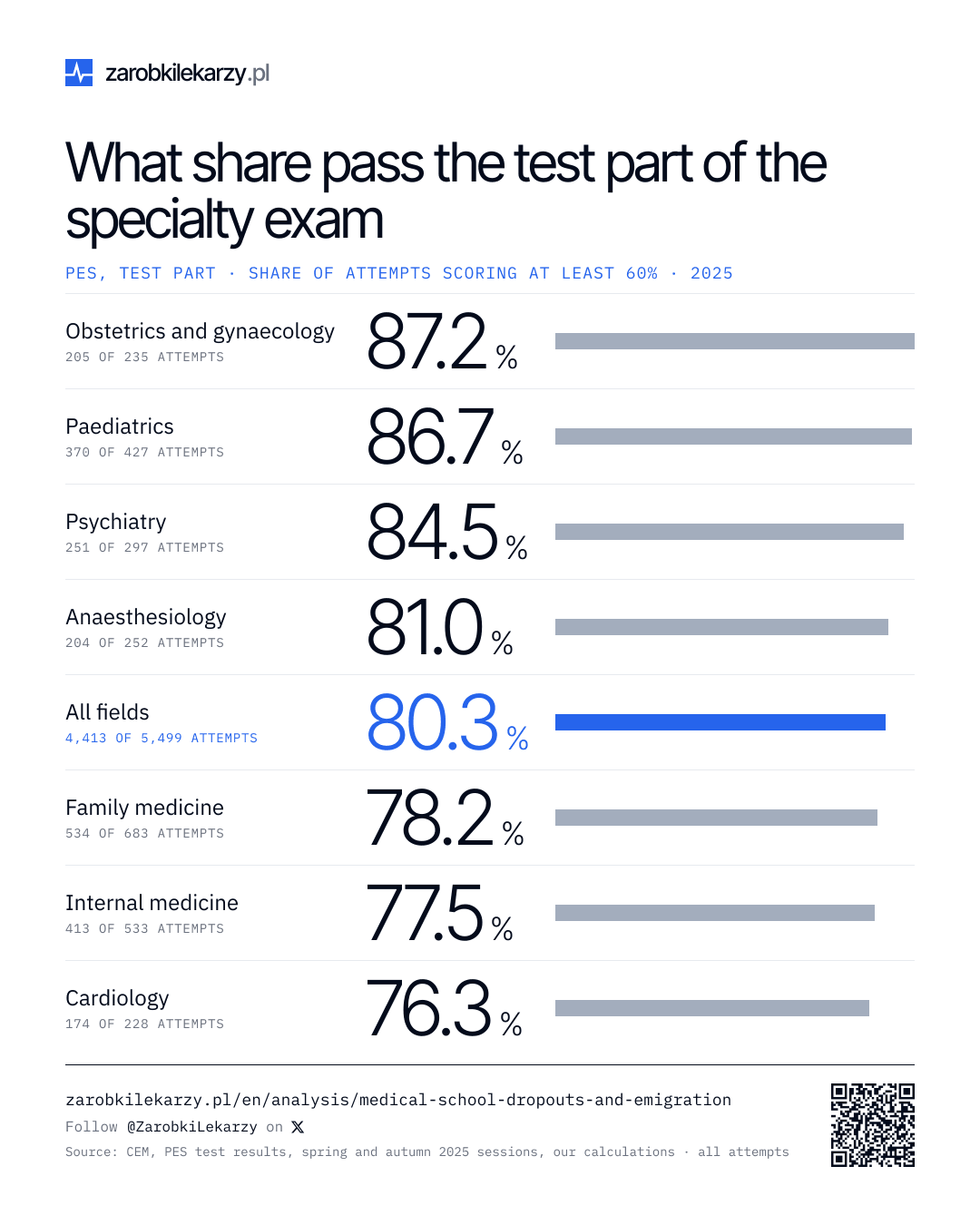
- the written test of the State Specialisation Examination (PES), which concludes the training, was passed in 80.3% of attempts in 2025 (4,413 of 5,499), and among first-time candidates in 89.5%. The Medical Examinations Centre does not publish the results of the oral part, from which a test score of at least 75% has exempted candidates since 31 December 2022.33
What share of graduates become specialists, and after how many years, cannot be established from public data today.
Compared with other countries
Countries measure dropout differently, and some select candidates before medical school or after a common first year, rather than during studies. Only measures concerning the loss of students already admitted to medicine can therefore be compared:
| What it measures | Result | |
|---|---|---|
| Poland | Poles who do not finish their studies on time (cohort comparison, delays included) | about 20% |
| USA | Attrition over the full MD programme: average of 20 cohorts (starting in 2000/01–2019/20), all MD programmes, including combined ones; selection takes place after the bachelor’s degree, before admission | 3.1% |
| Germany | Leaving higher education without a degree among people who started medicine (changing programme or university does not count); students with German citizenship, rate for the 2020 graduates; selection mainly by school-leaving examination results | about 6% |
The data for the USA come from the AAMC,34 for Germany from the DZHW.35 The Polish result also includes delays, while the German one covers only leaving university without any degree, so part of the difference is a difference of definitions. Nor does the German rate measure “giving up medicine”: someone who moved from medicine to another programme is not counted in it.
France is deliberately left out of this comparison. The often-quoted 36% is the share of that year’s school leavers who in 2021 started a common first year (the PASS track) and after one year progressed to the second year of medicine or a related programme (midwifery, dentistry, pharmacy, physiotherapy; together the MMOPK group). This is a measure of selection at entry, not of dropout. Of those already admitted to the second year, 93% progress to the third, 5.4% repeat the year, and about 1% leave the MMOPK programmes.36
Closer to the Polish model — broad admission, a hard first year, large English-language programmes — are Hungary and Czechia, but only indicative data are available for them. In Hungary, 17% of people who in 2011/12 started long-cycle programmes in the group of medical fields, not medicine alone, did not complete their studies. We know this number only from a secondary source — the Eduline portal in 2019, with no definition of dropout.37 In 2019 the dean of the First Faculty of Medicine of Charles University in Prague estimated that about 30% of those enrolled drop out over the whole course of studies; he spoke separately about students who repeat a year.38
What is missing from the data
The state knows more about medical students than it shows, and some basic things it does not collect at all:
- reasons for removal — the list of grounds for removal is in the act,18 but only the date goes into POL-on; adding the ground to the register of students would make it possible to publish tables by university and year of study at a level of detail that does not allow individuals to be identified;
- dropout by university — today only LEK results are comparable across universities, and dropout data come from a medical chamber survey that only some universities answered;
- what happens to those removed — how many return to their studies and finish them, even though POL-on knows every student’s PESEL number;16
- careers after specialist training — what share of a cohort becomes specialists and how many doctors leave once they have completed it.
Linking data on the same person from several registers is already administrative practice. The Ministry of Health combines graduate data from POL-on, ZUS and the Central Register of Doctors,22 and publishes only aggregate tables from them.1 The site’s proposal rests on the same principle: the total paid from public money to each person, under a permanent identifier, without names.
Method
Student data come from the Ministry of Health application “Studenci i absolwenci kierunków medycznych” (“Students and graduates of medical programmes”; POL-on, read on 4.10.2026). The application is updated, so earlier readings may differ slightly.1 The “student semester” filter has values 1–6 and refers to semesters, not years of study: the sum of students in semesters 1–6 exceeds the total number of students, because the same person is counted in both semesters of the year. First-year dropout is students removed in semesters 1–2 as a share of first-semester students. “Finishes on time” is the graduates of year t divided by first-semester students of year t−5. The year 2024/25 may not be closed in the data. “No ZUS contributions” means that no payer paid contributions for the graduate in the given year.
LEK results were compared as the deviation of a university’s average score from the session average (candidates sitting in Polish from Polish universities), weighted by the number of candidates.14 The NIL report divides into “old” and “new” only the 19 universities that completed the survey. In the report, “old” — those with a long tradition of training doctors — are the medical universities in Białystok, Gdańsk, Katowice, Łódź, Poznań, Szczecin, Warsaw and Wrocław and the University of Warmia and Mazury; the other ten are “new”. As non-participants the report lists only the University of Kalisz and the Andrzej Frycz Modrzewski Krakow University, which took part in the previous edition.12 The Jagiellonian University Medical College, the Medical University of Lublin and Nicolaus Copernicus University Collegium Medicum are not in the report. In the comparison of LEK results we classify them as “old” by the same criterion — this is our classification, not NIL’s.
The “from a place to a PWZ” calculation compares the sum of admission limits for 2015/16–2019/20 with the number of doctors with a PWZ aged 26–30. The chamber counts age by year of birth, so these are people born in 1996–2000, that is — with a typical start of studies at 19 — admitted in 2015–2019. The figure of 20,457 covers all doctors (excluding dentists) who are members of the chamber, of whom 20,435 practise.26 In the printout as of 31.12.2025, from which the supply simulator starts, the same age group numbered 20,346 practising doctors; the difference is due to the date and the definition.39
Notes 39laws, data and statements we relied on
-
Ministry of Health, BASiW, application “Studenci i absolwenci kierunków medycznych” (“Students and graduates of medical programmes”, in Polish) — POL-on, ZUS and NFZ data; the tabs “Analizy w ujęciu tabelarycznym” (students, removals and graduates by nationality and semester; number of universities) and “Losy absolwentów” (graduates’ careers); read on 4.10.2026, our calculations. ↩ ↩2 ↩3 ↩4 ↩5 ↩6 ↩7 ↩8 ↩9 ↩10 ↩11 ↩12 ↩13 ↩14
-
OPI PIB, “Zjawisko drop-outu na polskich uczelniach” (“Dropout at Polish universities”, in Polish), slides 3 (average 40%) and 6 (medical sciences 29%); POL-on data as of 27.04.2020. ↩
-
Rynek Zdrowia, “Aplikują na potęgę, a potem rezygnują. Nawet 2/3 przyjętych na medycynę zwalnia miejsce” (“They apply en masse and then withdraw. Up to 2/3 of those admitted to medicine give up their place”, in Polish), 2024. ↩
-
NIK, “Zasoby kadry medycznej w systemie ochrony zdrowia” (“Medical staff resources in the healthcare system”, in Polish), 2023, pp. 12 and 33 — 4,884 certificates issued in 2018–2022 (up to the end of September) according to the Central Register of Doctors and Dentists; the caveat that the number of certificates is not the same as the number of people who left; no analyses of the scale of emigration at the Ministry of Health. ↩ ↩2
-
Medical University of Warsaw, Faculty of Medicine, Raport Wydziałowego Zespołu ds. Jakości Kształcenia 2023/2024 (“Report of the Faculty Education Quality Team 2023/2024”, in Polish), p. 45, recommendation 13. ↩
-
Act of 3 July 2018 — Provisions introducing the Act on Higher Education and Science (in Polish), Dz.U. 2018 item 1669, Article 263(1) (new study regulations from 1.10.2019 at the latest). ↩
-
POL-on, knowledge base: “Jak mogę wprowadzić studentów na rok 2019/20 do systemu POL-on?” (“How can I enter students for 2019/20 into the POL-on system?”, in Polish). ↩
-
Regulation of the Minister of Science and Higher Education of 11 March 2020 (in Polish) on the temporary restriction of the functioning of certain entities of the higher education and science system in connection with COVID-19, Dz.U. 2020 item 405, § 1. ↩
-
Rynek Zdrowia, “Nowe limity przyjęć na medycynę w roku 2025/2026. Sześć uczelni wypada z listy” (“New admission limits for medicine in 2025/2026. Six universities drop off the list”, in Polish), 12.06.2025 — discussion of the draft regulation. ↩
-
Konkret24, “Likwidują kierunki lekarskie. Jaki problem ma dziewięć uczelni” (“Medicine programmes being closed. What problem nine universities have”, in Polish), 17.06.2024. ↩
-
Supreme Medical Chamber, Medical Education Committee, report on the “Barometr 25” survey for the 2023/24 academic year (in Polish), p. 95 — share of students not promoted by university and year of study. ↩
-
Ibid., pp. 6–9 — list of the 19 participating universities, universities that did not take part in this edition, the criterion and division into “old” and “new” universities, number of students by university; medians — our calculations. ↩ ↩2 ↩3
-
Medical University of Warsaw, Faculty of Medicine, Raport Wydziałowego Zespołu ds. Jakości Kształcenia 2023/2024 (“Report of the Faculty Education Quality Team 2023/2024”, in Polish), p. 19 — tables for years I–VI (Polish track: 17.80% removed in the first year, nobody repeated the first year; English Division: 88 of 175 people completed the year). ↩ ↩2
-
Medical Examinations Centre, Statystyka Lekarskiego Egzaminu Końcowego (“Medical Final Examination statistics”, in Polish) — sessions from spring 2024 to autumn 2026, table “results of doctors sitting for the first time” by university (university rows are the examination in Polish; foreign universities separately); our calculations. ↩ ↩2 ↩3 ↩4 ↩5
-
NIL, reports from the survey of universities: edition 1 (2021/22), edition 2 (2022/23) (in Polish). ↩
-
Act on Higher Education and Science (in Polish), consolidated text Dz.U. 2024 item 1571, Article 344(1)(2) (PESEL) and (13) (date of removal from the student register). ↩ ↩2 ↩3
-
Regulation of the Minister of Science of 12 September 2024 on data processed in POL-on (in Polish), Dz.U. 2024 item 1403; the 2025 amendment (Dz.U. 2025 item 1337) does not concern this scope. ↩
-
Act on Higher Education and Science (in Polish), Article 108 — mandatory and optional grounds for removal from the student register. ↩ ↩2
-
Jagiellonian University Medical College, Faculty of Medicine, self-assessment report for the PKA — medicine (in Polish), 2022, p. 32, table 5. ↩
-
Medical University of Lodz, Raport Uczelnianego Zespołu ds. Zapewnienia Jakości Kształcenia 2022/23 (“Report of the University Education Quality Assurance Team 2022/23”, in Polish), p. 16. ↩
-
L.D. O’Neill et al., “Factors associated with dropout in medical education: a literature review”, Medical Education 45(5), 2011. ↩
-
NIK, “Zasoby kadry medycznej w systemie ochrony zdrowia” (“Medical staff resources in the healthcare system”, in Polish), 2023, p. 122 — position of the Minister of Health: “more than 90%” of graduates from 2014–2019 were working in Poland in 2019 (our translation); compiled from POL-on, ZUS and Central Register of Doctors data. ↩ ↩2
-
Rynek Zdrowia, “Tylko 13 proc. studentów medycyny wyklucza wyjazd z Polski” (“Only 13% of medical students rule out leaving Poland”, in Polish), 2023 — discussion of a study by the Centre of Migration Research, University of Warsaw (secondary source). ↩
-
OECD, “International migration and movement of doctors to and within OECD countries — 2000 to 2018”, OECD Health Working Paper No. 126, 2021, annex, table A.1. ↩
-
Ekonomiczne Losy Absolwentów (Ministry of Science/OPI), “Absolwenci obcokrajowcy na polskim rynku pracy” (“Foreign graduates on the Polish labour market”, in Polish). ↩
-
Supreme Medical Chamber, Zestawienie liczbowe lekarzy i lekarzy dentystów według wieku, płci i tytułu zawodowego, stan na 30.06.2026 (“Doctors and dentists by age, sex and professional title, as of 30.06.2026”, in Polish) — age groups counted by year of birth; doctors aged 26–30: 7,392 men and 13,065 women among chamber members, 20,435 practising. ↩ ↩2
-
Regulations of the Minister of Health on the admission limit for medicine and dentistry for 2015/16–2019/20: Dz.U. 2015 item 1119, Dz.U. 2016 item 982, Dz.U. 2017 item 1251, Dz.U. 2018 item 1381 and item 1845, Dz.U. 2019 item 1344 and item 1713 (in Polish; final version, with amendments); totals, including 8,940 places in a foreign language and 374 in the pool for foreigners — our calculations. ↩ ↩2
-
Supreme Medical Chamber, Zestawienie ilościowe według rodzaju prawa wykonywania zawodu, stan na 31.12.2024 (“Numbers by type of licence to practise, as of 31.12.2024”, in Polish) — a doctor’s PWZ for the duration of the internship. ↩
-
Regulation of the Minister of Health of 28 August 2026 on the admission limit for medicine and dentistry, Dz.U. 2026 item 1167 (in Polish), annex 1 — 10,730 places in medicine, of which 1,838 in a foreign language; the difference (8,892) — our calculations. The equivalent of about 1,110 places is one-eighth of 8,892 (90% compared with 80% finishing). ↩
-
Centre of Postgraduate Medical Education (CMKP), announcements of the results of qualification procedures, e.g. autumn session 2025 (in Polish); sum of sessions — our calculation (estimate). ↩
-
Statistics Poland (GUS), “Zasoby kadrowe w wybranych zawodach medycznych na podstawie źródeł administracyjnych” (“Human resources in selected medical professions based on administrative sources”, in Polish): 2025 edition, p. 3; 2024 edition. ↩
-
NIK, “Kształcenie i przygotowanie zawodowe kadr medycznych” (“Education and professional preparation of medical staff”, in Polish), 2016, p. 25. ↩
-
Medical Examinations Centre, results of the PES written test (in Polish) — lists of results for the spring and autumn 2025 sessions in all fields (one code number = one attempt, pass from 60% of points) and the “first-time candidates” statistics attached to the lists (excluding maxillofacial surgery in spring 2025 — 13 attempts); the percentages are our calculations. The autumn 2025 result (2,686 attempts, 2,224 passed) matches the Ministry of Health’s reply to parliamentary question No. 18220 (in Polish). Rules: Act on the professions of physician and dentist (in Polish), Article 16s(4) (test threshold), Article 16rc(10) (exemption from the oral part) and Article 16w(1) (CEM publishes only the test results). The exemption was added by the Act of 16 November 2022 (Dz.U. 2022 item 2770, Article 13) to the amendments to Article 16rc made by the Act of 16 July 2020 (Article 1(40)), which entered into force on 31 December 2022 — the date was set by the Act of 10 December 2020 (Dz.U. 2020 item 2345, Article 5(3)). ↩
-
AAMC, Data Snapshot: Graduation Rates and Attrition Rates of U.S. Medical Students, October 2025 — national average attrition rate of 3.1% across 20 cohorts starting in 2000/01–2019/20, for all MD programmes combined (including combined ones, e.g. a bachelor’s degree with an MD, and MD-PhD). ↩
-
DZHW, Brief 05/2022: Die Entwicklung der Studienabbruchquoten in Deutschland (in German), pp. 1 and 12 — medicine (Staatsexamen): about 6% for the 2020 graduating cohort. The rate covers people with German citizenship who left higher education without a first degree; changing programme or university is not counted as dropping out. ↩
-
MESR-SIES, information note 2024-31 on the PASS and L.AS tracks (in French), November 2024 — 2021 cohort: 36% of that year’s school leavers in PASS progressed after one year to the second year of MMOPK (medicine, midwifery, dentistry, pharmacy, physiotherapy); in the second year, 93% progressed to the third, 5.4% repeated the year, about 1% left MMOPK. ↩
-
Eduline.hu, “Riasztó lemorzsolódási adatok: orvos- és egészségtudományi szakok” (“Alarming dropout data: medical and health science programmes”, in Hungarian), 26.02.2019 — 17% dropout among those who in 2011/12 started long-cycle (“classical”) medical programmes, i.e. a group of fields, not medicine alone; based on analyses by the Oktatási Hivatal (Educational Authority), the original of which we have not found (secondary source). The article does not define dropout. ↩
-
Zdravotnický deník, interview with the dean of the First Faculty of Medicine of Charles University (in Czech), 11.04.2019 — an estimate for the whole course of studies (about 70% of those enrolled reach the final year); a statement, not administrative data. ↩
-
Supreme Medical Chamber, Zestawienie liczbowe lekarzy i lekarzy dentystów według wieku, płci i tytułu zawodowego, stan na 31.12.2025 (“Doctors and dentists by age, sex and professional title, as of 31.12.2025”, in Polish) — practising doctors by age; this is the starting point of the doctor supply simulator (in Polish). ↩
Infographics to download
2 graphics · portrait and landscape, light and dark
Graphics to share in two formats — portrait 1080×1350 (Instagram, Facebook, X) and landscape 1200×675 (X, LinkedIn, presentations) — light and dark. The sources, the page address and a QR code to the page are on the graphic.
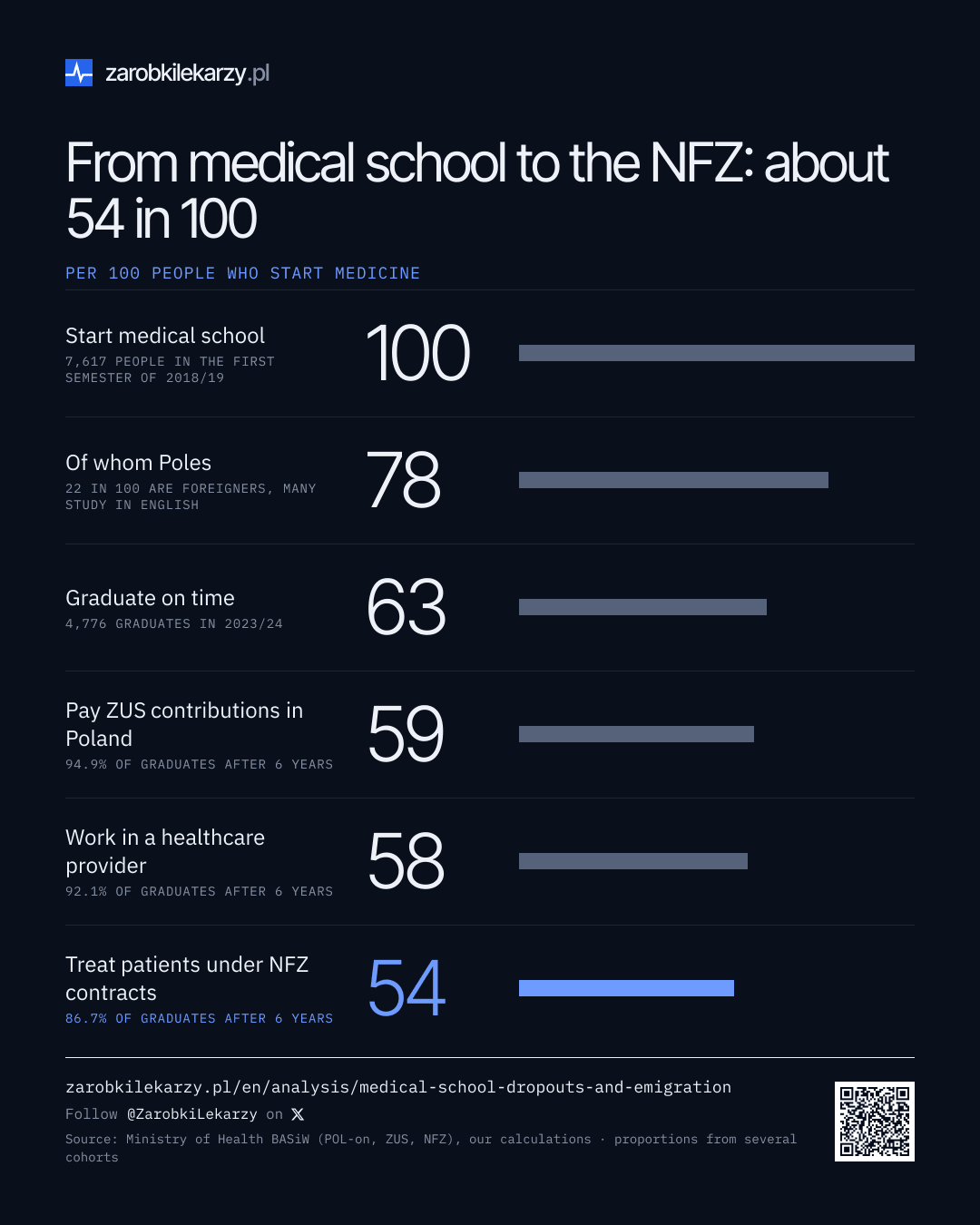
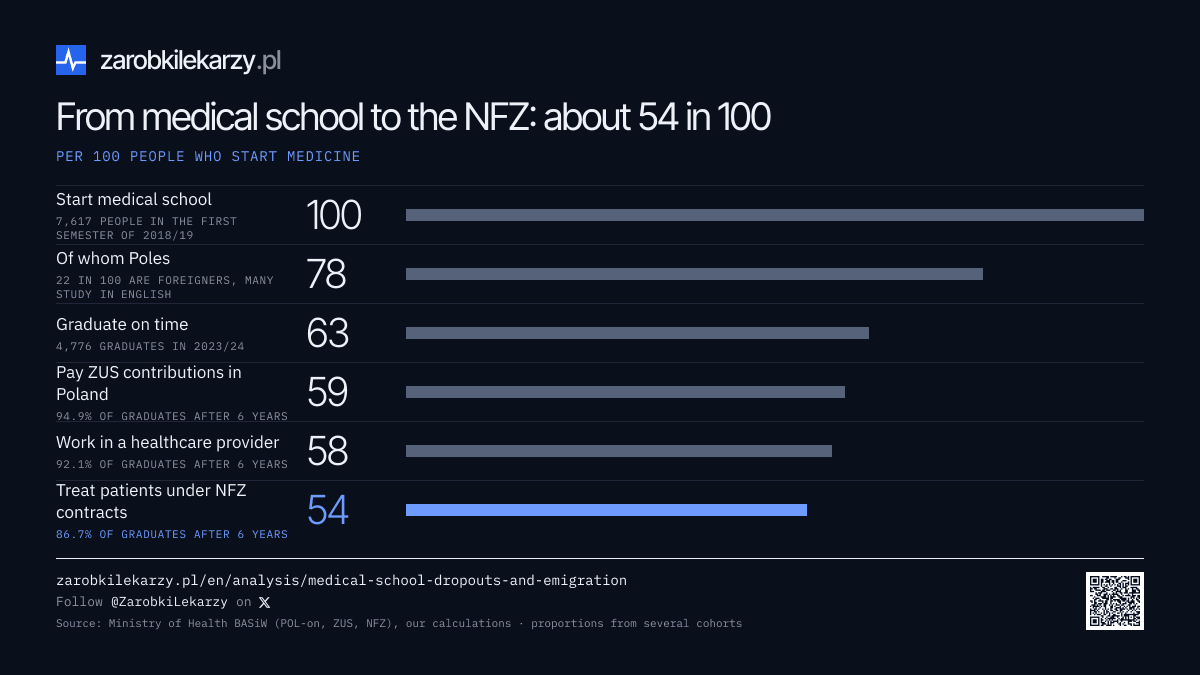
From medical school to the NFZ: about 54 in 100
What share pass the test part of the specialty exam