After the internship and the Medical Final Examination (LEK) a doctor may practise independently. To become a surgeon, a cardiologist or a family doctor, they still have to complete specialist training. That means four to six years of work in a hospital or clinic under a programme that lists courses, placements on other wards, on-call duty and the procedures the doctor must perform independently. Training ends with the State Specialisation Examination.
 Previous stageMedical studies in Poland: from the matura to the LEKAdmissions and cut-off scores, six years of study, the dissection room, the Medical Final Examination and the postgraduate internship.Read the analysis
This text describes the successive stages: recruitment, the programme, on-call duty, the supervisor’s oversight, the residency and non-residency modes, work outside the residency and the examination at the end.
77specialties
for doctors are listed in the regulation; 69 of them can be started right after the internship
ExactDz.U. 2023 item 975
500operations
must be performed independently over six years by a doctor training in general surgery
6,530residency places
are on the list for the autumn 2026 recruitment, plus 7,752 non-residency places
82.4%
of attempts at the test of the specialty examination were successful in spring 2026
Recruitment: a ranking based on the LEK result
There is no entrance exam for specialist training. Applications are submitted in the Training Monitoring System (SMK) twice a year, in February and in September, and list up to 15 options, i.e. combinations of field, voivodeship and mode.1 When there are more applicants than places, the order is set by a ranking. For a residency, what counts is the LEK result, up to 200 points, and a doctorate and publications can add at most 10 points more. In a tie, the average grade from the studies decides, and then the order in which applications were submitted.12
For the autumn 2026 recruitment, the list of the Centre of Postgraduate Medical Education (CMKP) provides 6,530 residency places and 7,752 non-residency places.3 Overall there are more places than applicants: in spring 2026, 52% of residency places and 89% of non-residency places remained empty.4 In the most sought-after fields, however, the ranking decides who gets a place. We describe the cut-off scores in the analysis Restricted access to the medical profession, and the number of places and applicants in individual fields in our overview by specialty.
77 fields, from four to six years
The Minister of Health’s regulation lists 77 medical specialties. Training is modular. In 29 fields, such as family medicine, psychiatry and anaesthesiology, it is a single module. In 40 it begins with a basic module shared by several fields, followed by a specialist module. There are five basic modules: general surgery, internal medicine, otorhinolaryngology, pathomorphology and paediatrics. The remaining 8 fields, such as clinical transplantology and paediatric urology, can be started only after obtaining another specialty.2 A doctor who completes a basic module can move to a related field without starting from scratch, if they qualify in a later recruitment round.1
Dentists have a separate list of nine specialties, such as orthodontics, periodontology and paediatric dentistry. Three of them — maxillofacial surgery, epidemiology and public health — are shared with the medical list.2 This text is about medical specialties, but the CMKP and the Medical Examinations Centre (CEM) report the number of places and the exam results together with dentists.
Two thirds of specialties take five or six years
1 dot = 1 specialty
Family medicine and ophthalmology, among others, take four years; internal medicine, paediatrics and psychiatry five; and general surgery, anaesthesiology and intensive care, neurosurgery and urology six.25 Breaks come on top of the minimum: training is extended by, among other things, illness, maternity and parental leave, unpaid leave of up to three months and a placement abroad of up to two years.1
Is 77 a lot
The number of specialties depends on what counts as one. In Germany the model regulation of the German Medical Association lists 51 medical specialties and, within them, further subspecialties, such as paediatric cardiology within paediatrics.6 The Czech act lists 43 specialties, and a regulation another 46 fields that can be obtained only after a specialty.7 In Spain the rules list 43 specialties for doctors.8 The Polish list combines both levels: paediatric cardiology is a separate specialty here, which begins with the basic module in paediatrics.2
Poland has the most specialties to start with. Including subspecialties, Czechia has more
In Sweden, alongside 44 basic specialties, the rules list 9 subspecialties and 10 additional specialties, which require a basic specialty.9 So Poland has the longest list of specialties that can be started without another specialty, while Czechia has more once subspecialties are included.
The start of the path differs too. In Czechia, training takes place in the chosen field from the first day: it begins with a common trunk shared by several fields, which counts towards the length of the specialty.7 In Poland, specialist training is preceded by a 13-month postgraduate internship on several wards.
The programme: courses, placements and procedures
Specialist training is work under a programme. The programme for each field is drawn up at least once every five years by a team of experts that includes the national consultant, a representative of the scientific society and representatives of the Supreme Medical Council, one of them a doctor in training. The CMKP edits the programme and the minister of health approves it.1 The act lists what the programme consists of: an introductory course in the first year, specialty courses, a basic placement with a set number of procedures, specialty placements on other wards, on-call duty, self-study and an attestation course at the end.1
From 47 to 61% of training time is the basic placement
General surgery
6 years, of which the basic placement is 61.0% of working days
Basic module2 years
Specialty placements, 22 weeks: orthopaedics and traumatology 6 weeks, anaesthesiology and intensive care 2 weeks, laparoscopic surgery 4 weeks, general surgery outpatient clinic 4 weeks, hospital emergency department 6 weeks (year 2). Courses: 6 courses, 15 days.
Specialist module4 years
Specialty placements, 44 weeks: ultrasonography 2 weeks (year 1), vascular surgery 4 weeks (year 1 or 2), endoscopy 4 weeks (year 1 or 2), orthopaedics and traumatology 4 weeks (year 2), cancer surgery 4 weeks (year 3), laparoscopic surgery 8 weeks (year 3 or 4), neurotraumatology 2 weeks (year 3 or 4), thoracic surgery 4 weeks (year 4), urology 4 weeks (year 4), general surgery at another centre 8 weeks (year 4). Courses: 6 courses, 16 days.
Internal medicine
5 years, of which the basic placement is 59.8% of working days
Basic module2 years
Specialty placements, 16 weeks: intensive medical care 4 weeks, hospital emergency department 12 weeks. Courses: 10 courses, 26 days.
Specialist module3 years
Specialty placements, 39 weeks: cardiology 4 weeks, pulmonology 3 weeks, gastroenterology 3 weeks, endocrinology 3 weeks, nephrology 3 weeks, haematology 3 weeks, rheumatology 3 weeks, infectious diseases 3 weeks, palliative medicine 2 weeks, psychiatry 4 weeks, hospital emergency department 8 weeks. Courses: 2 courses, 15 days.
Cardiology
5 years, of which the basic placement is 50.2% of working days
Basic module: internal medicine2 years
Specialty placements, 16 weeks: intensive medical care 4 weeks, hospital emergency department 12 weeks. Courses: 10 courses, 26 days.
Specialist module3 years
Specialty placements, 60 weeks: cardiac intensive care 16 weeks, electrophysiology and electrotherapy 8 weeks, interventional cardiology 8 weeks, echocardiography 4 weeks, paediatric cardiology 4 weeks, heart defects in adults 4 weeks, cardiac surgery 4 weeks, non-invasive electrocardiographic diagnostics 6 weeks, radiology and diagnostic imaging 4 weeks, angiology 2 weeks. Courses: 18 courses, 37 days.
Family medicine
4 years, of which the basic placement is 47.4% of working days
Single module4 years
Specialty placements, 64 weeks: internal medicine 13 weeks, diabetology 4 weeks, cardiology 4 weeks, paediatrics 21 weeks, general surgery 3 weeks, hospital emergency department 4 weeks, neonatology 2 weeks, psychiatry 3 weeks, geriatrics 2 weeks, dermatology 2 weeks, otorhinolaryngology 2 weeks, palliative medicine 4 weeks. Courses: 16 courses, 60 days.
Hover over a segment or tap it to see the details.
The programme lists how many procedures a doctor must perform independently — in general surgery, at least 500 operations
| General surgery | Internal medicine | Cardiology | Family medicine | |
|---|---|---|---|---|
| Length of training | 6 years (2 + 4) | 5 years (2 + 3) | 5 years (2 years of internal medicine + 3) | 4 years, one module |
| Courses | 12 courses, 31 days | 12 courses, 41 days | 28 courses, 63 days | 16 courses, 60 days |
| Procedures performed independently, examples | 500 operations, including 65 inguinal hernia repairs and 60 on the bile ducts | 30 ECGs with assessment, 20 bladder catheterisations and 10 pleural punctures in the basic module | 200 ECGs and 200 transthoracic echocardiograms in the cardiology module | 10 home visits to newborns, 10 check-ups in the first year of life, 2 certifications of death |
| On-call duty in the programme | an average of 10 hours 5 minutes a week | an average of 10 hours 5 minutes a week | an average of 10 hours 5 minutes a week | the programme does not specify it |
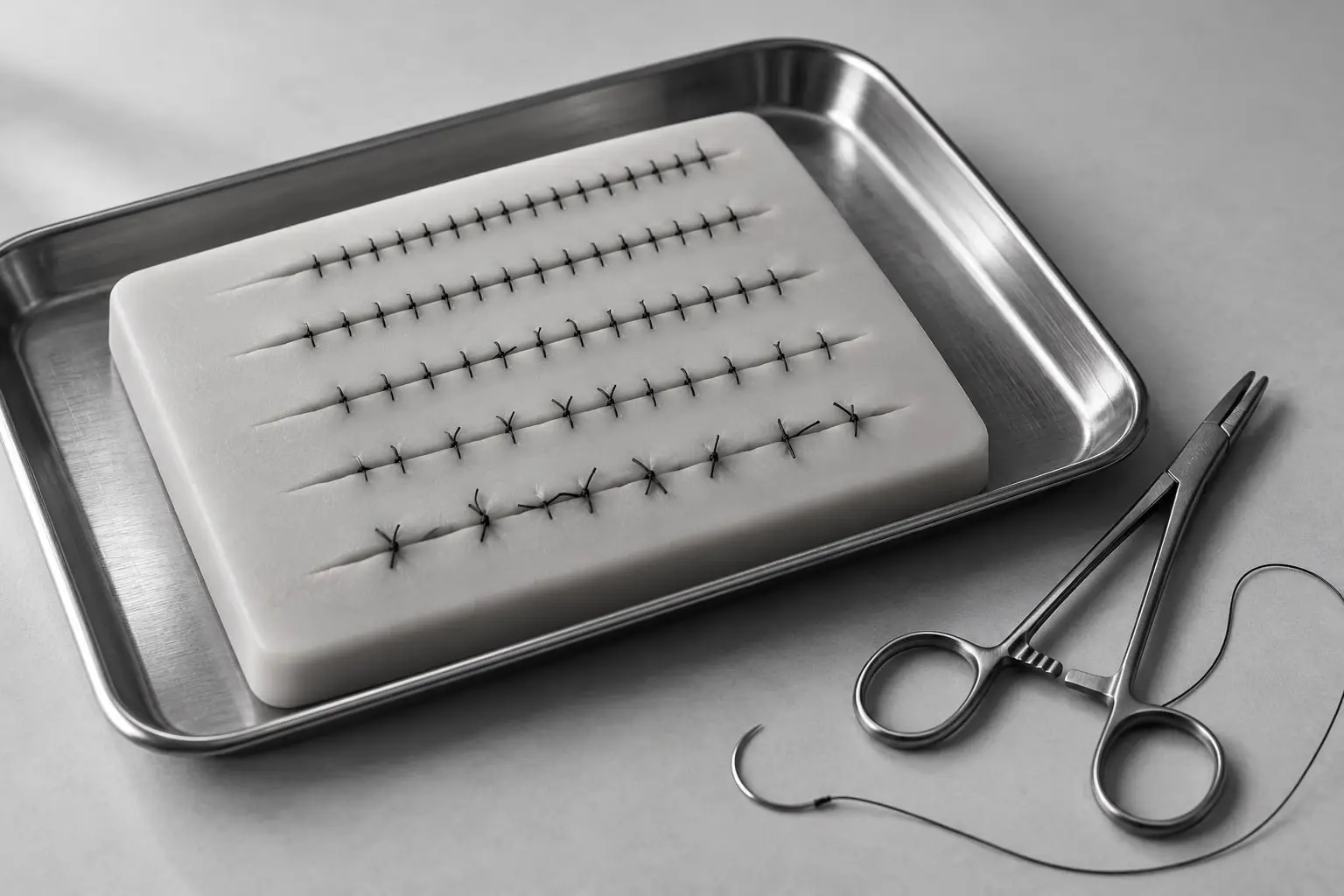
The doctor performs code A procedures independently, under supervision; for code B procedures they assist. In general surgery the programme requires 750 code A procedures, and at least 500 of them are operations: 150 in the basic module and 350 in the specialist module.10 Specialty placements take place on other wards. In surgery, one of them lasts eight weeks on a general surgery ward other than the doctor’s home ward and is recommended in the fourth year.10 In specialties with a basic module in general surgery, internal medicine or paediatrics, at least six months of training must take place in a hospital of the first or second tier of the basic level of healthcare provision.1
Courses and assessment
The courses in the programme are run by institutions on the CMKP list, and doctors can sign up only through the SMK. The facility where the doctor trains must release them for a course they have been accepted for.1 In the four programmes in the table, courses last from one to ten days. Every course ends with a test and every placement with an oral or written assessment. In general surgery, before the attestation course the organiser also checks knowledge from the whole training.10111213 Assessments are confirmed by the specialisation supervisor or the placement supervisor, and the doctor is obliged to keep the electronic training record in the SMK up to date.110
The four programmes described do not say who pays for the courses. In 12 fields, including internal medicine, family medicine, paediatrics and psychiatry, the CMKP is running the FERS1 project in 2024–2029, worth more than PLN 135 million (≈ €30.7 million). It covers about 2,500 compulsory specialty courses and co-financing of travel, accommodation and meals for courses and placements away from the doctor’s place of residence.14
Apart from courses and placements, each of the four programmes provides for 6 days a year of self-study, for example conferences, and requires a research or review paper published in a peer-reviewed journal. In family medicine the doctor must also prepare and run classes, for example for residents or students.10111213
On-call duty
A doctor in specialist training works full-time and is on call for the number of hours set in the programme.1 The programmes for general surgery, internal medicine and cardiology provide for on-call duty “for an average of 10 hours 5 minutes a week” or shift work, up to an average of 48 hours a week in total.101112 The family medicine programme does not specify on-call duty.13
During the basic placement a doctor is on “accompanied” duty, under the direct supervision of a specialist or another doctor authorised to be on call independently, or on independent duty if the specialisation supervisor agrees in the SMK. During a specialty placement at another facility, duty is accompanied only. For the first year of training, or longer if the programme so provides, a doctor may refuse independent duty. They then cannot do it under contracts at other facilities either. The exceptions are night and holiday medical care and work by a doctor who is already a specialist in another field.1 Duty under the programme is paid like overtime or, at the doctor’s request, compensated with time off. When on-call duty does not allow for 11 hours of uninterrupted rest, the rest is due immediately afterwards and does not extend the training.1
A doctor on an employment contract may do more on-call duty than the programme requires under the opt-out clause, that is, written consent to work more than an average of 48 hours a week. If they are on duty in the units named in the programme, have the consent of the specialisation supervisor and total rest after on-call duty does not exceed an average of five working days a month, the rest does not extend the training. After duty under the programme, rest counts towards a resident’s working time and does not reduce their salary; after additional duty, no salary is due for that time.115 The opt-out clause is due to expire on 1 January 2028.15 How on-site duty differs from standby “on the phone”, and what it costs a hospital, we describe in the analysis On-call duty in a county hospital.
The specialisation supervisor
Every doctor trains under a specialisation supervisor appointed by the head of the facility. The supervisor must hold a second-degree specialisation or the title of specialist in the field, or, in justified cases, in a related field. One supervisor oversees at most three doctors at a time, and four with the consent of the national consultant when staffing needs require it. They may also oversee the specialty placement of two more. For this they receive an allowance: PLN 500 (≈ €114) gross a month for one doctor or PLN 1,000 (≈ €228) for more than one.1
The supervisor sets the doctor’s detailed training plan, including where courses and placements take place. Until the supervisor gives a written opinion that the doctor may treat patients independently, the doctor provides care under supervision — the supervisor’s or that of another specialist.1 Only facilities accredited by the CMKP may provide training. How accreditation and the limit on supervisors restrict the number of places we describe in the analysis Restricted access to the medical profession.
Supervision in practice
Nobody measures how much time a supervisor devotes to the doctors they supervise. It is not even known how many supervisors there are. In 2016 the Ministry of Health estimated about 6,000–8,000, but it worked this out from the statutory limit on the number of doctors per supervisor, not from data.16
The rules allow accompanied on-call duty to be supervised not only by a specialist but also by “another doctor authorised to be on call independently”.1 This can be, for example, a more senior colleague in training who already has consent to be on call independently. How often this happens is not known: no study we have found asked about it.
There are individual findings. An audit by the Supreme Audit Office (NIK) of anaesthesiology and intensive care wards in the Podkarpackie region found that in two hospitals doctors in training treated patients without the supervision of a specialist in the field. In one of them, supervision was provided by a specialist on standby “on the phone”, which in NIK’s view did not meet the supervision requirement.17 In a survey by the Residents’ Agreement of the OZZL trade union among doctors training in psychiatry, 44% said that a specialist is present at the facility during 24-hour on-call duty, and almost 20% that one never is. The survey was completed by 825 people who chose to take part, so the result is not representative.18
A supervisor with no minimum working time
The act sets out how many doctors a supervisor may oversee and how large an allowance they receive for it. It does not set out how much time they must have for those doctors, and it does not require them to work at the training facility for any minimum number of hours. They may have an employment contract or a civil-law contract there for any number of hours.1
The problem has been known since at least 2014. NIK described an audit by a voivode (the government’s regional representative) in which three periodontologists employed half-time supervised the training of four doctors. The facility refused to make changes, and a department of the Ministry of Health replied that the role of supervisor “should not be held by a doctor employed for fewer hours than the doctor training under them”. The rules, however, do not require this.19
This is to change under a draft amendment to the act prepared by the Ministry of Health. A supervisor would have to work at the training facility at least half-time, and the monthly allowance would be replaced by an award paid once a year, on condition that the supervisor has filled in the electronic training record.20 The government plans to adopt the draft in the fourth quarter of 2026; for now it is a draft, not law in force.21 The Presidium of the Supreme Medical Council is calling for the whole draft to be rejected. In its view, the half-time requirement would eliminate a large group of current supervisors, especially dentists. The Presidium acknowledges that the role “requires a considerable commitment of time” and proposes an allowance of PLN 1,000 (≈ €228) a month for each doctor.22
Residency and non-residency modes
Specialist training can be completed in two modes. They differ in who pays the doctor and under what contract. The programme and the examination at the end are the same in both modes.1 As of 30 September 2025, 31,509 doctors and dentists were in specialist training, 7,927 more than at the end of 2015.23 Most train on a residency: in mid-2022 — the latest split between the modes we have found — 21,933 of 27,944 people were on a residency and 6,011 in the non-residency mode.24
Almost half of non-residency places are in two fields
Residency
A resident doctor has an employment contract with the facility for the time needed to complete the programme, and the salary is financed by the minister of health from the state budget.1 From 1 July 2026 a resident’s basic salary is PLN 10,595.24 (≈ €2,410) gross a month, and in one of the 23 priority fields PLN 11,654.76 (≈ €2,650). After two years it rises to PLN 10,913.10 (≈ €2,480) and PLN 12,714.29 (≈ €2,890).25 The minister reimburses a resident’s on-call duty up to the overtime rate calculated from the basic salary, and the hospital where the doctor was on call pays the rest of the cost.1
In 2025 the minister of health spent PLN 3.97 billion (≈ €905 million) under the budget chapter “Internships and medical specialisations”. According to the ministry, this money went on residency training for doctors and dentists as well as nurses and midwives; it financed the training of 28,300 people.2627 The budget act provided PLN 5.79 billion (≈ €1.32 billion) for this purpose, so 68.7% of the plan was spent.26 The ministry explains that it plans spending as if all advertised places were filled and nobody were absent, and that it moved the unspent money to the National Health Fund (NFZ).27 For 2026 the budget provides PLN 5.31 billion (≈ €1.21 billion).28 How much of this goes on salaries, and how much on on-call duty and social contributions, the budget documents do not show.
A resident may also voluntarily commit to working in Poland for 2 years out of 5 after the specialty, at a facility that treats patients with public money. In return they receive PLN 600 (≈ €137) more a month, and in a priority field PLN 700 (≈ €159).1 A doctor who does not keep the commitment or stops following the training programme pays a penalty: 75% of the supplements received, reduced in proportion to the time worked in line with the commitment. A change of field under the rules in the act, or a change because of health contraindications, does not count as stopping the programme.1 For example, a doctor who received PLN 700 (≈ €159) more for four years, PLN 33,600 (≈ €7,650) in total, and did not work a single day of the commitment repays PLN 25,200 (≈ €5,740). Salaries in individual fields are shown in our overview by specialty.
Non-residency places
Non-residency places are the remaining free places at facilities authorised to provide training. They come with no salary from the minister of health’s pool. The act allows several forms: an employment contract or a full-time civil-law contract with the training facility, paid training leave from the doctor’s own employer, a scholarship from the facility or a civil-law training contract. The amount of pay is set by the contract. For a civil-law training contract, the act only requires that it be no lower than the minimum hourly rate — PLN 31.40 (≈ €7) in 2026.129 It is mainly these places that stay empty: in spring 2026, 89% of them were not filled.4
Interrupting training and returning to a residency
The act lists seven situations in which a doctor cannot continue training. They include: not starting training within three months of the date on the referral; “ceasing” training, meaning actually stopping work under the annual plan or making no entries in the electronic record for 12 months; and interruption of training at the request of the specialisation supervisor, after an opinion from the consultant and the regional medical chamber. The decision to remove a doctor from the register of doctors in training is taken by the voivode, and it is final.1
A return to a residency is possible only to a limited extent. A doctor can change field once without giving a reason, and when changing to another basic or single module only in the first 12 months. After training is interrupted at the supervisor’s request for reasons beyond the doctor’s control, a doctor can apply for a residency once, but in a different field; the same applies to health contraindications confirmed by an occupational medicine doctor. A doctor who has three times been accepted for a residency and started training cannot apply again. Every new application goes through the regular recruitment and ranking.1
Moving between the modes is less clear. Moving from a non-residency place to a residency goes through recruitment: after the lists of accepted doctors are published, the voivode enters the change of mode and a new end date for the training.12 The act and the regulation describe a move in the other direction in only one case: a resident who does not manage to complete the programme during the contract may finish training in the non-residency mode with the voivode’s consent.1 What happens to a resident who wants to give up the residency but stay in training on a non-residency place, the rules do not say explicitly. The draft amendment also changes the procedure for interrupting training; the Presidium of the Supreme Medical Council considers the two-month deadline it proposes for the regional chamber’s opinion to be unworkable.22
Work outside the residency
The Act on the professions of physician and dentist does not prohibit a doctor in specialist training from working at other facilities, for example on a contract, outside training hours. It addresses this in two places. A doctor who refuses independent on-call duty in the first year cannot do it under civil-law contracts at other facilities either. The exceptions are night and holiday medical care and work by a doctor who is already a specialist in another field. For additional on-call duty at the training facility, beyond the programme, the supervisor’s consent is one of the conditions for rest afterwards not to extend the training.1
How far this can go was shown by a case from 2026. A Warsaw doctor — a resident doctor without a completed specialisation who coordinated a hospital emergency department (SOR) — worked simultaneously in four public facilities. In 2025 the doctor earned more than PLN 1.6 million (≈ €364,000) from self-employment, according to the doctor’s asset declaration.30 According to data from the hospital where the doctor coordinated the SOR, 3,976 hours of work were reported there over the year, an average of 331 hours a month.3031 The amount is visible only because the doctor, as a local councillor, filed an asset declaration.30 We describe the case and its consequences in the text Multiple jobs and parallel contracts.
This may change. The act on pay limits for medical staff, passed by the Sejm on 22 October 2026, limits total working time across all workplaces to two full-time posts, and makes further employment in a hospital conditional on the consent of the heads of the hospitals where the person already works. The act is now before the Senate.3233 Details are in the analysis Pay limits for Polish health professionals.
The specialty examination
A doctor can apply for the State Specialisation Examination (PES) after completing the penultimate year of training, with the consent of the specialisation supervisor, and can take it within five years of confirmation that training has been completed. It is organised twice a year by the CEM. It consists of a test with 120 questions with five answers each, passed with 60% of the points, and an oral exam. Those who score at least 75% in the test are exempt from the oral part. A doctor is entitled to 6 days of paid training leave to prepare for the exam, and from the third application the exam carries a fee.1
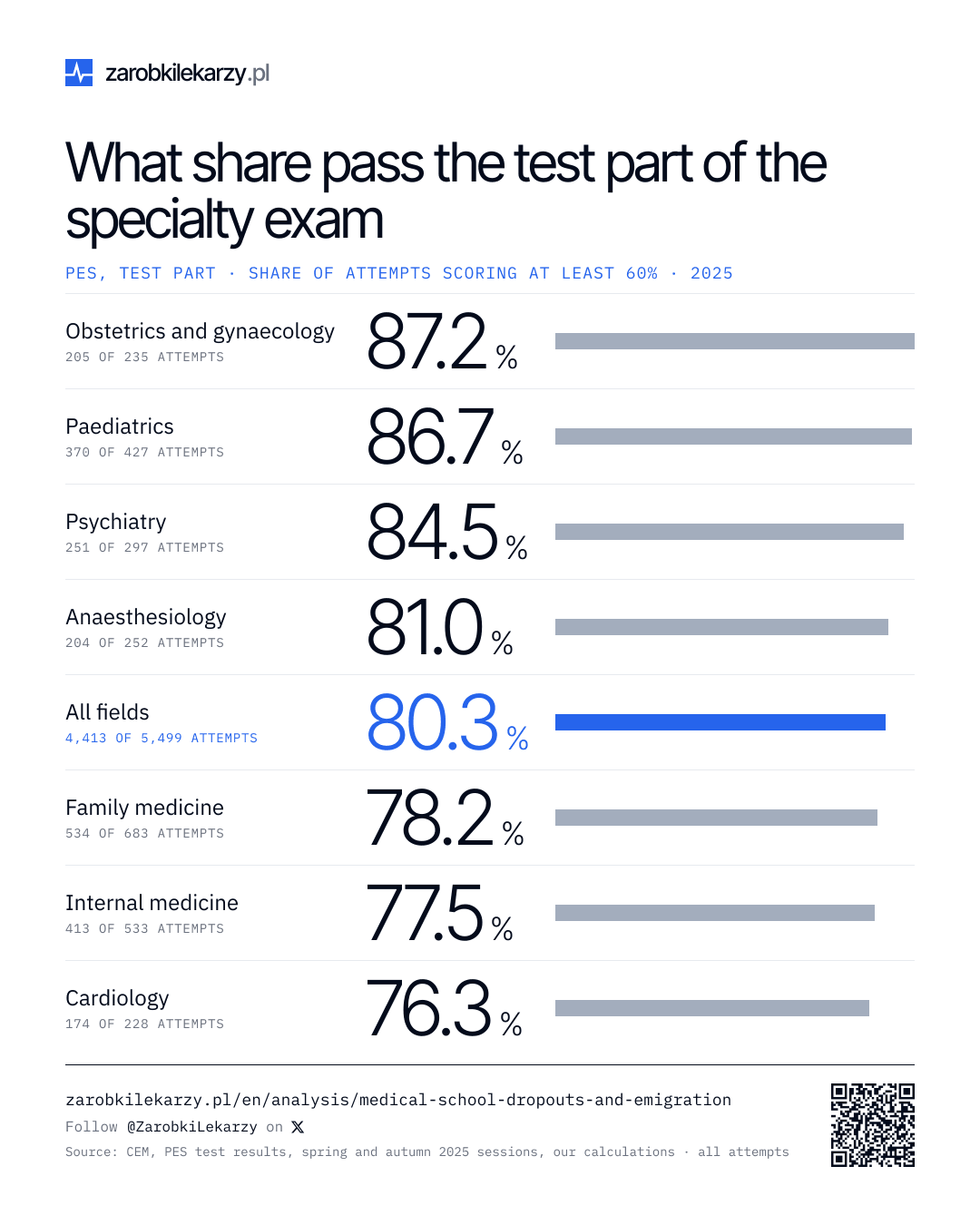
In spring 2026, 82.4% of attempts at the test were successful, and 90.4% among first-time candidates.34 This average combines two very different groups. At the first attempt, from 87.3 to 90.4% of candidates pass the test. At a later attempt, from 36.8 to 44.8%, which is less than half.34
At the first attempt, close to 90% of candidates pass the PES test. At a later attempt, less than half
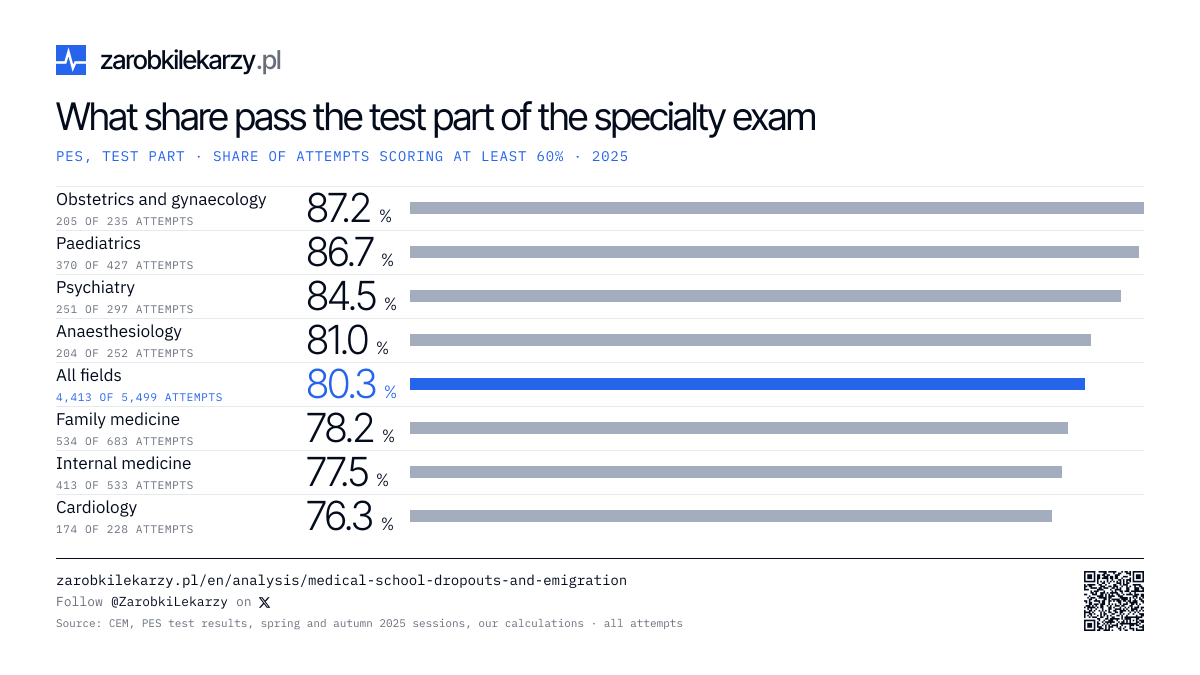
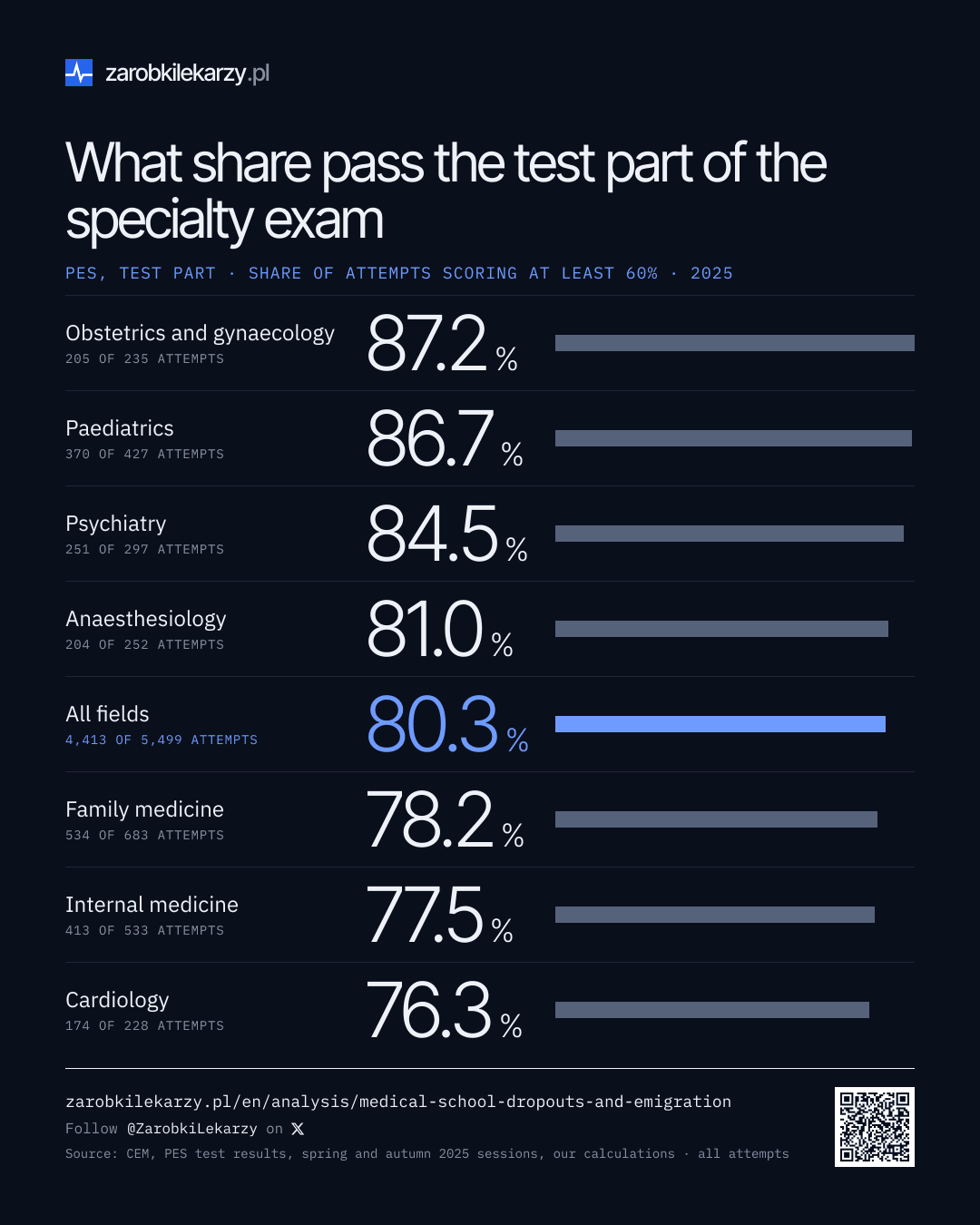
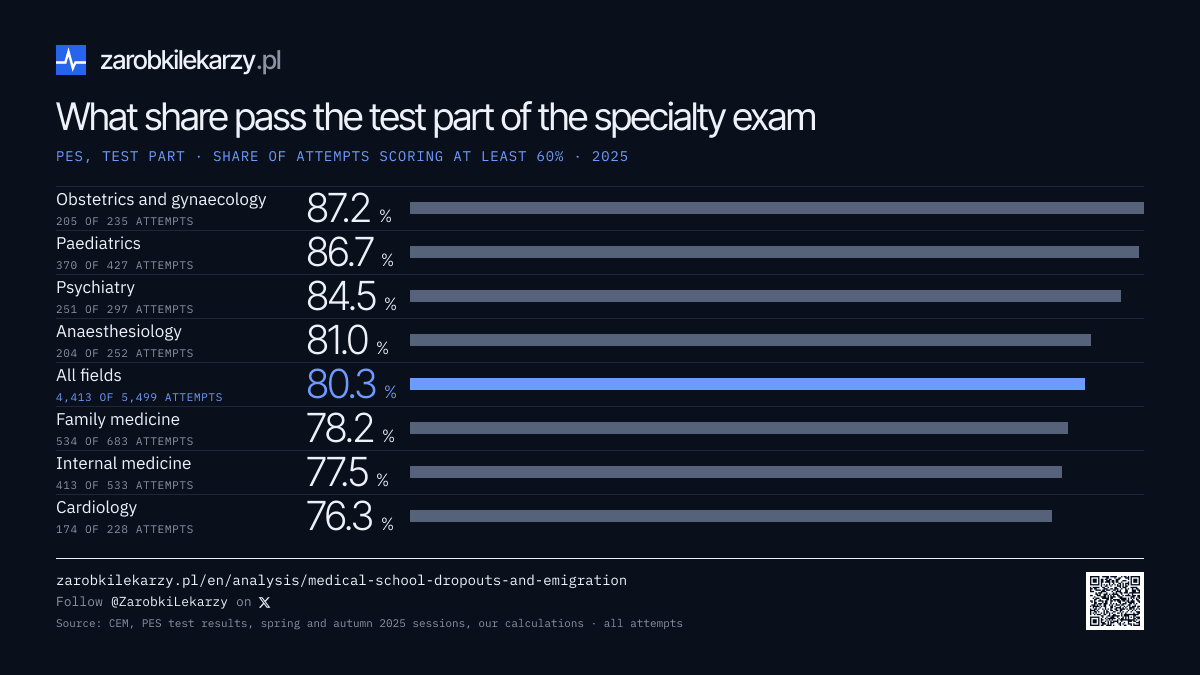
In 2025 later attempts accounted for 1,085 of 5,486 attempts, and 463 of them were successful. Why later attempts fare so poorly cannot be established from public data. Fields differ too: in 2025, among the seven fields with the most attempts, from 76.3% in cardiology to 87.2% in obstetrics and gynaecology passed the test.34 The results for these fields are shown in the infographic below the text. The CEM does not publish results of the oral part. According to the Ministry of Health, 93.1% of candidates passed the oral exam in autumn 2025 and 88.9% in spring 2026. Fewer people take it than the test, because a test result of at least 75% exempts them from it.35
After specialist training
Six years of study, 13 months of postgraduate internship and four to six years of specialist training add up to 11 to 13 years from admission to medical school to the title of specialist, not counting breaks and waiting for a place.36 What this means for the number of specialists in the coming years we describe in the analysis Why Poland is short of doctors. In 2025, 63.9% of doctors working directly with patients had a specialty.37
A specialist can work under an employment contract, on a contract or combine several contracts at different facilities. How these forms differ we describe in the texts Contract or employment and Multiple jobs and parallel contracts.
What is not known
- How many doctors complete specialist training each year. The Ministry of Health does not say, because many doctors extend their training. As an approximation it gives the number of people who passed the PES: from 3,376 to 4,388 a year in 2016–2021, together with dentists.38
- How long training really takes. Extensions are recorded in the SMK, but we have not found aggregate data on them.
- How many doctors give up. The last measurement comes from a NIK audit in 2016: 5.2% of those referred to a residency in the 2011–2014 recruitment rounds gave up.39
- How the oral exam goes. The CEM publishes only the test results; data on the oral part appear in the reply to one parliamentary question, for two sessions.35
Where else the data on a doctor’s path stop we describe in the analysis Who drops out of medical school in Poland, and who leaves the country.
Notes 39laws, data and statements we relied on
-
Act of 5 December 1996 on the professions of physician and dentist, consolidated text Dz.U. 2026 item 37 (in Polish): art. 16 sections 2–3 (modules, change of field after the basic module), art. 16c sections 1, 1a, 1d, 10, 10a, 11 and 17f (application in the SMK, deadlines, options, ranking, change of mode in the record), art. 16ea (new application for a residency), art. 16f sections 3–6 (content of the programme, team of experts), art. 16h sections 1, 1d and 2 (residency and non-residency modes, finishing training after the residency contract, minimum rate under a training contract), art. 16i sections 1–1c, 3, 5, 6 and 8–11 (working time, on-call duty, rest), art. 16j sections 1, 2, 2b and 2l–2n (financing of residency, reimbursement of on-call duty, commitment and penalty), art. 16l sections 1–2 (extension of training), art. 16m sections 1–2 and 4–6 (specialisation supervisor, allowance, limit on doctors, training plan), art. 16o (interruption of training and removal from the register), art. 16oa (duties and rights of the doctor), art. 16rb sections 1–1a, art. 16rc sections 1–2 and 10, art. 16s sections 2–4 and art. 16t sections 1 and 5 (PES), art. 19g sections 1 and 4a–4b (courses). ↩ ↩2 ↩3 ↩4 ↩5 ↩6 ↩7 ↩8 ↩9 ↩10 ↩11 ↩12 ↩13 ↩14 ↩15 ↩16 ↩17 ↩18 ↩19 ↩20 ↩21 ↩22 ↩23 ↩24 ↩25 ↩26 ↩27 ↩28 ↩29
-
Regulation of the Minister of Health of 4 May 2023 on the specialist training of physicians and dentists, Dz.U. 2023 item 975 (in Polish): annex 1 (list of specialties), annexes 2–5 (modules, minimum training length and specialties required beforehand) and annex 7 § 1 (points in the qualification procedure), § 7 (change of mode to a residency); our count. ↩ ↩2 ↩3 ↩4 ↩5 ↩6
-
CMKP, number of places for the autumn 2026 qualification procedure (in Polish), 27.08.2026 — places by voivodeship and field, including dental ones; among residency places 69 doctoral ones. National totals — our calculations. ↩
-
CMKP, final results of specialist training recruitment, spring 2026 session (in Polish), 14.04.2026 — 4,039 residency places and 8,221 non-residency places, 2,868 confirmations (1,927 and 941); shares of empty places — our calculations. ↩ ↩2
-
CMKP, modular specialist training programmes (in Polish), programmes for doctors without a specialty, section on the length of training. ↩
-
Bundesärztekammer, (Muster-)Weiterbildungsordnung 2018 (in German), version of 3.07.2026 — table of contents: specialties (“Facharzt/Fachärztin für …”) and subspecialties (“Schwerpunkt”), including “Schwerpunkt Kinder- und Jugend-Kardiologie” within paediatrics; our count. This is a model — the regulations of the medical chambers of the federal states are binding. ↩
-
Act No. 95/2004 Sb. on the conditions for obtaining and recognising the qualifications of physicians, dentists and pharmacists, annex 1 (in Czech), part “Lékaři” — 43 specialties with a minimum length of training “včetně délky vzdělávání v základním kmeni” (“including the length of training in the common trunk”); Decree No. 152/2018 Sb., annex 1 (in Czech), part I — 46 “nástavbové” (follow-on) fields; our count, as of 2026. ↩ ↩2
-
Real Decreto 183/2008, annex I point 1 (consolidated text, BOE, in Spanish) — specialties for which access requires a medical degree; our count. ↩
-
Socialstyrelsen, HSLF-FS 2021:8 on the specialist training of doctors (in Swedish), consolidated version in force from 1.12.2022, chapter 6 § 1 — table of basic specialties (“basspecialiteter”) and subspecialties (“grenspecialiteter”) and list of additional specialties (“tilläggsspecialiteter”); our count. ↩
-
CMKP, specialist training programme in general surgery (in Polish), 2023: courses (tables of the basic and specialist modules), procedures with codes A and B (tables of groups 1–3), specialty placement at another centre, on-call duty, self-study and publication, assessment methods; number of courses and days — our count. ↩ ↩2 ↩3 ↩4 ↩5 ↩6
-
CMKP, specialist training programme in internal medicine (in Polish), 2024 update: courses, procedures with codes A and B, on-call duty, self-study and publication. ↩ ↩2 ↩3
-
CMKP, specialist training programme in cardiology (in Polish), 2024 update: courses, procedures with codes A and B, on-call duty, self-study and publication. ↩ ↩2 ↩3
-
CMKP, specialist training programme in family medicine (in Polish), 2023: courses, procedures with code A, self-study, publication and running classes; the programme has no section on on-call duty. ↩ ↩2 ↩3
-
CMKP, co-financing to support the postgraduate education of doctors in selected priority fields (in Polish) — FERS1 project, accessed 28.10.2026. ↩
-
Act on medical activity, Article 96 (in Polish; consolidated text Dz.U. 2026 item 156) — work beyond an average of 48 hours a week after written consent; repeal from 1.01.2028: Article 3(2) and Article 12(3) of the Act of 5 July 2018 (in Polish; Dz.U. 2018 item 1532). ↩ ↩2
-
Ministry of Health, reply to parliamentary question No. 1995 (in Polish), 22.04.2016 — 22,786 doctors in training (as of 31.10.2015) and “about 6,000–8,000 specialisation supervisors”, worked out from the limit in Article 16m(4) of the Act on the professions of physician and dentist. ↩
-
NIK, “Funkcjonowanie szpitalnych oddziałów anestezjologii i intensywnej terapii oraz bloków operacyjnych w województwie podkarpackim” (“The functioning of hospital anaesthesiology and intensive care wards and operating theatres in the Podkarpackie voivodeship”, in Polish), P/21/088, 2022, pp. 42–43. ↩
-
Residents’ Agreement of the OZZL trade union (Porozumienie Rezydentów OZZL), report on the survey on the on-call duty of doctors training in psychiatry (in Polish), 2025 — online survey, 825 responses, including 639 doctors in training; answers to the question about the presence of a specialist at the facility during on-call duty. ↩
-
NIK, “Kształcenie i przygotowanie zawodowe kadr medycznych” (“Education and professional preparation of medical staff”, in Polish), 2016, p. 42 — description of a voivode’s audit of 2014–2015 in periodontology and the reply of the Ministry of Health’s Department of Science and Higher Education of 31.03.2015. ↩
-
Government Legislation Centre, draft act amending the Act on the professions of physician and dentist and certain other acts (UD384) (in Polish) — draft of 3.06.2026, Article 1 point 36 (new wording of Article 16m sections 1–1e). ↩
-
List of legislative work of the Council of Ministers, draft UD384 (in Polish) — planned date of adoption: fourth quarter of 2026, accessed 28.10.2026. ↩
-
Supreme Medical Chamber, “Prezydium NRL wnioskuje o odrzucenie nowelizacji ustawy o zawodach lekarza i lekarza dentysty” (“The Presidium of the Supreme Medical Council calls for the amendment to be rejected”, in Polish), 13.07.2026 — position No. 6/26/X of the Presidium of 10.07.2026, points 27–30 and 32. ↩ ↩2
-
Ministry of Health, reply to parliamentary question No. 13211 (in Polish), 1.12.2025, p. 3 — 31,509 doctors and dentists in specialist training (as of 30.09.2025), compared with 23,582 at the end of 2015. ↩
-
NIK, “Zasoby kadry medycznej w systemie ochrony zdrowia” (“Medical staff resources in the healthcare system”, in Polish), P/22/047, 2023, p. 43 — number of people in specialist training on 30.06.2022, including the residency and non-residency modes. ↩
-
Regulation of the Minister of Health of 25 June 2026 on the basic monthly salary of physicians and dentists in specialist training under residency, Dz.U. 2026 item 856 (in Polish), § 1 and 2; priority fields — Regulation of the Minister of Health on determining priority fields of medicine, consolidated text Dz.U. 2024 item 791. ↩
-
NIK, “Wykonanie budżetu państwa w 2025 r. w części 46 – Zdrowie oraz wykonanie planu finansowego Funduszu Medycznego” (“Implementation of the 2025 state budget in part 46 – Health and of the financial plan of the Medical Fund”, in Polish), P/26/001, 2026, p. 44 — chapter 85157 “Staże i specjalizacje medyczne”: budget act PLN 5,786,000.0 thousand, implementation PLN 3,973,963.7 thousand (68.7%). ↩ ↩2
-
Health Committee of the Sejm, full record of sitting No. 149 (in Polish), 18.06.2026, pp. 6 and 14 — statements by representatives of the Ministry of Health on the report on the implementation of the 2025 budget. ↩ ↩2
-
Budget Act for 2026 of 9 January 2026, Dz.U. 2026 item 62 (in Polish), annex 2, part 46 – Health, chapter 85157: PLN 5,312,142 thousand. ↩
-
Regulation of the Council of Ministers of 11 September 2025 on the minimum wage and the minimum hourly rate in 2026, Dz.U. 2025 item 1242 (in Polish), § 2. ↩
-
TVN Warszawa, “1,6 mln zł w rok — kontrola w szpitalu i interwencja izby lekarskiej” (“PLN 1.6 million in a year — an inspection at the hospital and an intervention by the medical chamber”, in Polish) — more than PLN 1.6 million from self-employment according to the asset declaration; 3,976 hours in 2025 at the hospital where the doctor coordinated the SOR alone, and work at three other facilities. ↩ ↩2 ↩3
-
Rynek Zdrowia, “Lekarz na celowniku izby lekarskiej — średnio 331 godzin w miesiącu” (“A doctor in the medical chamber’s sights — an average of 331 hours a month”, in Polish), 15.06.2026 — 3,976 hours in 2025 according to data from the hospital where the doctor coordinated the SOR; work at four facilities. ↩
-
Report of the Health Committee on the government bill on pay limits, print No. 3193 (in Polish), 7.10.2026 — limit of two full-time posts in total, at least a half-time post in a hospital, consent to further employment. ↩
-
Additional report of the Health Committee, print No. 3193-A (in Polish), 21.10.2026 — amendments from the second reading, including No. 9 (consent procedure), adopted by the Sejm on 22.10.2026. ↩
-
Medical Examinations Centre, results of the PES test part (in Polish) — lists of results of the sessions from spring 2023 to spring 2026 in all fields (one code number = one attempt) and the “first-time candidates” statistics attached to the lists; shares — our calculations. ↩ ↩2 ↩3
-
Ministry of Health, reply to parliamentary question No. 18220 (in Polish), 20.07.2026 — tables for the autumn 2025 and spring 2026 sessions: those who took and those who passed the oral exam, total for all fields — our calculations. ↩ ↩2
-
Regulation of the Minister of Health of 24 February 2023 on the postgraduate internship of physicians and dentists, Dz.U. 2023 item 377 (in Polish), § 3 and annex 1. ↩
-
Statistics Poland (GUS), “Zasoby kadrowe w wybranych zawodach medycznych na podstawie źródeł administracyjnych” (“Human resources in selected medical professions based on administrative sources”, in Polish), 2025 edition, p. 3. ↩
-
Ministry of Health, reply to parliamentary question No. 31481 (in Polish), 9.04.2022 — table “Number of doctors who passed the PES”, spring and autumn sessions, doctors and dentists; annual totals — our calculation. ↩
-
NIK, “Kształcenie i przygotowanie zawodowe kadr medycznych” (“Education and professional preparation of medical staff”, in Polish), 2016, p. 25. ↩
Infographic to download
1 graphic · portrait and landscape, light and dark
A graphic to share in two formats — portrait 1080×1350 (Instagram, Facebook, X) and landscape 1200×675 (X, LinkedIn, presentations) — light and dark. The sources, the page address and a QR code to the page are on the graphic.
What share pass the test part of the specialty exam
Change history 2
latest change 1 November 2026 · Corrected the description of on-call duty beyond the programme: rest after duty under the programme counts towards a resident’s working time and does not reduce their salary, and no salary is due only for rest after additional duty. Added the conditions that determine whether rest extends the training, and the exceptions to the ban on independent duty after a refusal.
CorrectionCorrected the description of on-call duty beyond the programme: rest after duty under the programme counts towards a resident’s working time and does not reduce their salary, and no salary is due only for rest after additional duty. Added the conditions that determine whether rest extends the training, and the exceptions to the ban on independent duty after a refusal.
Added a chart of residency and non-residency places for the autumn 2026 recruitment and the course of four specialist training programmes, module by module.