This text describes the path from the matura — the Polish secondary-school leaving examination — to specialist training: which matura subjects count in admissions, how many points you need, what you learn over six years and how anatomy is taught in the dissection room, and then, after graduation, the Medical Final Examination (LEK), the internship and specialist training. We compare the difficulty of medical studies with other demanding programmes — law, psychology, architecture, mathematics, physics and computer science — using the same measures: the cut-off score, the number of applicants per place and the share of students who get through the first year.
These numbers show that medicine is hard to get into mainly because there are many more applicants than places. The matura result required is similar to that for law or psychology, and fewer students drop out during their studies than in many other programmes. What sets medicine apart is its length: six years and at least 5,700 hours of classes.
5,700hours
of classes over 12 semesters is the minimum required by the standard of medical education
ExactDz.U. 2021 item 755
32.8per place
applicants per place in medicine at the University of Warsaw in 2026 — the most at the university; in law 5.5
ExactUniversity of Warsaw
81.3%
of medical students move on to the second year on time; in law 73.3%, in mathematics 42.3%
6%
of those who took extended-level biology in 2026 scored at least 80% in it
The matura and admissions
Admission to medicine depends above all on extended-level biology and chemistry, and at many universities also on mathematics or physics. Each university has its own formula. The Medical University of Warsaw adds up the results in biology, chemistry and physics or mathematics to a maximum of 300 points, the Jagiellonian University takes the average of the same subjects on a scale of up to 100, and the Medical University of Białystok adds up two subjects to a maximum of 200 points.1 That is why below we compare the percentage of the maximum score rather than the points themselves.
For 2026/27, 39 universities received an admission limit for full-time studies in Polish.2 Fourteen of them published their cut-off, meaning the score of the last person admitted. The others show results only to applicants, in their accounts in the admissions system.
At most universities the cut-off for medicine in 2026 was between 75% and 84% of the maximum score
At medical universities and large universities the cut-offs were between 75.5% and 83.7% of the maximum. Two smaller institutions that publish lists with scores came out lower: at the University of Applied Sciences in Nowy Targ the last qualified candidate had 68.5% of the maximum, and at the Academy of Applied Medical and Social Sciences in Elbląg — 56.6%.3
What does 80% in the matura mean? According to the percentile scales of the Central Examination Board (CKE), in 2026 at least that much in extended-level biology was scored by 6% of those taking the subject, and in extended-level chemistry by 10%.4 That is a result from the upper part of the distribution, but measured among everyone taking the exam, not among applicants to medicine. The CKE does not publish such data.
The cut-off is not set in advance. It is the score of the last person who fit within the limit of places, so it rises when applicants multiply and places do not. The Jagiellonian University shows this well. In 2024–2026 the number of places in medicine barely changed (258, 253, 252), while the number of applicants grew from 1,085 to 1,779. Over that time the cut-off rose from 73.67 to 81.33 points.5 The difficulty of the matura in a given year also affects the cut-off, but with a fixed number of places it is the number of applicants that decides how high you have to reach. Who sets the number of places, and on what basis, we describe in the analysis Cutting medical school places and in the text on restricted access to the profession.
Old and new universities
Up to 2014/15, 12 universities had an admission limit for medicine: nine medical universities, the Jagiellonian University, Nicolaus Copernicus University and the University of Warmia and Mazury. From 2015/16 another 27 universities received a limit, 12 of them in a single year, 2023/24.6 Below we call them “new” and the first twelve “old”. We divide universities the same way in the analysis Who drops out of medical school, and who leaves the country.
Since 2015/16 the number of universities offering medicine has grown from 12 to 39
The new universities are usually small. In 2026/27 they have from 40 to 375 places, and 14 of the 27 have fewer than 100. The old ones have from 270 to 1,127. Together the new universities received 3,232 of the 10,730 places, or 30%, and in full-time studies in Polish 2,486 of 7,051, or 35%.2 The old universities also gained places: from 5,202 in 2012/13 to 7,498 in 2026/27.6
The cut-offs do not show a divide between old and new universities. In the cut-off chart above the new ones are marked in cobalt. The cut-offs of the old universities in 2026 were between 75.5% and 83.7% of the maximum, and those of the four new ones that publish them (Jan Kochanowski University in Kielce — 83.6%, University of Warsaw — 79.8%, Cardinal Stefan Wyszyński University in Warsaw — 76.5%, Wrocław University of Science and Technology — 76.5%) fell within the same range. Only two small new academies, which publish nothing but lists of qualified candidates, came lower.3 How the new universities fare in dropout and in the LEK we describe below, in the section on the quality of training.
What medical studies cost
Full-time studies in Polish at public universities are free. You pay for part-time studies — in the limit for 2026/27 that is 1,734 of 10,730 places — for studies at non-public universities, full-time ones too, and for studies in a foreign language.27
A year of paid medical studies costs from PLN 40,000 to PLN 69,500 at a public university
Six years of part-time studies at the Medical University of Warsaw cost PLN 417,000 (≈ €94,900) — the university gives this amount itself. Non-public universities charge from PLN 48,000 to PLN 60,000 for the first year, and studies in English at the Medical University of Warsaw cost €18,800 a year.8 The fee may not exceed the cost of running the programme, and during the studies the university may raise it at most by inflation, by no more than 30% in total.7
Those who pay for studies in Polish have been able, since December 2021, to take out a medical studies loan. The bank transfers it to the university, at most PLN 22,000 (≈ €5,010) per semester, or up to PLN 264,000 (≈ €60,100) for the whole programme — less than the tuition at most universities.9 Interest during the studies and for the following 12 years is covered by the state budget. After that the doctor repays the loan over 12 years and pays half of the interest. The loan is written off in full if, for 10 years within 12 years of graduation, the doctor works in Poland at a facility treating patients with public money and in that time becomes a specialist in one of the priority fields.10 By the end of September 2026 the bank had signed 5,807 such contracts worth a total of PLN 1.27 billion (≈ €289 million), and interest subsidies cost the budget PLN 25.6 million (≈ €5.83 million) in 2025 alone.11
How much the state spends on a student in free studies is not known. The Ministry of Health replies that in the subsidy for universities “it is not possible to separate the funds” allocated to medicine. As an approximation it points to the fee for part-time studies, from PLN 44,000 (≈ €10,000) to almost PLN 60,000 (≈ €13,700) a year12 — although the Medical University of Warsaw and the Pomeranian Medical University charge more.
Compared with other demanding programmes
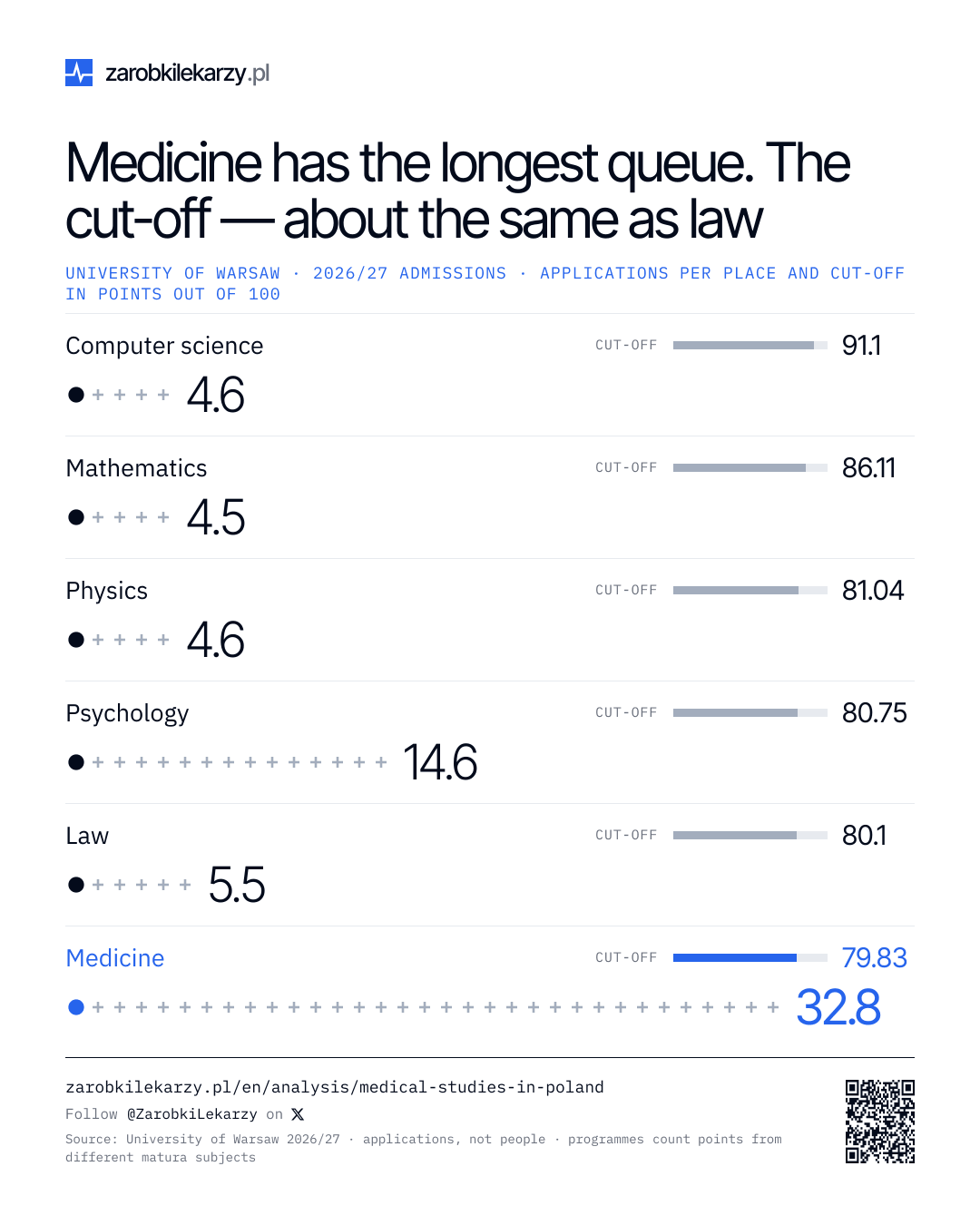
Programmes are easiest to compare at the same university, because then the cut-off means the same thing. The University of Warsaw publishes for all programmes the score of the last person admitted on a scale of up to 100 points and the number of applicants per place.13
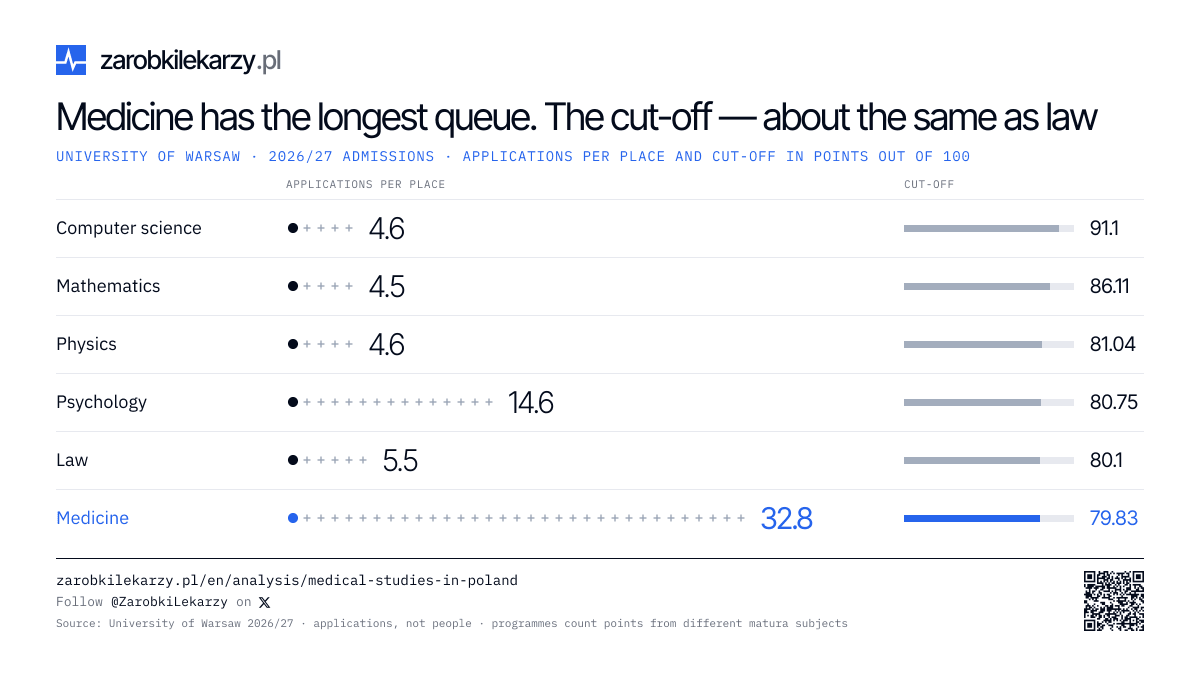
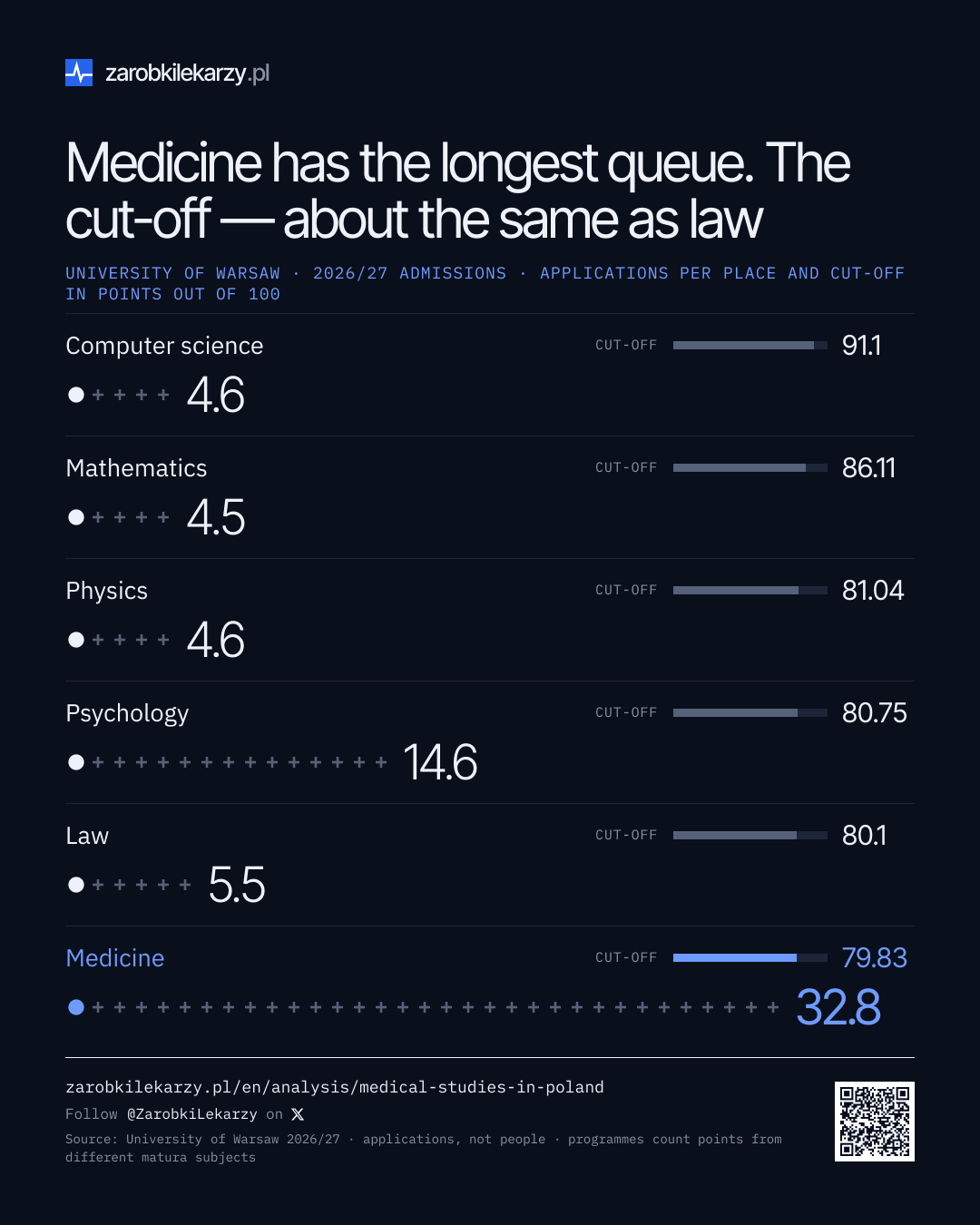
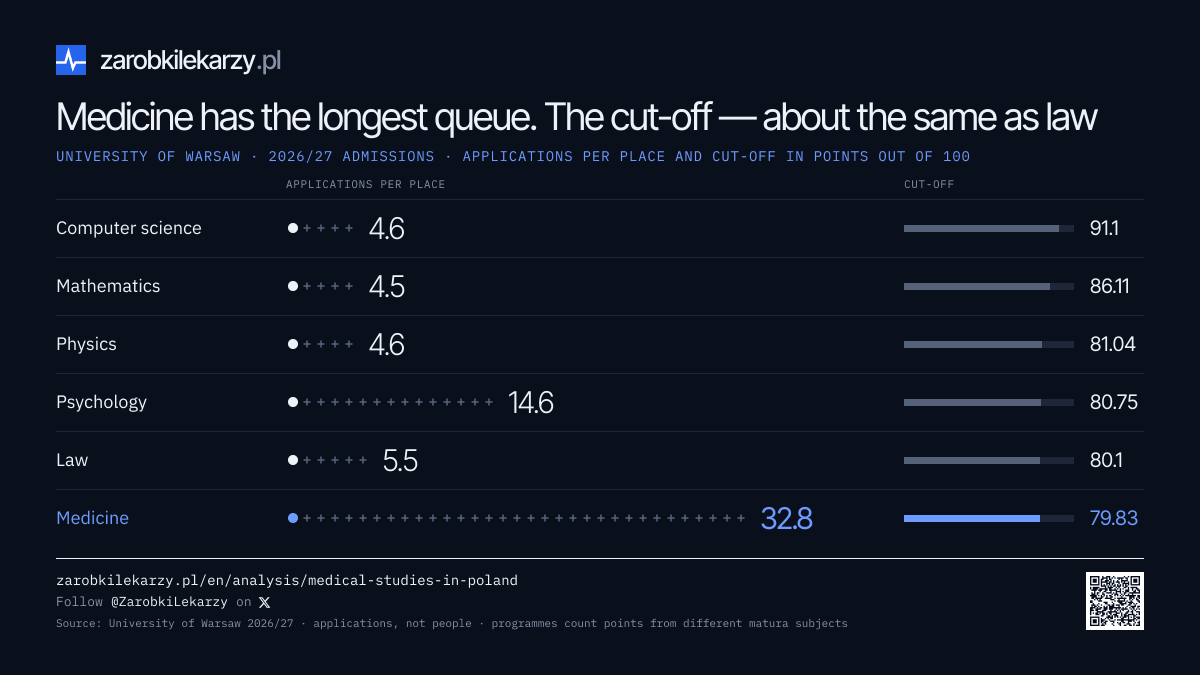
For each place in medicine at the University of Warsaw there were 33 applications — seven times as many as for computer science. And the cut-off was lower
At the Jagiellonian University the picture is similar. In 2026 the last person admitted to law had 86 points, to psychology at the Faculty of Philosophy 85.5, to analytical computer science 92, and to medicine 81.33. For ordinary computer science and mathematics 60 and 64 points were enough, because there were fewer applicants per place — 3.96 and 2.52.5
The SGH Warsaw School of Economics comes out similarly. It admits to full-time studies in Polish from one list for the whole school, and students choose their programme at the end of the first year. In 2026 its cut-off was 336 of 433 points, or 77.6% of the maximum. That is within the range of the cut-offs for medicine (75.5–83.7%, chart above).14 The SGH score, however, includes four matura subjects and the school’s own test, so the comparison is approximate. SGH does not publish the number of applicants per place.
Programmes count points from different matura subjects, so the same points do not mean exactly the same thing. The CKE scales show, however, that 80% at extended level is a similarly rare result in the subjects that count for these programmes: in 2026 it was achieved by 6% of those taking biology, 8% mathematics, 10% chemistry and 14% Polish. The exception is English, in which 46% of candidates scored at least 80%.4 A foreign language counts towards the result in some programmes — at the Jagiellonian University it is 30% of the points for law, and at the University of Warsaw 10% of the points for medicine.15
So the matura result required for medicine is similar to that for law or psychology at the same universities and lower than for the most popular computer science programme. What sets medicine apart is the number of applicants.
Who gets through the first year
How many students move on says more about the studies themselves. The Ekonomiczne Losy Absolwentów system (ELA, graduate tracking), run by the National Information Processing Institute for the minister of science, follows every cohort using the same method in all programmes.16
81.3% of medical students move on to the second year on time — more than in law and psychology
| Length of studies | Second year on time | Dropped out | |
|---|---|---|---|
| Medicine | 6 years | 81.3% | 7.4% |
| Architecture | 4 years | 82.3% | 8.6% |
| Psychology | 5 years | 74.8% | 9.8% |
| Law | 5 years | 73.3% | 7.5% |
| Computer science | 4 years | 62.6% | 17.7% |
| Mathematics | 3 years | 42.3% | 12.0% |
| Physics | 3 years | 34.4% | 21.2% |
In medicine a similar share of students moves on to the second year on time as in architecture, clearly more than in law and psychology and almost twice as many as in mathematics. For medicine, however, ELA does not give the number of students who graduate on time, so we do not compare that measure with other programmes. Other data show that roughly 80% of Poles who start medicine finish on time — see Who drops out of medical school, and who leaves the country. “Dropping out” in ELA means leaving without taking up other studies in Poland, which is why these figures are lower than dropout counted from removals from the student register.
The longest programme
What really sets medicine apart is its length. The standard of medical education requires 12 semesters, at least 5,700 hours of classes and 360 ECTS credits.17 Long-cycle architecture studies, which also have a standard, require 3,800 hours for the same number of ECTS credits.18 Law and psychology are five-year programmes worth 300 ECTS credits, without an education standard.19 Psychology will get one from 19 February 2027.20
Six years: subjects and exams
The standard divides the studies into groups of classes. The first years are basic sciences: anatomy, histology, biochemistry, physiology, and then pathology, microbiology and pharmacology. From the fourth year clinical subjects, taught in hospitals, dominate.21 The sixth year consists of 900 hours of practical clinical teaching on hospital wards, plus 600 hours of summer placements.17
Six years, 5,760 hours and 30 exams: the medical curriculum at the Medical University of Warsaw
Hover over a subject or tap it to see the hours and ECTS credits.
The Medical University of Warsaw curriculum for students who started in 2026 has 30 exams: two in the first year (anatomy and histology), then from five to seven a year.21 Each exam has three dates — the first and two resits. Those who fail may in some cases be admitted conditionally to the next year or repeat the year; at the Medical University of Warsaw the same year may be repeated only once.22

Clinical classes with patients
Practical classes in clinical subjects may take place “only in clinics and hospital wards” whose profile and number of patients treated allow students to acquire the required skills. On top of that come exercises in simulation centres, and in the sixth year simulation may take from 5% to 15% of the hours. A group at a patient’s bedside has at most six people.23
A university does not need its own hospital. The act on the professions of physician and dentist allows practical teaching in healthcare providers that have an agreement with the university, if they treat patients within the scope of the curriculum, employ doctors with the appropriate qualifications and have the necessary diagnostic facilities. The student works there under the direct supervision of a tutor.24 Under the act on medical activity, hospitals run by medical universities are obliged to train students and make wards available to the university, and other hospitals may do so on the basis of an agreement. Only such hospitals and wards may use the names “clinic”, “clinical” and “university”.25 The Supreme Audit Office (NIK), which in 2025 audited ten clinical hospitals, found that they provided proper conditions for training students.26
Anatomy and the dissection room
Anatomy is the first big exam. At the Medical University of Warsaw it takes 180 hours of the first year, at the Jagiellonian University 190, at Wroclaw Medical University 160, and in Białystok 190.27 Most of these hours are practicals in the dissection room, on specimens from human bodies, bones and models. Structures have to be known by their Latin names, and at the Medical University of Warsaw also in Polish and English.
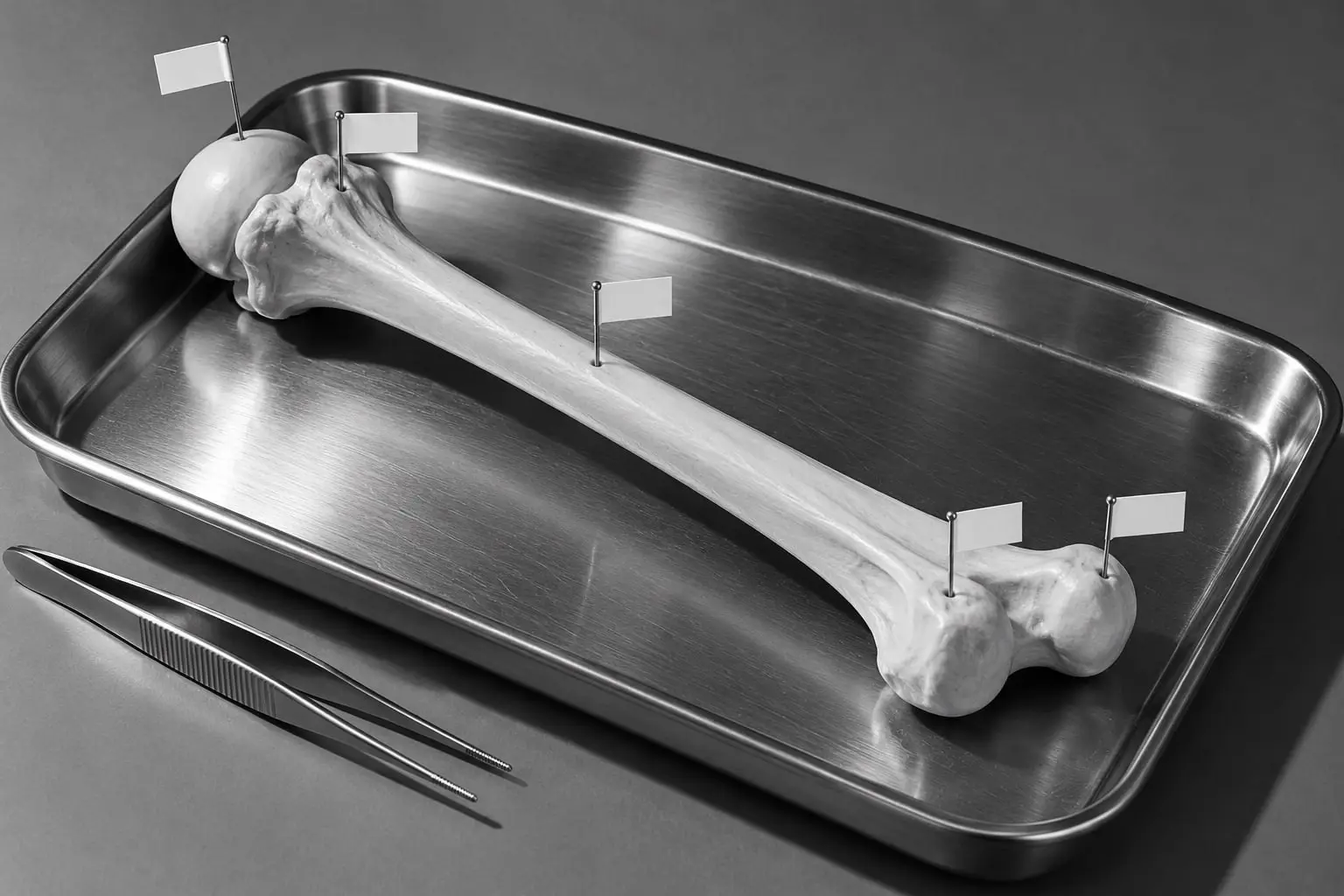
The exam usually has two parts. In the practical part the student moves from station to station and names the structures pointed to by a pin on a specimen. At the Medical University of Warsaw there are 30 stations with two pins each and one minute for each; at the Jagiellonian University — 20 specimens, 40 seconds each, and you pass after identifying at least half. The second part is a test with 100–120 questions.28 During the year there are also tests; at the Jagiellonian University there are five, and you need at least half of their points to sit the exam.28
In the anatomy exam you have to name in Latin the structure a pin points to
Osteology · year 1
Bones
ossa
Anatomy starts with the bones. Each must be known in Latin, and in the practical exam students identify structures marked with a pin on a specimen.
- 206
- bones in the adult skeleton
- 160–190
- hours of anatomy in the first year
- 20–30
- stations at the practical exam
Hover over a bone or click it. The humerus and the femur have pins.
All bones in the drawing
- cranium
- mandibula
- vertebrae cervicales
- vertebrae thoracicae
- vertebrae lumbales
- os sacrum
- os coccygis
- manubrium sterni
- sternum
- costae
- clavicula
- scapula
- humerus
- radius
- ulna
- ossa carpi
- ossa metacarpi
- phalanges manus
- ossa coxae
- femur
- patella
- tibia
- fibula
- ossa tarsi
- ossa metatarsi
- phalanges pedis
Angiology · year 1
Heart and vessels
systema cardiovasculare
Darker lines are arteries, lighter ones are veins. A number on the drawing opens the description of the vessel.
- Heart cor
- Aortic arch arcus aortae
- Superior vena cava vena cava superior
- Inferior vena cava vena cava inferior
- Common carotid artery and internal jugular vein arteria carotis communis, vena jugularis interna
- Renal artery and vein arteria et vena renalis
- Femoral artery and vein arteria et vena femoralis
- Great saphenous vein vena saphena magna
- Radial artery arteria radialis
- Median cubital vein vena mediana cubiti
The specimens most often come from people who during their lifetime donated their body to the university. The act on cemeteries requires a written declaration for this; universities also accept bodies that no family member buried, on the basis of a decision of the district head (starosta).29 Body donation programmes have their own rules — the Jagiellonian University, Wroclaw Medical University and the University of Warsaw require a declaration certified by a notary.30 After the classes end, universities bury the donors and hold farewell ceremonies; at the University of Rzeszów the third such ceremony took place in 2025.31
Virtual tables, headsets and 3D printing
Since the 2025/26 academic year the rules have explicitly allowed anatomy to be taught outside the dissection room. From 5% to 15% of the hours of practicals in morphological sciences may take place in simulated conditions: on a virtual anatomy table, on 3D specimens and models, charts and manikins. The dissection room stays “to the extent of hours allowing the required learning outcomes to be achieved”.23
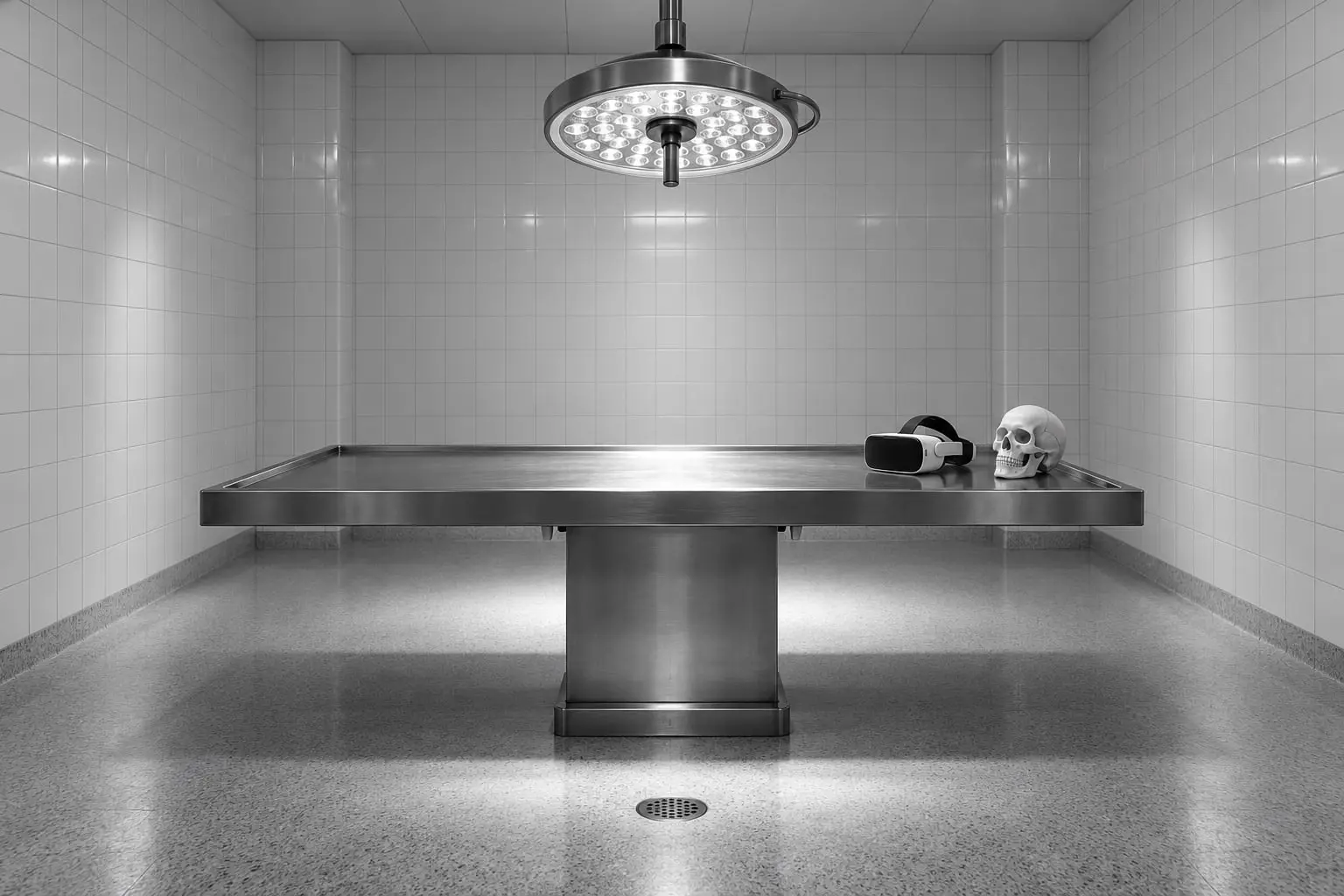
Virtual tables — large touch screens with a three-dimensional model of the body that can be cut layer by layer — are already in use at more than a dozen universities. The Medical University of Lodz bought two for PLN 1.114 million (≈ €254,000) from EU funds in 2017, the Medical University of Białystok one in 2023, and the Medical University of Warsaw one in 2024 for PLN 632,500 (≈ €144,000).32 Since 2022 Jagiellonian University Collegium Medicum has used 10 HoloLens 2 augmented reality headsets in anatomy classes, in which a model of the body is displayed in the space of the room.33 In 2026 the Pomeranian Medical University opened a new anatomy building with virtual reality headsets and a virtual table — next to 75 dissection stations.34 None of the universities whose information we obtained has replaced the dissection room with technology.
The anatomy lab the Pomeranian Medical University opened in 2026: VR headsets next to dissection stations
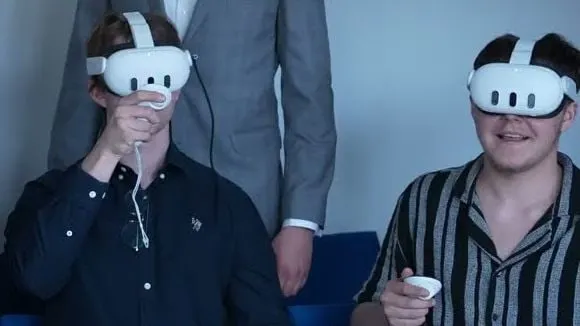
In studies the new methods do no worse than traditional ones, and VR headsets and 3D-printed models even gave better test results in most meta-analyses. The details:
- Virtual reality (VR) headsets gave moderately better test results than traditional methods in two meta-analyses of randomised trials, but a third found no significant difference.35
- Augmented reality (AR), a model overlaid on the view of the room, did no better than traditional methods in a meta-analysis of 24 studies.35
- 3D-printed models give the most consistent positive result, although the studies are small and very varied.36
- Virtual tables have no meta-analyses of randomised trials. In a review of 22 studies, student results improved in 86% of them, but only 2.4% to 30.2% of those surveyed preferred to learn on the table alone.37
- Dissecting yourself did not give better test results than learning on prepared specimens, models or with computer programs — that was the finding of a review of 27 studies involving 7,731 people. The studies, however, tested knowledge shortly after the classes.38
The new methods also have side effects. In a survey of 84 students at Jagiellonian University Collegium Medicum, 71% reported symptoms resembling motion sickness when using VR headsets.39
 AnalysisArtificial intelligence in medicine: where things stand in 2026What AI can already do in diagnosis, radiology and surgery, how it performs in independent studies and why certification is the brake.Read the analysis
The dissection room requirement itself does not come from an act of parliament or from the medical self-government, but from the science minister’s regulation on the education standard. A university’s infrastructure is to include “in particular a dissection room and a microscopy laboratory”, and classes may also take place at healthcare providers that have an agreement with the university.17 The rules do not, however, define what a dissection room is — for example, whether a lab with prepared specimens from human bodies, where students do not dissect themselves, is enough.
The dispute over dissection rooms concerns mainly the new medical programmes. In 2023 the Residents’ Agreement of the OZZL doctors’ union stated that 17 units were running medicine without their own dissection room. These are the organisation’s data, without a list of universities or a description of the method, so they cannot be checked.40
More students and the quality of training
Since 2023 the medical self-government has warned that the rapid growth in students and new programmes will lower the standard of training. The Presidium of the Supreme Medical Council wrote in 2025 that ensuring proper quality “requires qualified and experienced teaching staff and access to clinical facilities”.41 These are the same conditions the education standard lists: a dissection room, classes with patients in clinics and small groups. So the dispute is about whether universities that admit more and more students meet these conditions.
A medical programme may be launched by an academic university with a high research category in medical sciences, or by a university that already runs studies preparing for a medical profession, such as nursing, and has a research category in medical or health sciences or employs at least 12 academic teachers in these fields. Permission is granted by the minister of science after consulting the Polish Accreditation Committee (PKA) and the minister of health, but their opinions are not binding.42 In 2022–2023 ten universities received permission despite a negative opinion from the PKA.43
When in 2024 the PKA, at the minister’s request, assessed eight of these programmes, five received a negative assessment. The ministry did not withdraw their permission, but it did not grant them an admission limit for the following year. A year later three of those five universities were assessed positively, and two — the universities of applied sciences in Nowy Sącz and Nowy Targ — negatively again.43 Earlier the Supreme Audit Office (NIK) found that staff shortages concerned “mainly newly created programmes at universities that had no experience in training medical staff”. The Ministry of Health had also not examined how exceeding admission limits affects the quality of training.44
Whether weaker doctors are coming through is not known, because programmes opened in 2023 will produce their first graduates in 2029 at the earliest. The results of universities that already have graduates, however, do not line up with the divide into “old” and “new”. In the spring 2026 LEK session, the highest average among first-time candidates was achieved by graduates of the University of Opole and Lazarski University, that is, two new universities. The lowest was at the Silesian Academy, also new, and the medical universities in Warsaw, Lublin and Gdańsk also came below the average.45
In 2026 the highest and the lowest LEK results were achieved by graduates of new universities
Dropout by university is shown only by a survey of the Supreme Medical Chamber (NIL) for 2023/24. In it, the universities themselves reported what share of students were not promoted to the next year, and NIL did not define what that means. In the first year the results range from 0 to 24%. The median is 10% among the eight “old” universities and 10.5% among the ten “new” ones in NIL’s classification, and 14% if two new universities with a result of zero, which may not yet have completed their first cohort, are left out.46 The results for each university and a comparison of LEK results from six sessions are in the analysis Who drops out of medical school, and who leaves the country.
The LEK is a test of knowledge, not of skills at the patient’s bedside. Those are not compared publicly between universities by anyone. The PKA responds to the self-government’s criticism that claims of a general decline in quality are “too general, subjective and unfair” towards universities with positive assessments. It also points out that its procedures for medical programmes were approved in 2025 by the World Federation for Medical Education (WFME), and that the PKA itself decides neither on creating programmes nor on admission limits.47
What tools exist
Some tools already exist. The PKA assesses a new medical programme after the first, third and sixth year, and a university with a negative assessment may not receive an admission limit or may lose its permission.43 The science ministry has also announced a change in the law: only academic universities with a high research category (A+, A or B+) in medical sciences or health sciences could apply to run medicine. The change has not been passed so far: the consolidated text of the act from September 2026 still provides for both routes to a medical programme.4342 The Supreme Medical Council proposes more: a binding PKA opinion, phasing out programmes without a positive assessment, a re-assessment of all programmes opened since 2017 and supervision by one ministry instead of two.48
After graduation: the LEK and the internship

After the sixth year the graduate takes the Medical Final Examination (LEK): 200 test questions, passed with 56% correct answers.49 In autumn 2025, 98.3% of candidates passed — more than in the exams that end the path to other professions of public trust.50
In autumn 2025, 98.3% of candidates passed the LEK — more than the advocates’ and legal advisers’ exams and the architect and building engineer exams
In the autumn 2026 session, 87.1% passed at the first attempt. The CEM does not give the reason for the drop. Exams from previous years can be taken on our site: the LEK exam online (in Polish).
Postgraduate internship
The diploma does not yet give the full right to practise. At first the graduate receives it only for the duration of the postgraduate internship.51 A doctor’s internship lasts 13 months. The fixed part covers internal medicine (11 weeks), paediatrics and surgery (8 each), family medicine (6), emergency medicine (3) and intensive care (2), and for 10 weeks the intern trains in a field of their own choice.52
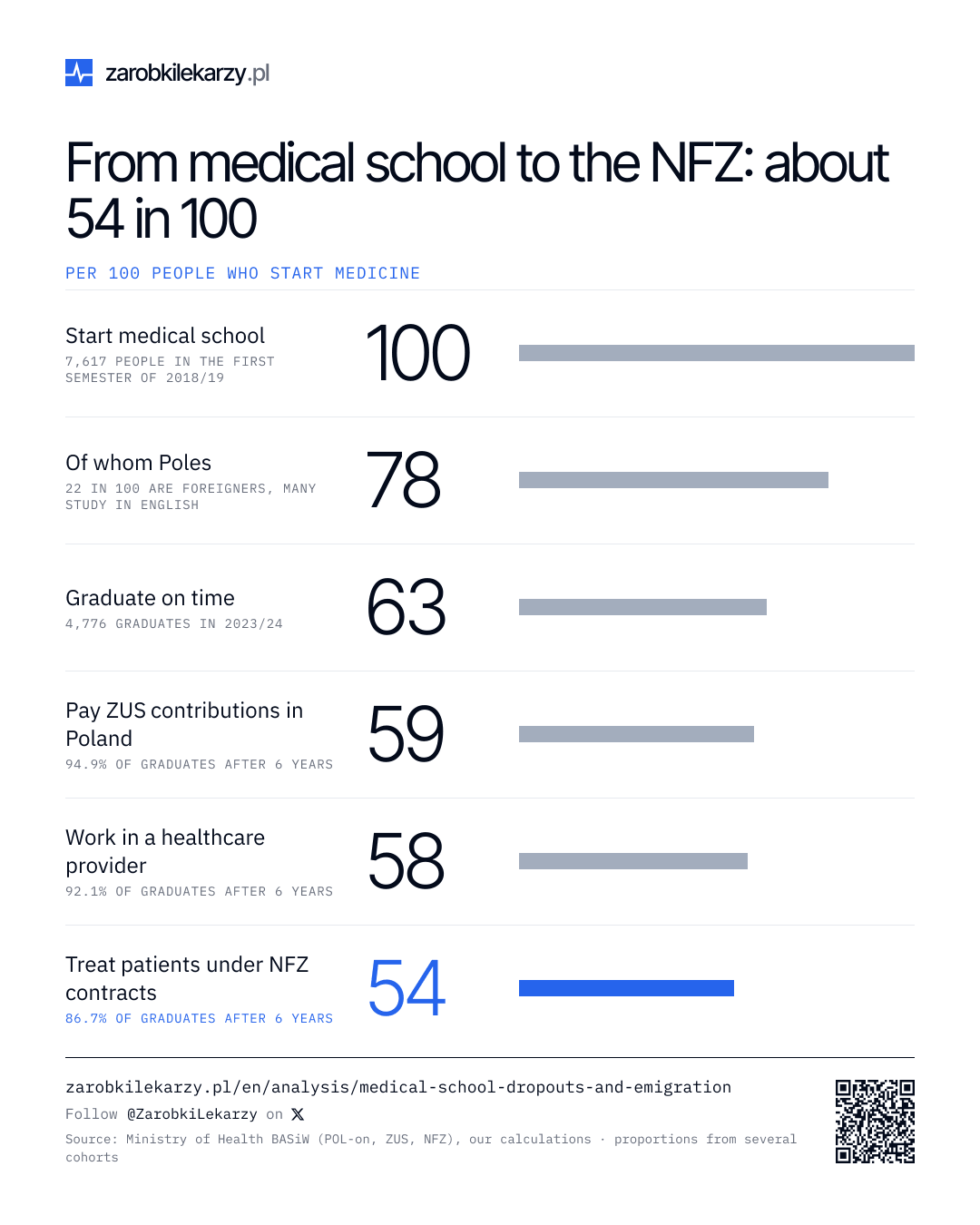
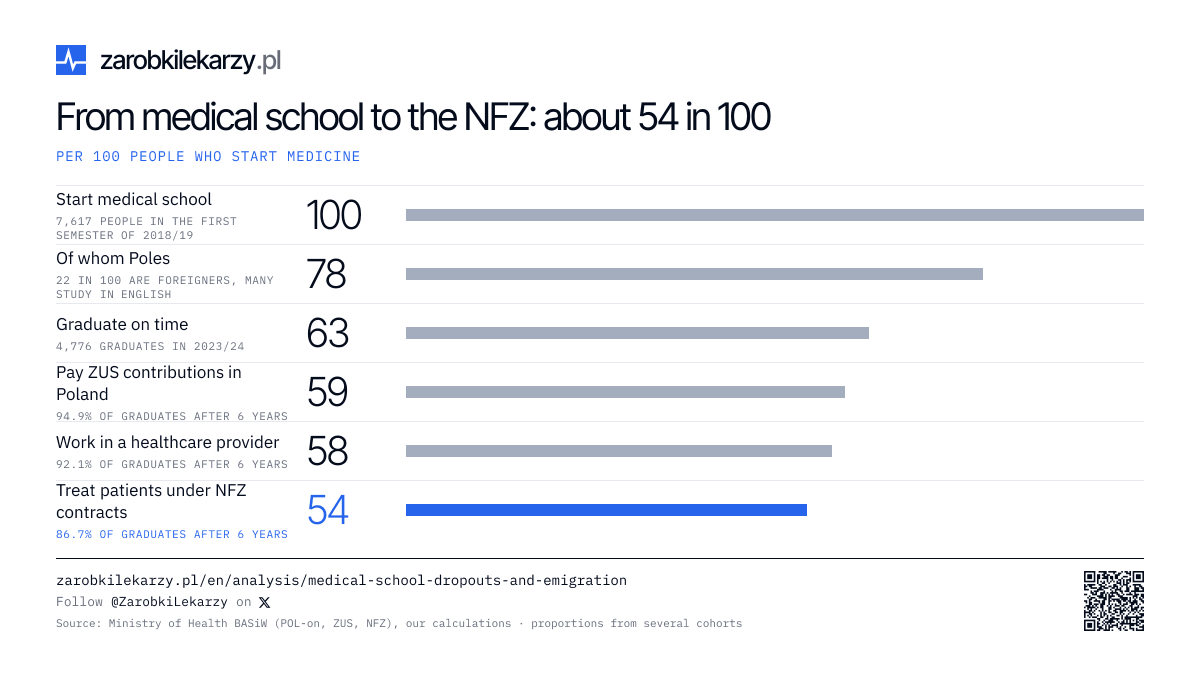
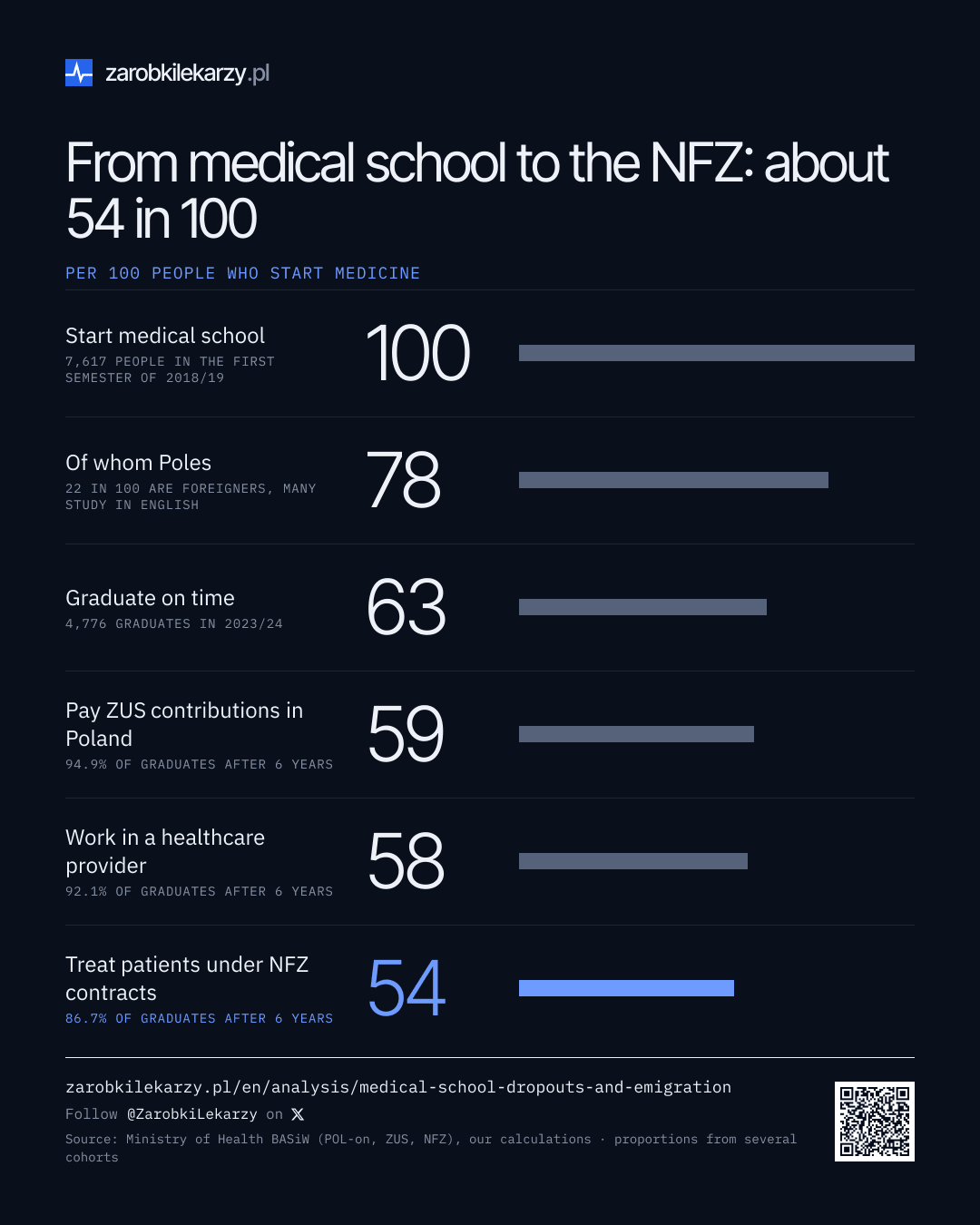
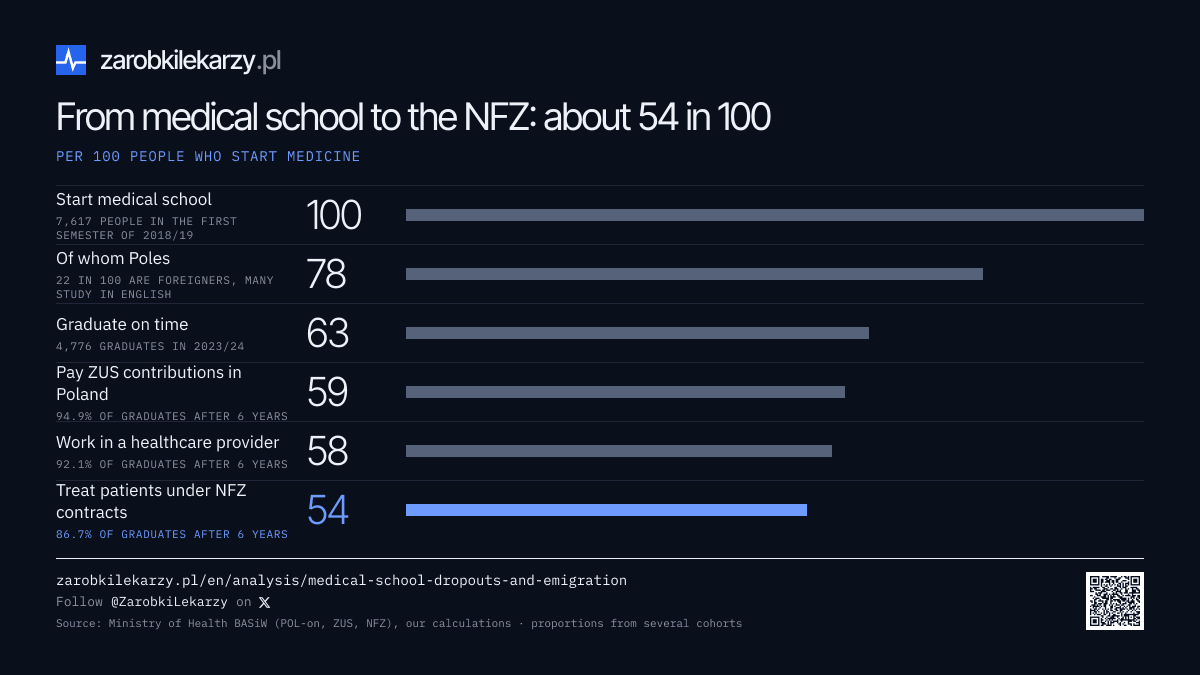
Interns are assigned by the regional medical council. Those with a higher average exam grade from their studies are assigned first to the hospital of their choice, and the internship is organised and financed by the regional marshal (marszałek województwa).53 From 1 July 2026 an intern’s basic salary is PLN 8,458.38 (≈ €1,930) gross a month.54 The intern treats patients under the supervision of an experienced doctor; among other things they may write prescriptions and certify death, but only as part of the internship. They receive the full right to practise only after the internship and after passing the LEK.5351 How many of those admitted to medical school reach a licence to practise in this way we calculate step by step in the analysis Who drops out of medical school, and who leaves the country. It is about 55% of the places in the admission limit, but most of the difference is places for foreigners and in foreign-language programmes, not dropout.
The Ministry of Health has prepared a draft act that shortens the internship to six months. In the government’s list of legislative work its adoption is planned for the fourth quarter of 2026.55 The Supreme Medical Council opposes this: in its view, entering the profession without an internship is “simply dangerous both for patients and for the doctor themselves”.56 For now it is a draft, not the law in force.
Specialist training
After the internship and the LEK a doctor may practise independently. To become, for example, a surgeon, a paediatrician or a family doctor, they still have to complete specialist training and pass the State Specialisation Examination.57 The Minister of Health’s regulation lists 77 medical specialties. Right after the internship you can start 69 of them, and the remaining eight, such as clinical transplantology or paediatric urology, only after obtaining another specialty.58 How the training itself works — recruitment, the programme, on-call duty, supervision and the examination — we describe in the analysis Specialist training for doctors in Poland.
Training takes from four to six years. Four years are, among others, family medicine and ophthalmology, five — internal medicine, paediatrics and psychiatry, and six — general surgery, anaesthesiology and intensive care, and neurosurgery.5859 Some specialties begin with a shared basic module: cardiology is two years of internal medicine and three years of cardiology. After the basic module you can move to a related field without starting from scratch, if you qualify in a later recruitment round. Training is extended by absences such as illness or maternity leave.57
So from admission to medical school to the title of specialist it takes from 11 to 13 years, not counting breaks and waiting for a place. What this means for the number of specialists in the coming years we describe in the analysis Why Poland is short of doctors.
Residency and non-residency places
There are two kinds of specialist training places. Residencies are granted and financed from the state budget by the minister of health. A resident doctor has an employment contract with the facility where they train.57 From 1 July 2026 their basic salary is PLN 10,595.24 (≈ €2,410) gross a month, and in one of the 23 priority fields, such as paediatrics or emergency medicine, PLN 11,654.76 (≈ €2,650). After two years it rises to PLN 10,913.10 (≈ €2,480) and PLN 12,714.29 (≈ €2,890).60 A resident may also voluntarily commit to working in Poland for two years out of five after the specialty, at a facility that treats patients with public money. In return they receive PLN 600 or PLN 700 more a month, and if they do not keep the commitment they repay up to 75% of these supplements.57
Non-residency places are the remaining free places at facilities authorised to provide training. The doctor then trains, for example, under an employment contract or a civil-law contract with such a facility, on paid training leave from their employer or on a scholarship from the facility. They receive no salary from the minister of health’s pool.57
There is no entrance exam for specialist training. Applications are submitted through the online Training Monitoring System (SMK) twice a year: in February and in September. Up to 15 options can be listed, i.e. combinations of field, voivodeship and mode.57 When there are more applicants than places, the order is set by a ranking. For a residency, what counts above all is the LEK result, up to 200 points, and a doctorate and publications can add at most 10 points more. In a tie, the average grade from the studies decides.5758 That is why some doctors take the LEK again even though they have already passed it.
For the autumn 2026 recruitment, the list of the Centre of Postgraduate Medical Education (CMKP) provides 6,530 residency places and 7,752 non-residency places. The most residencies are in internal medicine (774) and family medicine (749).61 The results of this recruitment are not yet known. In spring 2026, 2,868 doctors and dentists confirmed acceptance of a place, and 52% of residency places and 89% of non-residency places remained empty.62 So overall there are more places than applicants, but not in every field. The number of places and applicants in individual fields is shown in our overview by specialty.
The specialty examination
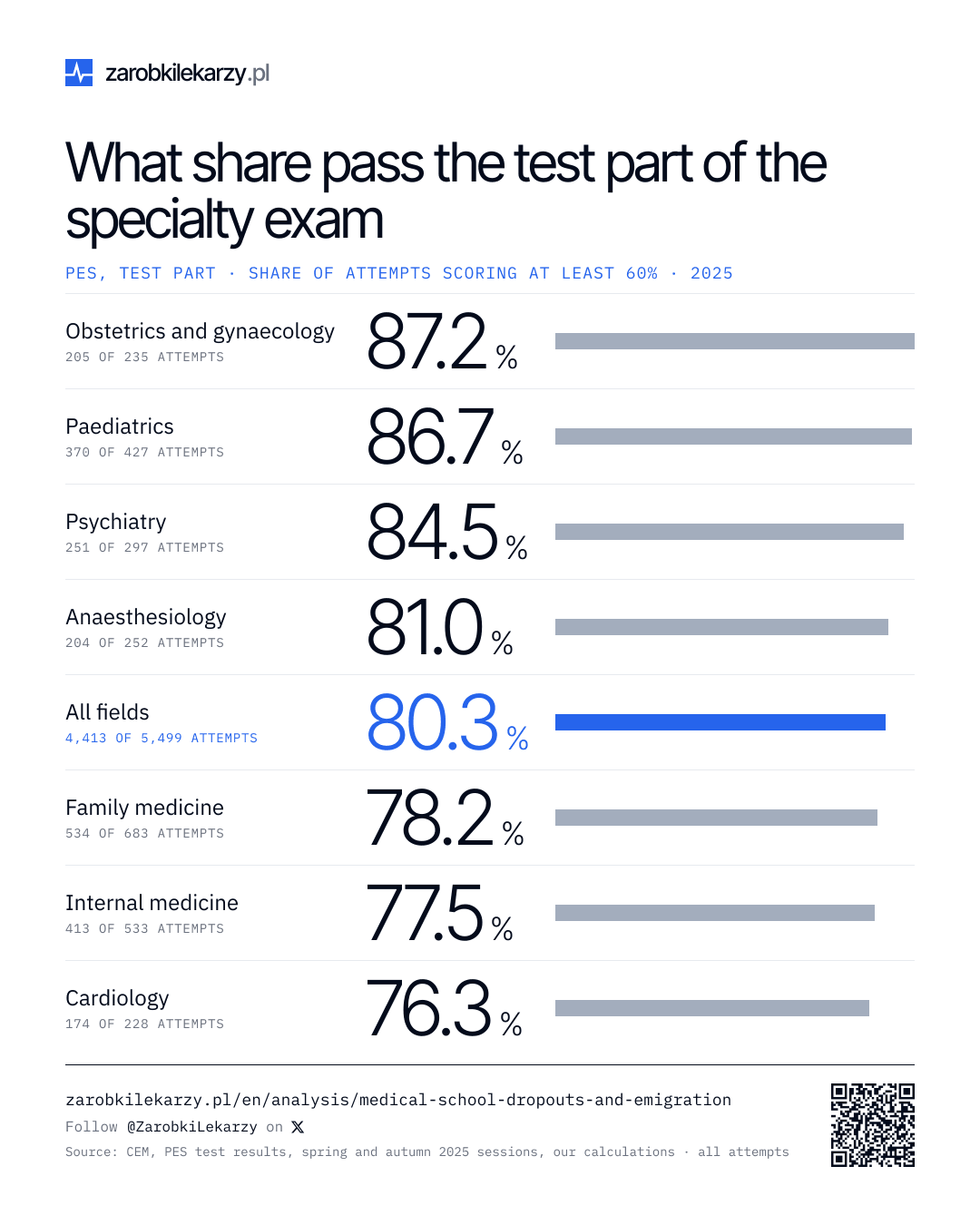
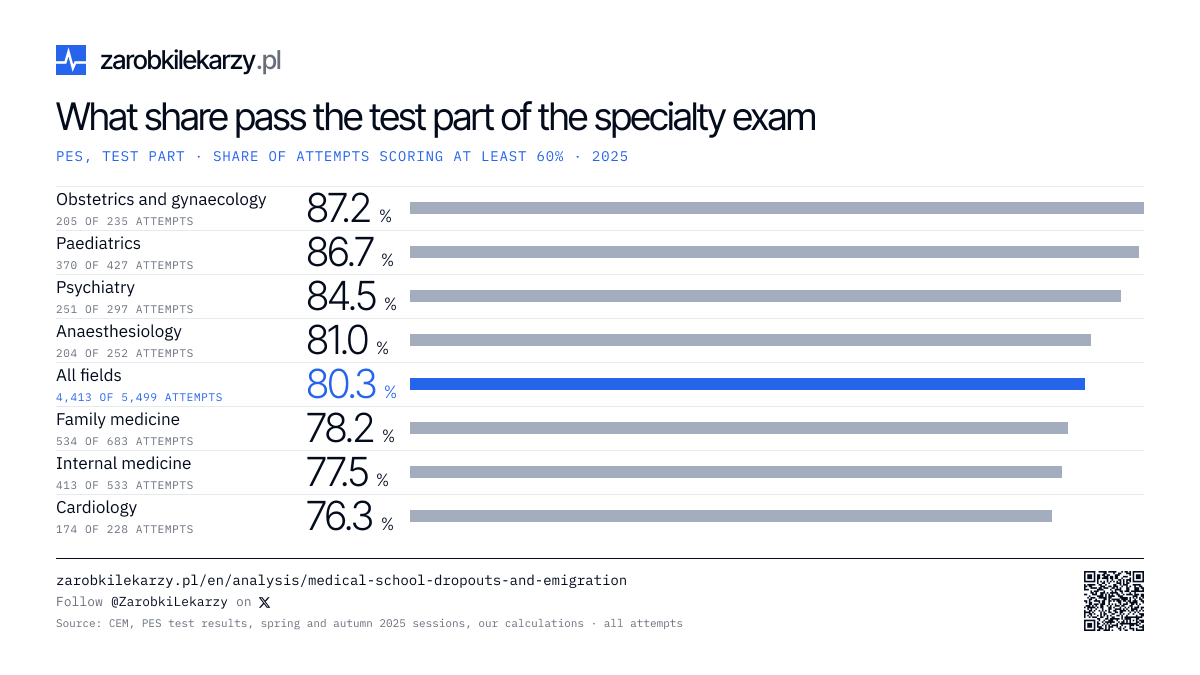
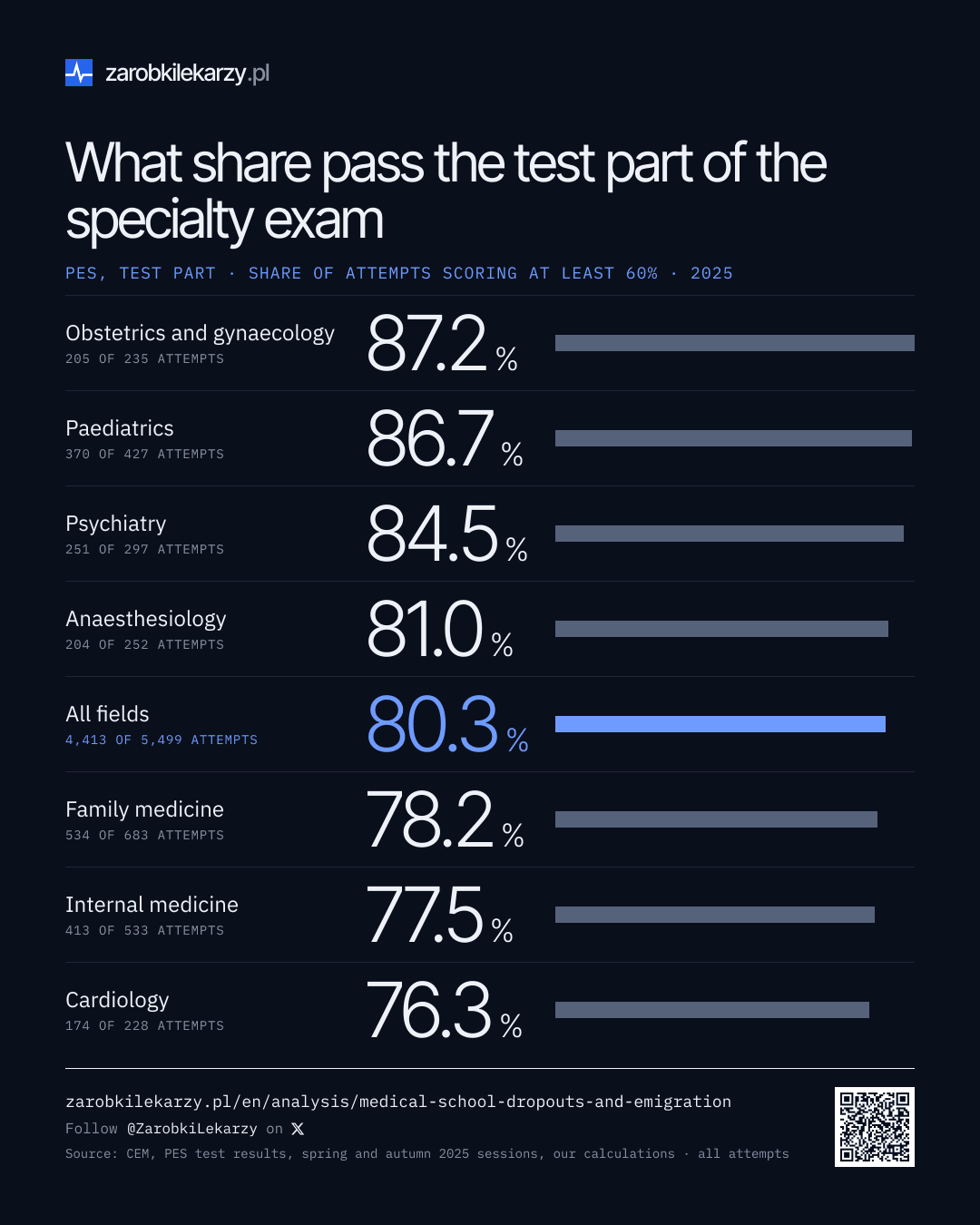
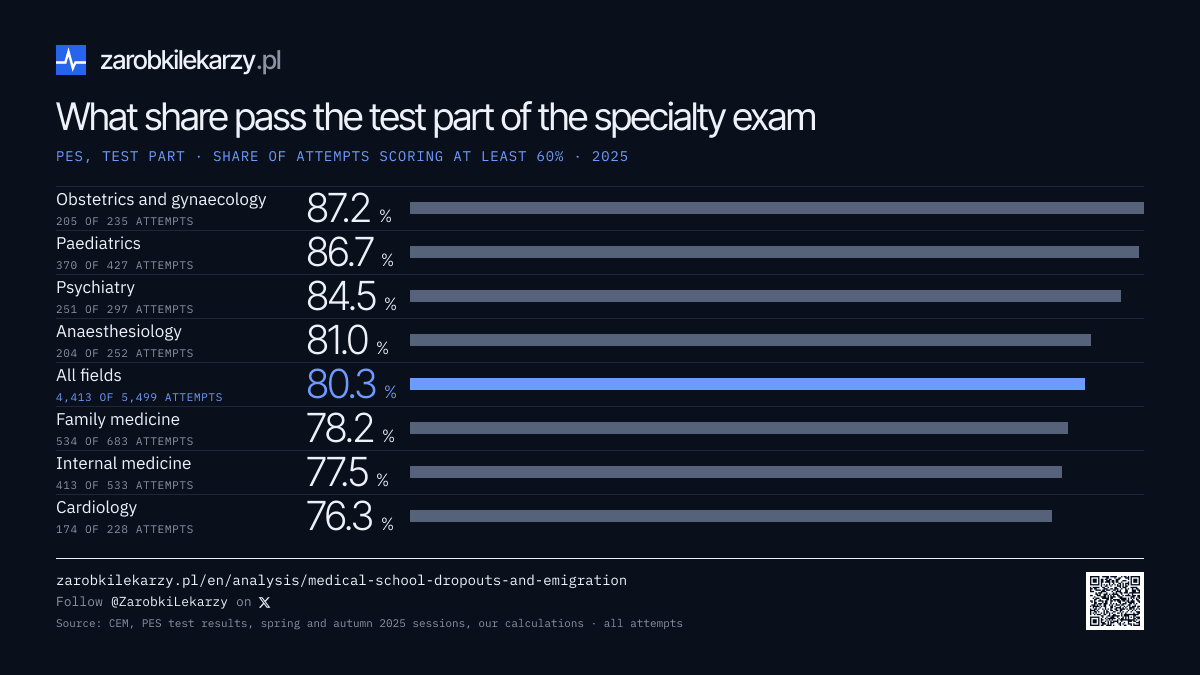
Training ends with the State Specialisation Examination (PES). It is organised twice a year by the Medical Examinations Centre. It consists of a test with 120 questions, passed with 60% of the points, and an oral exam. Those who score at least 75% in the test are exempt from the oral part.57 A smaller share of candidates pass the PES test than the LEK: in 2025 80.3% of attempts, and among first-time candidates 89.5%.63 At the first attempt, 96.0% passed the LEK in autumn 2025.50
 Next stageSpecialist training for doctors in Poland: from the internship to the title of specialistRecruitment, a programme with courses and procedures, on-call duty, the residency, work outside it and the specialty examination.Read the analysis
Notes 63laws, data and statements we relied on
-
Admission formulas for 2026/27: Medical University of Warsaw, “załącznik nr 9 do warunków rekrutacji” (“annex 9 to the admission conditions”, in Polish); Jagiellonian University, resolution no. 58/VI/2025 of the UJ Senate, annex 1 (in Polish); Medical University of Białystok, admission resolution 2026/27 (in Polish). ↩
-
Regulation of the Minister of Health of 28 August 2026 on the admission limit for medicine and dentistry, Dz.U. 2026 item 1167 (in Polish), annex 1, column “studia stacjonarne w języku polskim” (“full-time studies in Polish”). ↩ ↩2 ↩3
-
Cut-offs 2026/27: Medical University of Lublin (list of admitted students of 6.10.2026), UJK, Medical University of Gdańsk (list of admitted students of 14.10.2026), UJ, Medical University of Lodz, Medical University of Białystok, University of Warsaw, Pomeranian Medical University, Medical University of Silesia, UKSW, Wrocław University of Science and Technology, Medical University of Warsaw (all in Polish); University of Applied Sciences in Nowy Targ and Academy of Applied Medical and Social Sciences in Elbląg — lists of qualified candidates on the universities’ admission pages. Percentage of the maximum — our calculations. ↩ ↩2
-
Central Examination Board, “Wstępne informacje o wynikach egzaminu maturalnego 2026 — centyle” (“Preliminary information on the 2026 matura results — percentiles”, in Polish), 8.07.2026, extended level. “At least 80%” = 100 minus the percentile of a score one point lower — our calculations. ↩ ↩2
-
Jagiellonian University, “Rekrutacja na studia pierwszego stopnia i jednolite studia magisterskie — zestawienie statystyczne” (“Admission to first-cycle and long-cycle master’s studies — statistical summary”, in Polish), 5.10.2026, columns “real cut-off” (first round) and “number of people per place”. ↩ ↩2
-
Regulations of the Minister of Health on the admission limit for medicine and dentistry for 2012/13–2026/27, annex 1, in the final version (with amendments from the same admission round), including Dz.U. 2014 item 1125 (2014/15), Dz.U. 2015 item 1119 (2015/16), Dz.U. 2023 item 1322 and item 2027 (2023/24), Dz.U. 2026 item 1167 (2026/27), all in Polish; a list of all acts with links is in the table in the analysis English Division. Number of universities with a limit above zero and totals of places — our calculations. ↩ ↩2
-
Act of 20 July 2018 – Law on Higher Education and Science, consolidated text Dz.U. 2026 item 1362 (in Polish), art. 79 section 1 (what a public university charges fees for) and art. 80 sections 1 and 3 (fee no higher than costs; increases once a year at most by the price index, by 30% in total). ↩ ↩2
-
Tuition for 2026/27 (all in Polish): Medical University of Warsaw, Rector’s ordinance no. 96/2026, annex 3 (PLN 69,500; “for the whole course of studies” PLN 417,000) and ordinance no. 58/2026 (studies in English); Wroclaw Medical University, ordinance no. 57/XVI R/2026, annex 1; Medical University of Białystok, fee table to ordinance no. 34/2026; Medical University of Lodz, tuition fees; Medical University of Gdańsk, ordinance no. 41/2026; Medical University of Silesia, tuition fees; Pomeranian Medical University, tuition fees (ordinance no. 89/2026); University of Rzeszów, ordinance no. 97/2026, annex 3; Maria Skłodowska-Curie Medical University, ordinance no. 5/2026; Andrzej Frycz Modrzewski Krakow University, fee list; Silesian Academy, fees; WSB Academy, medicine programme. Fees per semester converted to a year — our calculation. ↩
-
Minister of Health, notice of 24 April 2026 on the maximum amount of the medical studies loan, M.P. 2026 item 424 (in Polish) — PLN 22,000 per semester; for 12 semesters PLN 264,000 (our calculation). The loan was introduced by the act of 17 November 2021 (Dz.U. 2021 item 2232), in force since 18 December 2021. ↩
-
Law on Higher Education and Science, consolidated text Dz.U. 2026 item 1362 (in Polish), art. 103a sections 1 and 12 (who and for how long), art. 103b section 1 (payment to the university’s account), art. 103c sections 1, 3–6 (repayment after 12 years, over 12 years, half of the interest), art. 103d section 1 (full write-off) and art. 422a section 2 (interest from the Medical Studies Loan Fund); priority fields — consolidated text Dz.U. 2024 item 791. ↩
-
Bank Gospodarstwa Krajowego, Medical Studies Loan Fund, report on the implementation of the financial plan as of 30 September 2026 (cumulative contracts: 5,807 worth PLN 1,268,835.73 thousand) and as of 31 December 2025 (interest subsidies in 2025: PLN 25,635.27 thousand), both in Polish. ↩
-
Ministry of Health, reply to parliamentary question no. 18621 (in Polish), 11.08.2026. ↩
-
University of Warsaw, “Punkty ostatniej osoby przyjętej 2026/27” (“Points of the last person admitted 2026/27”) and “Liczba kandydatów na jedno miejsce 2026/27” (“Number of applicants per place 2026/27”), in Polish. ↩
-
SGH Warsaw School of Economics: past cut-off scores for bachelor’s studies (Polish citizens, full-time studies, 2026 — 336 points, in the first ranking 340 points), conversion of matura points (up to 333 points), SGH test (up to 100 points), admissions step by step (general economics first year) and admission limits 2026/27 (970 places), all in Polish. Percentage of the maximum — our calculation. ↩
-
Jagiellonian University, resolution no. 58/VI/2025 of the UJ Senate, annex 1 (law); University of Warsaw, annex 1 to the 2026/27 admission resolution (medicine), both in Polish. ↩
-
Ekonomiczne Losy Absolwentów (graduate tracking system), source data — Students, field of study (file students-major-data.csv, accessed 27.10.2026), indicators P_TERM_2 and P_PROC_DROPOUT; averages weighted by the number of students — our calculations. ↩
-
Regulation of the Minister of Science and Higher Education of 26 July 2019 on the education standards preparing for the profession of physician (…), consolidated text Dz.U. 2021 item 755 (in Polish), annex 1, sections 1.3–1.5; hours of class groups and placements and infrastructure (section 6.1) as worded in Dz.U. 2023 item 2152. ↩ ↩2 ↩3
-
Regulation of the Minister of Science and Higher Education of 18 July 2019 on the education standard preparing for the profession of architect, Dz.U. 2019 item 1359 (in Polish), part on long-cycle master’s studies, sections 1.1–1.3. ↩
-
Jagiellonian University, curriculum of the law programme; University of Warsaw, resolution no. 77 of the UW Senate (psychology) (in Polish). ↩
-
Act of 23 January 2026 on the profession of psychologist and the professional self-government of psychologists, Dz.U. 2026 item 187 (in Polish), art. 145 (psychologist added to art. 68 of the act on higher education) and art. 161 point 2 (entry into force 12 months after publication, which took place on 18.02.2026). ↩
-
Medical University of Warsaw, curriculum for the cycle starting in 2026/2027 (in Polish), tables for years I–VI, column “form of assessment” — our count. ↩ ↩2
-
Medical University of Warsaw, study regulations, annex to Senate resolution no. 23/2026 (in Polish), § 28–29 and the provisions on conditional admission and repeating a year. ↩
-
Regulation of the Minister of Science and Higher Education of 12 August 2025 amending the regulation on education standards (…), Dz.U. 2025 item 1133 (in Polish), § 1, amendments to annex 1: section 4.4 (groups) and section 6.5 (classes in simulated conditions). ↩ ↩2
-
Act of 5 December 1996 on the professions of physician and dentist, consolidated text Dz.U. 2026 item 37 (in Polish), art. 5 sections 9–13. ↩
-
Act of 15 April 2011 on medical activity, consolidated text Dz.U. 2026 item 156 (in Polish), art. 89 sections 1–6. ↩
-
Supreme Audit Office, “NIK o funkcjonowaniu szpitali klinicznych” (“NIK on the functioning of clinical hospitals”, in Polish), 25.06.2026; information on the audit results P/25/041. ↩
-
Medical University of Warsaw, teaching guide for first-year students 2026/2027; Jagiellonian University CM, medical programme syllabus 2025/26; Wroclaw Medical University, list of subjects 2025/2026; Medical University of Białystok, study plan for the 2025–2031 cycle (all in Polish). ↩
-
Medical University of Warsaw, teaching guide for first-year students 2026/2027 (rules of anatomy classes); Jagiellonian University CM, anatomy timetable and pass criteria 2026/27 (both in Polish). ↩ ↩2
-
Act of 31 January 1959 on cemeteries and burial of the dead, consolidated text Dz.U. 2025 item 1590 (in Polish), art. 10 sections 2 and 6. ↩
-
Jagiellonian University CM, “Program Świadomej Donacji” (“Informed Donation Programme”); Wroclaw Medical University, ordinance no. 84/XVI R/2021, annex 1; University of Warsaw, ordinance no. 90 of the UW Rector of 9.09.2024 (all in Polish). ↩
-
University of Rzeszów, They donated their bodies to science, 30.10.2025. ↩
-
Notices in the Official Journal of the EU: Medical University of Lodz, 424718-2017 and 25316-2018; Medical University of Białystok, 767919-2023 and university announcement (in Polish); Medical University of Warsaw, 702212-2024 and project description (in Polish). ↩
-
Jagiellonian University Collegium Medicum, MRAME project, HoloAnatomy and mixed reality in the Jagiellonian University, 2.11.2022. ↩
-
Pomeranian Medical University, “Nowoczesna anatomia na PUM dzięki środkom z KPO” (“Modern anatomy at PUM thanks to National Recovery Plan funds”, in Polish), 7.05.2026. ↩
-
D. Salimi, M. Asgari et al., Efficacy of virtual reality and augmented reality in anatomy education: A systematic review and meta-analysis, Anatomical Sciences Education 2024, 17(9); P. García-Robles, I. Cortés-Pérez et al., Immersive virtual reality and augmented reality in anatomy education: A systematic review and meta-analysis, Anatomical Sciences Education 2024, 17(3); C. Moro, J. Birt et al., Virtual and Augmented Reality Enhancements to Medical and Science Student Physiology and Anatomy Test Performance: A Systematic Review and Meta-Analysis, Anatomical Sciences Education 2021, 14(3). ↩ ↩2
-
S. Asghar, N. Naaz et al., Effectiveness of 3D-printed models prepared from radiological data for anatomy education: A meta-analysis and trial sequential analysis of 22 randomized, controlled, crossover trials, Journal of Education and Health Promotion 2022, 11:353; G. Chytas, G. Noussios et al., The effectiveness of three-dimensional printing in undergraduate and postgraduate anatomy education: A review of reviews, Morphologie 2024, 108(361). ↩
-
T. Telecan, R. Capraș et al., Dissection in the 21st century: virtual tables versus traditional methods and their influence on medical students’ perception – a systematic review, BMC Medical Education 2025, 25:1332. ↩
-
A. Wilson, C. Miller et al., A meta-analysis of anatomy laboratory pedagogies, Clinical Anatomy 2018, 31(1). ↩
-
M. Walecki, K. Dąbrowa et al., From traditional to immersive: The impact of 3D technologies on medical student learning, Bio-Algorithms and Med-Systems 2024, 20(1). This is a survey, not a knowledge test. ↩
-
Residents’ Agreement of the OZZL, position on teaching anatomy in medical programmes without adequate facilities (in Polish), 13.11.2023 (as of 1.08.2023). ↩
-
Presidium of the Supreme Medical Council, position no. 54/25/P-IX of 26 June 2025 on admission limits (in Polish). ↩
-
Act of 20 July 2018 – Law on Higher Education and Science, consolidated text Dz.U. 2026 item 1362 (in Polish), art. 53 sections 3 and 6 and art. 54 section 2. ↩ ↩2
-
Ministry of Science and Higher Education, reply to parliamentary question no. 12246 (in Polish), 13.10.2025, answers to questions 1–3. ↩ ↩2 ↩3 ↩4
-
Supreme Audit Office, “Zasoby kadry medycznej w systemie ochrony zdrowia”, P/22/047 (“Medical staff resources in the healthcare system”, in Polish), information on the audit results, June 2023. ↩
-
Medical Examinations Centre, aggregate results of the Medical Final Examination (in Polish), spring 2026 session, table “first-time candidates” (accessed 27.10.2026). ↩
-
Supreme Medical Chamber, Medical Education Committee, report on the “Barometr 25” survey for the 2023/24 academic year (in Polish), p. 95 — share of students not promoted by university and year of study; pp. 6–9 — participating universities and the division into “old” and “new”; medians — our calculations. ↩
-
Polish Accreditation Committee, statement of 17 June 2026 (in Polish) in response to position no. 40/26/P-IX of the Presidium of the Supreme Medical Council. ↩
-
Supreme Medical Council, position no. 7/23/IX of 15 December 2023 (in Polish). ↩
-
Act on the professions of physician and dentist, consolidated text Dz.U. 2026 item 37 (in Polish), art. 14d section 2 and art. 14e section 4. ↩
-
Medical Examinations Centre, results of the Medical Final Examination (in Polish) — autumn sessions 2025 and 2026. ↩ ↩2
-
Act on the professions of physician and dentist, consolidated text Dz.U. 2026 item 37 (in Polish), art. 5 sections 3, 4 and 7. ↩ ↩2
-
Regulation of the Minister of Health of 24 February 2023 on the postgraduate internship of physicians and dentists, Dz.U. 2023 item 377 (in Polish), § 3 and annex 1. ↩
-
Act on the professions of physician and dentist, consolidated text Dz.U. 2026 item 37 (in Polish), art. 15b, art. 15d sections 1 and 3, art. 15i section 1. ↩ ↩2
-
Minister of Health, notice of 22 April 2026 on the basic monthly salary of intern physicians (in Polish), point 2; the amount is 95% of the average salary in 2025 (PLN 8,903.56, M.P. 2026 item 192) — the coefficient of 0.95 for an intern from the annex to the act on determining the minimum basic salary of certain employees of healthcare providers, consolidated text Dz.U. 2022 item 2139, item 4. ↩
-
List of legislative work of the Council of Ministers, draft act amending the act on the professions of physician and dentist and certain other acts (UD384) (in Polish), accessed 27.10.2026. ↩
-
Supreme Medical Council, position no. 3/26/X of 12 June 2026 (in Polish), point 1. ↩
-
Act of 5 December 1996 on the professions of physician and dentist, consolidated text Dz.U. 2026 item 37 (in Polish): art. 16 sections 1–3 (specialist title, modules, change of field after the basic module), art. 16c sections 1, 1a, 1d, 8, 10, 10a and 11 (application in the SMK, deadlines, options, ranking), art. 16h sections 1 and 2 (residency and non-residency modes), art. 16j sections 1, 2b and 2l (financing of residency, voluntary commitment and penalty), art. 16l section 1 (extension of training), art. 16rc sections 1, 2 and 10 and art. 16s sections 3–4 (PES). ↩ ↩2 ↩3 ↩4 ↩5 ↩6 ↩7 ↩8
-
Regulation of the Minister of Health of 4 May 2023 on the specialist training of physicians and dentists, Dz.U. 2023 item 975 (in Polish): annex 1 (list of 77 medical specialties), annex 5 (minimum training length and specialties required beforehand) and annex 7 § 1 (points in the qualification procedure); our count. ↩ ↩2 ↩3
-
CMKP, modular specialist training programmes, programmes for doctors without a specialty, e.g. family medicine, internal medicine, anaesthesiology and intensive care, general surgery (all in Polish). ↩
-
Regulation of the Minister of Health of 25 June 2026 on the basic monthly salary of physicians and dentists in specialist training under residency, Dz.U. 2026 item 856 (in Polish), § 1 and 2; priority fields — Regulation of the Minister of Health on determining priority fields of medicine, consolidated text Dz.U. 2024 item 791. ↩
-
CMKP, number of places for the autumn 2026 qualification procedure (in Polish), 27.08.2026 — places by voivodeship and field, including dental ones; among residency places 69 doctoral ones. National totals — our calculations. ↩
-
CMKP, final results of specialist training recruitment, spring 2026 session (in Polish), 14.04.2026 — 4,039 residency places and 8,221 non-residency places, 2,868 confirmations (1,927 and 941); shares of empty places — our calculations. ↩
-
Medical Examinations Centre, results of the PES test part (in Polish) — lists of results of the spring and autumn 2025 sessions in all fields (one code number = one attempt) and the “first-time candidates” statistics attached to the lists; shares — our calculations. The CEM does not publish results of the oral part. ↩
Infographics to download
3 graphics · portrait and landscape, light and dark
Graphics to share in two formats — portrait 1080×1350 (Instagram, Facebook, X) and landscape 1200×675 (X, LinkedIn, presentations) — light and dark. The sources, the page address and a QR code to the page are on the graphic.
Medicine has the longest queue. The cut-off — about the same as law
From medical school to the NFZ: about 54 in 100
What share pass the test part of the specialty exam
Change history 1
latest change 29 October 2026 · Added a comparison of first-year dropout at “old” and “new” universities from the Supreme Medical Chamber’s survey for 2023/24: median 10% and 10.5%, and 14% without two new universities with a result of zero.
Added a comparison of first-year dropout at “old” and “new” universities from the Supreme Medical Chamber’s survey for 2023/24: median 10% and 10.5%, and 14% without two new universities with a result of zero.